

By Jason Cruz
NORTHWEST ASIAN WEEKLY
Mayor Katie Wilson faced the public a week after making the announcement that she was pausing expansion of cameras in new areas of the city. Many in attendance voiced their concern, frustration and sometimes anger over the decision.
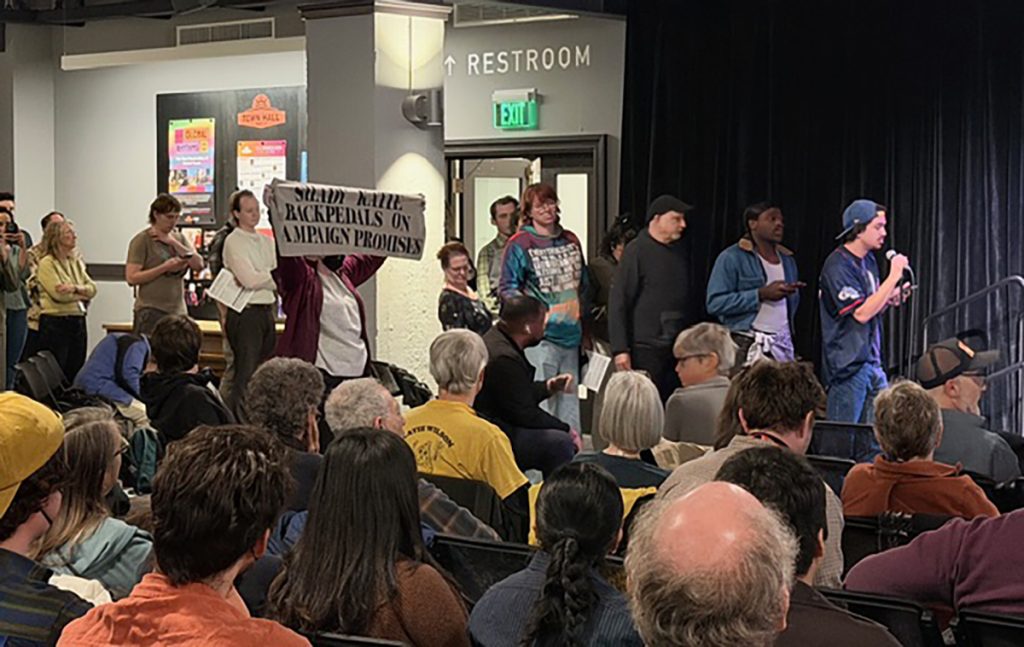
A woman holds up, “Shady Katie backpedals on campaign promises” at public Town Hall Meeting (Photo by Jason Cruz)
Many of Wilson’s supporters at the March 27 event were dismayed by her decision to continue the use of cameras. A woman yelled out during the forum that “Mayor Katie backpeddles on her campaign promises!” which seemed to be in direct inference to her decision to continue utilizing cameras. Others expressed dissatisfaction with Wilson’s decision to continue with the addition of cameras around the Stadium District despite her call to stop the plan of cameras in more areas of the city.
During the Q&A, one person expressed concern that ICE would use the camera footage for the purpose of arresting, detaining and possibly deporting individuals. Another questioned the current trust (or lack thereof) people have with the Seattle Police Department. There were also questions of privacy and constitutional rights with cameras put in areas that are frequented by many people of color. Mayor Wilson affirmed, despite audience skepticism, that the city would not work with ICE to aid the agency’s purpose. She maintained that there is a need for the audit for her team to make a decision.
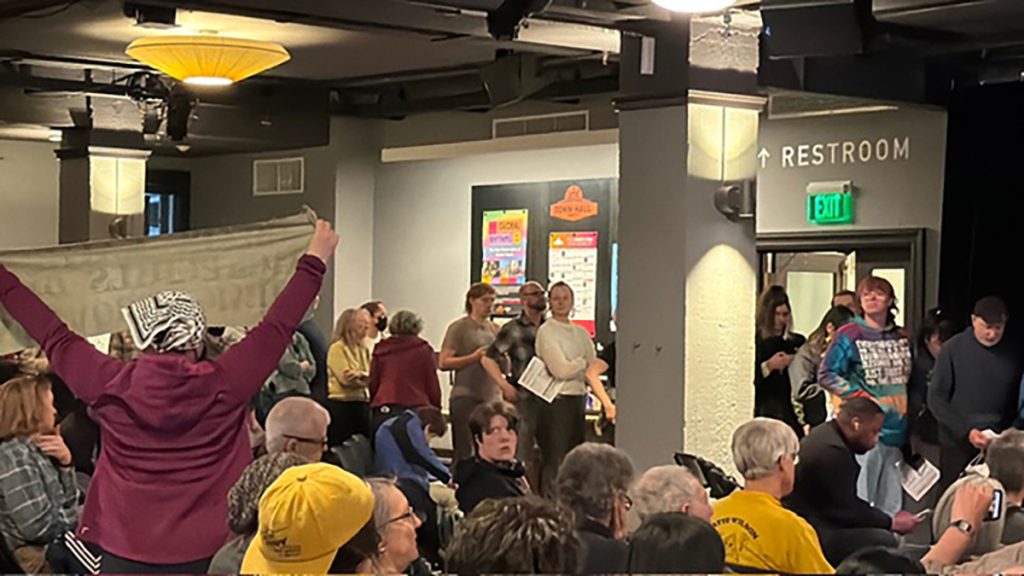
Members of the public lined up to ask Mayor Wilson questions about the RTCC (Photo by Jason Cruz)
Despite the criticism of the cameras, there is support. Last week, the Chinatown-International District Public Safety Council presented the Seattle City Council with over 1,000 signatures of Chinatown-International District (CID) residents, senior citizens, business owners, and community leaders praising the cameras as a step toward helping with the area’s public safety.
The Real Time Crime Center (RTCC) utilizes 62 police cameras along downtown, Aurora Avenue North and the CID. The RTCC monitors areas that are known for high-crime. The RTCC is not monitored 24/7 and the surveillance network is small compared to other cities. The RTCC is monitored by civilian employees and the videos are recorded, stored for five days and then it is deleted unless it is flagged for an incident. The saved footage is uploaded to servers on Evidence.com, the storage mechanism for Axon, the tech company that runs the technology.
Former Mayor Bruce Harrell extended the cameras to the Stadium District, the Central District around Garfield High School, and the Capitol Hill Nightlife District.
None of the cameras have been installed, turned on or connected to the RTCC according to Wilson. At a March 19 news conference, she stated that the program would be put on pause until they could conduct a privacy and data governance audit and “take significant steps to strengthen our policies.”
She also noted that given the unique nature of the FIFA World Cup event coming to Seattle and the “current geopolitical situation,” Mayor Wilson has decided to move forward with installing cameras around the Stadium District which encompasses Lumen Field and T-Mobile Park. However, she states that they will not “be turned on” or connected to the RTCC unless they are aware of a credible threat warranting such action. They will be turned off after the threat subsides.
Also, she noted that she is turning off a camera that is near a reproductive health care/gender-affirming facility. She stated that Seattle Police currently mask (i.e., blur the images on the camera) the location.
Cognizant of issues with the U.S. Department of Homeland Security, specifically ICE, she stated that the City of Seattle would not be sharing information with them unless required by law. She also noted that if they are aware of an insurgency of ICE officers as in Minnesota, Mayor Wilson would turn off all cameras.
In addition to these measures, she also would be pausing the use of Automated License Plate Recognition which capture and record the license plates in a certain area.
The statistics received from the Seattle Police Department as a means of measuring the success of the RTCC will be determined through a third-party audit this summer and a longer-term decision by the end of the year.

Florangela Davila and Mayor Katie Wilson discuss security and surveillance at a Town Hall meeting (Photo by Jason Cruz)
The event was held on Friday, March 27 at the Wyncote NY Forum with the public free to attend. The discussion was moderated by Florangela Davila, the executive director of the South Seattle Emerald and Mayor Wilson. The first part of the session was a discussion between Davila and Mayor Wilson and the second half was dedicated to concerned citizens with most opposing the cameras.
Jason can be reached at newstips@nwasianweekly.com.
Leave a Reply