


By Carolyn Bick
NORTHWEST ASIAN WEEKLY
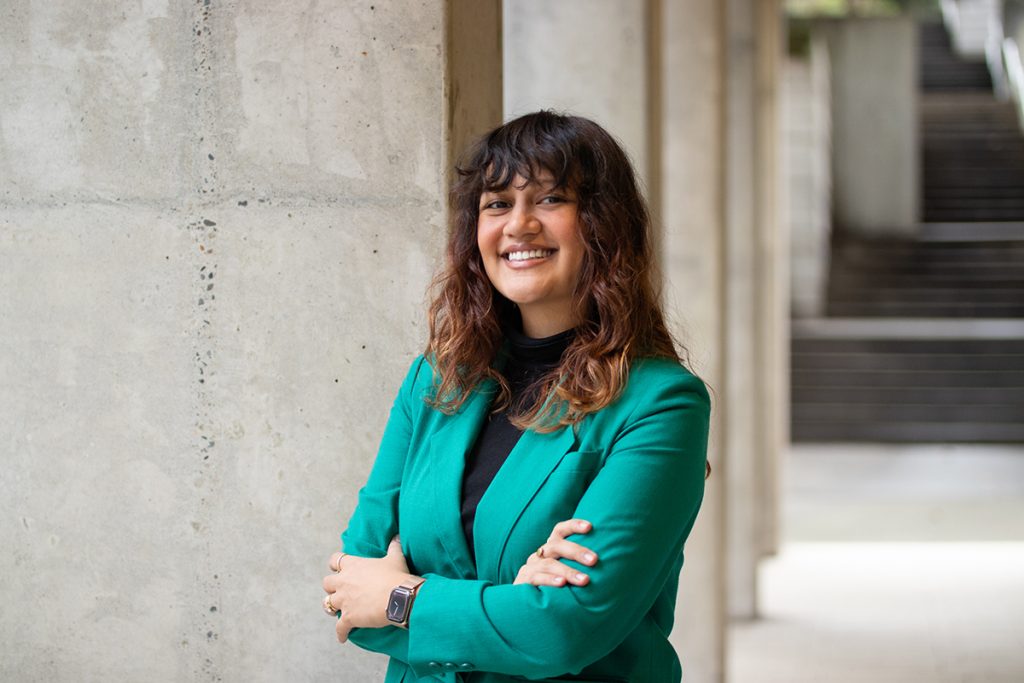
Hannah Sabio-Howell
Hannah Sabio-Howell today announced her candidacy for Washington’s 43rd legislative district, a position Rep. Jamie Pedersen has held for the last two decades. Sabio-Howell, a 30-year-old first-generation Filipina American, has served in both the Washington House and Senate in different capacities, and currently works as the communications director for Working Washington, a statewide organization that fights for better pay and labor standards for the state’s diverse workforce.
Sabio-Howell believes it is time for a change, especially in light of the many challenges immigrant communities across the Asian diaspora now face, both when it comes to the affordability crisis and at the hands of the federal government. She sat down with the Northwest Asian Weekly to talk about her background, the need for bolder commitments to affordability and immigrant protections, and how she plans to approach legislative action, if elected.
Northwest Asian Weekly
Tell me about your background. You are a first-generation Filipina American, so what did that mean for you growing up and what does that mean for you now?
Hannah Sabio-Howell
Yes, so I have been so lucky. I’m proudly the daughter of Filipino immigrants. My mom’s side of the family moved here in the late ‘60s, early ‘70s from Tuguegarao.
When I was young, though I was born in St. Louis, Missouri, and spent most of my upbringing in the suburbs outside of Chicago, we lived actually for nearly two years in the Philippines in a mountain town called Baguio City. That’s where a lot of my first memories are from. It’s also a city whose climate really reminds me of Seattle’s in the best way, so sometimes I think I found my way to Seattle because it reminded me so much of Baguio.
I also have roots in eastern Washington. My dad’s side of the family for generations have been wheat farmers in Ritzville, so part of the reason I ended up going to college in Spokane, Washington is because of the proximity to my dad’s side of the family, who still to this day live in Walla Walla and Spokane. My multiracial, multicultural upbringing absolutely shaped the person I have become today.
I am very proud of my beautiful and vibrant multiracial family. I think that as both of my parents were also educators, I know that I was raised in part with these pro-worker, pro-democracy, and pro-fairness values, in part because of the pioneering way in which they were building their own family. And I have loved getting to uplift and be very connected to my Filipino heritage and the values that my parents really instilled in my brothers and me.
NWAW
When did you specifically move to the Seattle area?
Sabio-Howell
That was in 2018. I graduated in 2018 from Whitworth University in Spokane, and my first job right away was working for a member of the House of Representatives. I was a legislative aide, and for those first nearly two years, I lived in Seattle. I worked at the state legislature. I served a member who represents the 45th legislative district, so East King County—think Kirkland, Redmond, Woodinville.
I built the skills around constituent casework, making sure that everyday people understood how to engage and shape policy outcomes that are meant to serve us, and had the absolute honor and privilege of working in that role, where really my job was about making the legislature accessible.
From there, I moved into a role as a communications specialist in the Senate Democratic Caucus. Similarly, I was working not only on policy messaging, supporting senators, working on everything from the capital gains tax, to postpartum health equity, to climate justice policy, but also again, ensuring that everyday people understood what the legislature does for us—how to engage, how to contact and move our lawmakers, and how to make our state legislature a truly democratic place.
Again, an honor to do that, to do that work. So, a long-winded way of saying: that is how I ended up in Seattle on the west side of the state.
NWAW
This might sound like a little bit of a detour. I don’t think I’m mistaken: You also do portrait photography, is that right?
Sabio-Howell
I do, yes, I’m a photographer. I’ve been a photographer for over 10 years now, which feels kind of crazy to say. I have so loved that expression of artistry and a way to connect with people. I also find photography to be a service that is oftentimes out of reach for people. Photography services can be expensive, so I have really loved providing that over the years and being engaged with a very artistic community and creative community here in the 43rd District, which I now very much hope to get to represent.
NWAW
Yeah, so tell me about that. Why did you decide to challenge the current Democratic incumbent?
Sabio-Howell
Absolutely. Well, for the last three years, I’ve been the communications director at an organization called Working Washington, organizing shoulder-to-shoulder with underpaid workers to raise wages, raise labor standards, and enforce those standards. The work that we have done has fundamentally been about winning big fights with big corporate interests, throwing their money and their weight behind a system that works better for them than it does for working people.
And I really believe, as does the labor organizing movement that I have been really honored to call home for these last three years, that Washington could be the best place in the nation to build a good life if people can actually afford to do that. I believe we could be a state where housing is abundant and child care is affordable, our education and healthcare systems could be world-class quality, and we could and need to tax the record-breakingly wealthy corporations that built their wealth here in Washington to make that happen. And there is no better place for championing that vision than in the most bold and progressive and visionary district in the state, which is the 43rd.
I really think that this is a vision that our district has uplifted time and again. We have reaffirmed that we believe in taxing the rich, that we believe in standing up to big corporations and building a just economy that works for us. We believe in housing being affordable, and we believe in bold programs that could lift people out of struggle, like universal child care, social housing, universal health care.
I think our incumbent, who has held a seat as a representative of our district for 20 years now, is out of step with that vision, as someone who has had a more moderating effect on policy. Right now, I am really honored and really excited about the opportunity to present our district with the first chance that we’ve had in years to choose our fighter.
NWAW
What are your main positions and focal points in your campaign and why?
Sabio-Howell
The overarching agenda is one of affordability. I think we deserve leadership that is going to fight with the urgency that the crisis of affordability deserves, and that means winning abundant and affordable housing. It means winning universal child care that lifts families out of struggle and transforms lives.
It means not only restoring investments in our education system and our health care system, but also building those out—and then, to make those things possible, it really means standing up to a corporate agenda that for too long has shaped priorities in Olympia, and taxing those ultra-wealthy corporations to make our social safety net strong.
NWAW
And so I take it that you support the millionaire’s tax?
Sabio-Howell
I do, very much. I also, though, support fixing some of the gaps that currently exist in it, including a large corporate tax break costing the state around $500 million. That’s moving in parallel with a rollback of an estate tax that is similarly going to cost the state around $500 million, and so we’re giving up a billion dollars for services—over a billion dollars that could be used for services that last year experienced devastating cuts, and continue to be on the chopping block in a way that I think is unacceptable. And so I absolutely, absolutely support the millionaire’s tax and commend all of the work that has gone into that. I think that right now is a time for courage and bold action, because we’re certainly not going to be getting that from the federal government.
NWAW
If you do unseat Pederson, how will you go about trying to persuade your colleagues to be bolder?
Sabio-Howell
I worked for Representative Larry Springer. And while he and I actually land differently on several different policy positions—he’s someone who in the caucus many would consider more of a centrist—I have learned so much of my leadership and collaboration and coalition building skills from him, because of the way in which I have seen him operate with honesty, with candor, with deep respect for every person he talks to.
I have seen that by being a straight shooter, and by being dedicated to the work and to solution-finding, that policy can make it to the finish line, where in other circumstances, a more, perhaps, dogmatic approach to policy might not. So I think about his leadership style, and what I learned from him, when I think about leadership in the state legislature.
At no point do we need to compromise on our district’s incredibly bold and progressive values, while also being effective and collaborative. This is something coming out of an organizing space and a labor movement background.
Something that I know to be true is that the strongest, most effective movement to win fair pay and dignity for workers on the job is by working alongside people, by finding the common ground that exists, even when a lot of disagreement or conflict might also be present. I think that by bringing in both an orientation to governing as an organizer, as a communicator, as someone whose first model of leadership is one of pragmatism, and with both my feet firmly planted in the progressive values of the 43rd, I feel really prepared to hit the ground running in Olympia—not just by knowing the ropes, but by bringing an approach to policymaking that is collaborative.
NWAW
So, switching gears just a tiny bit: Why do you think it’s important for you, as a first-generation Filipina American, to run for office?
Sabio-Howell
A lot of people of color who are running, or thinking about running or who currently serve in office, share the belief that our vision, our cultural experience, our family dynamics—these are assets to robust policymaking.
I think about how when I was at the state legislature, I staffed the Members of Color Caucus, and it was historically big. It had never been, at that time, nine members.
The richness of those conversations, the approach that every member in the Members of Color Caucus had to policy that was shaped not only by their own experience in their own district, but also by a cultural community and a legacy that they carry with them, really made policy better. It illuminated what would have been blind spots, it strengthened what would have been weak. I feel really excited and also deeply honored to bring that to not only a campaign, but also ultimately, hopefully, Olympia.
The last thing I’ll add about that, too, is that I similarly think that there are so few people of color in office. There is so little age diversity, there are so few renters. I’m also queer, and there are so few members of the LGBTQ [community] across the chambers. And I just think that … when we miss that in policymaking, we end up with outcomes that don’t serve everyone. And I would like to change that.
NWAW
With the understanding that this umbrella is extraordinarily broad, and does not recognize the different challenges that all the included communities face, what do you think are the most pressing challenges facing the Asian American, Native Hawaiian, and Pacific Islander community? And how would you address them?
Sabio-Howell
Yeah, thank you for this question, and for raising that, because I totally agree. Of course, communities of color are in no way a monolith, dealing with all the same challenges and sharing all the same priorities. I completely agree with that.
I think that, specific to the Asian American community, and through the conversations I’ve gotten to have with artists, health care workers, and restaurant workers in our community, I think something we definitely share is the acuteness in our community of the crisis of affordability.
The weight that that currently applies on communities of color, and particularly the Asian American community that has had to fight to carve out spaces where we can afford to build our lives, this is so particularly true just across the Asian diaspora here in Seattle.
The deep roots and the visible presence of the Asian community here in Seattle was something that made me feel at home, and safe, and seen, and comfortable. The ability to afford to build is a deep need, a deep pressure, and something that I think urgently demands solutions from our state lawmakers.
I also think, too, that immigrant communities are so targeted and fearful, and wrestling with hostile federal policymaking that is tearing our communities apart.
I have been a part of a coalition. Because so many of our members are immigrant workers—many of them are Asian immigrant workers—we have been part of efforts to protect our state from ICE. This is another thing that I think the state legislature really is responsible for, as our state and other local governments increasingly become the first and last line of defense against a hostile federal government. We need to do a better job standing up and imposing or implementing every possible tool to keep immigrant communities safe from ICE.
Workers particularly in the Chinatown-International District have been really rightfully fearful of ICE raids and increased ICE presence. Immigrants across the city have been foregoing things like health care appointments and taking children to school. That is absolutely unacceptable and something that our state legislature needs to and can do something about imminently.
For more information about Hannah’s campaign, go to hannahforwashington.com.