


By Carolyn Bick
NORTHWEST ASIAN WEEKLY
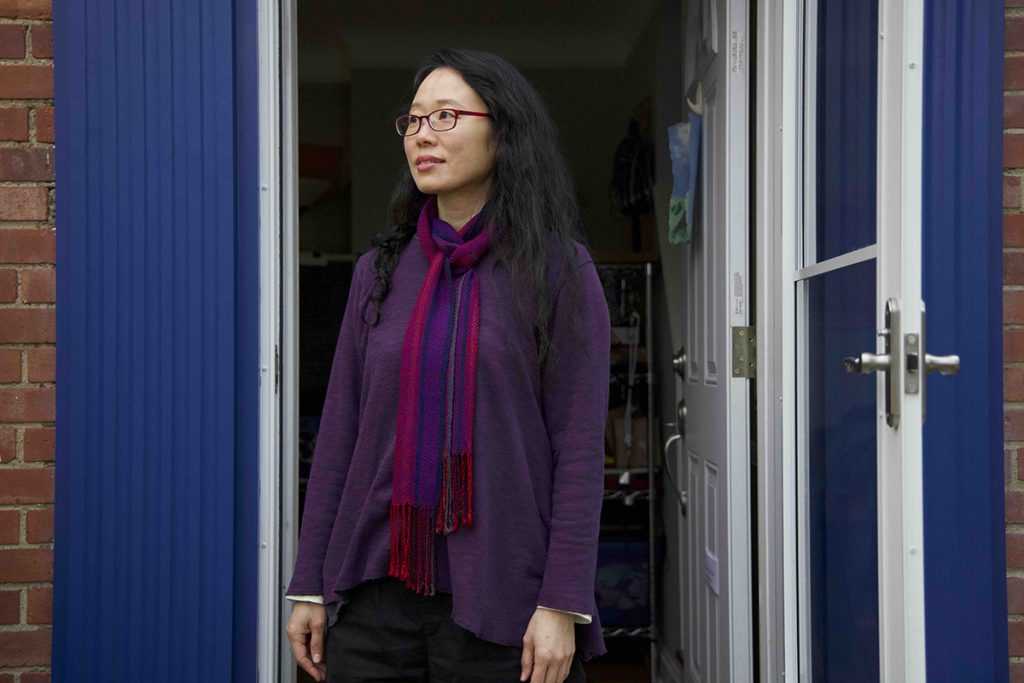
Aimee Lee (Courtesy of Aimee Lee)
Being the child of immigrants and the Korean diaspora never changes, hanji artist Aimee Lee said. She doesn’t really think about it—“that’s just my life.”
But these days, she said, she does reflect on how her hanji art, and the process of learning how to make it, was and still is a way of reclaiming and celebrating her heritage. Since learning how to make hanji, Lee has molded her career around it, creating art, writing a book called Hanji Unfurled, teaching classes, researching hanji creation, and participating in exhibitions. Lee’s work is currently on display at the Bainbridge Island Museum of Art, as part of the museum’s Handwork 2026 show.
Lee first encountered literature about hanji—Korean paper, of which there are many different kinds, all of which is made of the bark of a specific species of Mulberry tree, the Paper Mulberry—in her graduate school studies in Chicago at Columbia College, where she studied interdisciplinary book and paper arts. [technically, I had seen it first at Oberlin in the museum. But did not know about hanji’s history at that point] One of her required classes, hand papermaking, briefly covered the history of papermaking. It was in those history lessons that she learned about hanji, and the many uses of the durable and unique Korean craft.
At the time, though, she said, “it wasn’t cool to be Korean,” and there was a much bigger focus on Japanese paper, washi.
“There was actually more scholarship done in English on [washi], so there were multiple books—but when I would look into Korean papermaking, there was very, very little,” Lee recalled. “I realized I would have to go to Korea to actually get more information. I applied a couple years out of grad school for a Fulbright [scholarship], and was able to spend just over a year [in Korea]. The whole goal was to learn how to make hanji in the traditional style, which has very, very quickly become endangered.”
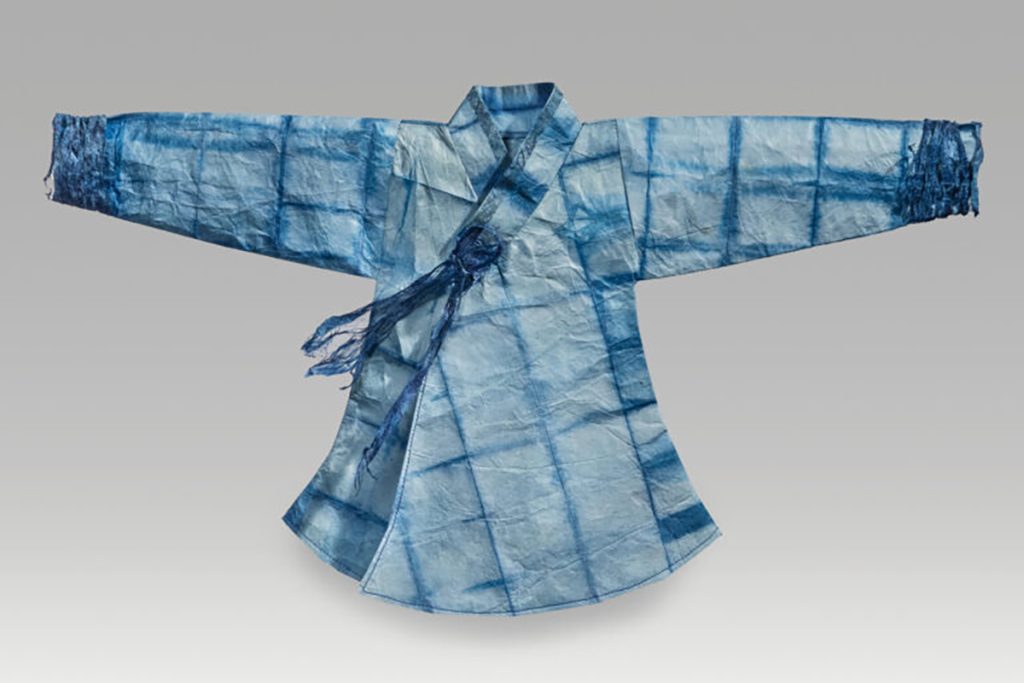
Aimee Lee, Panes, 2024, indigo and hanji on bark lace, thread, 11.6” x 20” x 2” (Courtesy of Aimee Lee)
A difficult process
Part of traditional hanji making relies on women, who do much of the intensive labor to create the paper: scraping down to the third, white layer of bark, which papermakers use to make hanji; and, later, picking out by hand bits of errant bark or discolored pulp from the large vat of boiled tree fibers.
“This is all just labor that is pretty invisible to most people who buy a sheet of paper,” Lee said.
Creating hanji also requires utilizing mucilage from plants like Hibiscus, Hollyhock, or Okra to suspend the long Mulberry fibers in the vat. Lee sometimes works with Okra, but said that most people who still make hanji work with Hibiscus. [I usually use polyacrylamide, a synthetic version. I do small batches with okra but I would never say I only work with okra or even mainly use it] She said that papermakers strategically grow Hibiscus, routinely deadheading the plant, so that they could drive more growth into the root for maximum mucilage.
“You would dig up the roots … and then you’d freeze them and … the day before you make paper, pound those, and then soak them in very cold water and then they will ooze this mucilage,” Lee explained. “And then you’d have to strain that out a couple times and then that would be what goes into the vat. And then at that point, you have your bamboo screen in a wooden frame that it sits on top of that suspended over the vat and you’d pass that through the slurry several times.”
Hanji makers stack all that wet paper [the stack grows as you work, it’s not that you pass the screen through the slurry and then all at once make a stack. You pull at the vat, then “couch” to lay down each sheet.] and put it into a press to press out the excess water, placing delineation threads between every other sheet. [you would do threads between every sheet for Japanese-style paper. Traditional hanji is 2-ply, so threads go between every two sheets] Lee said that, these days, hanji makers use hydraulic presses, but used heavy stones in the past. Once they press out all the excess water, hanji makers must carefully part the paper, following the threads they have placed between every other sheet, so as to dry two sheets together as one as a perfect whole (known as moon-sun paper or eumyangji, the same idea as yin and yang) . To dry the paper, they then use large brushes to brush the paper onto walls or wooden boards. Hanji makers use heated steel dryers, if they want the drying process to go faster.
Lee also briefly described dochim, a final finishing technique, wherein hanji makers “hammer all the papers to increase surface sheen, and reduce ink bleed, and strengthen the paper.”
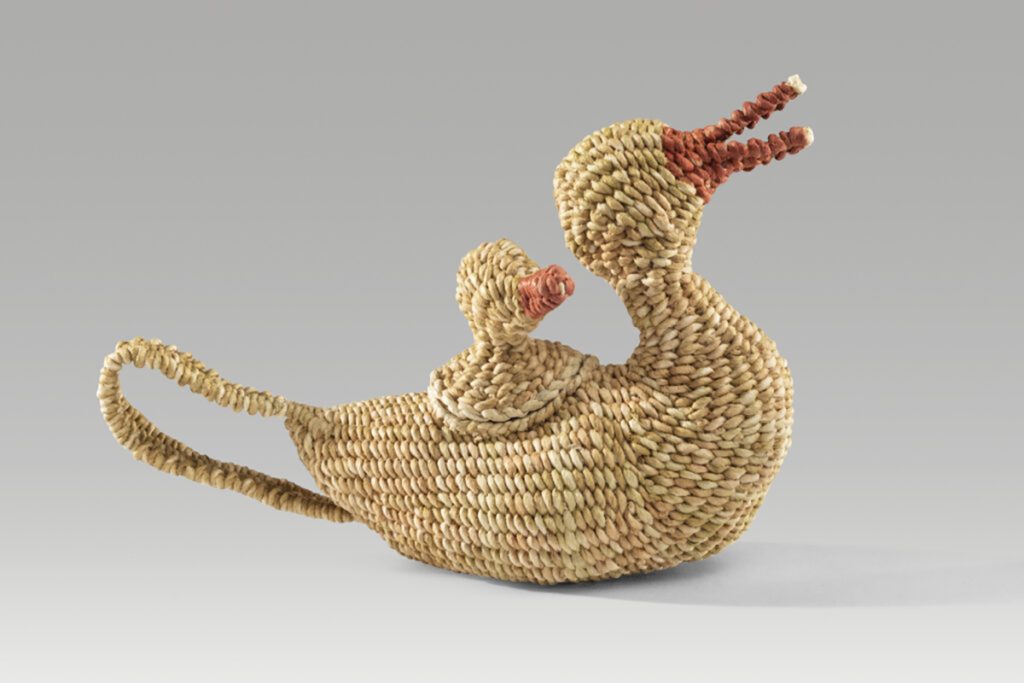
Aimee Lee, Duck and Duckling Teapot, 2020, Natural dyes, corded on twined hanji, 5.25 x 8 x 2” (Courtesy of Aimee Lee)
An endangered art
So few people make hanji anymore, Lee said, because of different kinds of colonization. Hanji factors heavily in the design and construction of a traditional Korean house, she explained—doors, windows, walls, ceilings, and many floors are all made of hanji. There’s even a specific kind of underfloor heating system, called ondol, designed to work with hanji floors.
Creating hanji in the traditional manner does not rely on industrial materials, and the process specifically takes place during the winter, when hanji makers can cut back the Mulberry tree for material. Families would replace the hanji—which also served as dust filters—in their doors and windows during that time.
But Western colonization changed all that. Linoleum floors, glass windows, wallpaper or paint, and wooden or metal doors replaced hanji in the home.
“Suddenly, there’s no more need for hanji. That was a huge decimation in the hanji industry—and when we think about that industry, it’s not just the papermakers. It’s the people who installed it,” Lee said. “There’s special ways of installing flooring paper. It’s so expensive and precious that if you were to move homes, you would pull up all the flooring paper [called jangpanji] and take it with you. Same with the door and windows, since that was replaced every year.”
After studying the process, Lee became determined to carry on the art of creating hanji. Looking back, she said, she didn’t realize that what she was doing was a process of ancestral reclamation.
“At the time it was just, ‘I love papermaking. I’m of Korean heritage. What were they doing in Korea? Information is not available here. How can I get it? I have to go there,’” she said. “And then once I found so much of it, it was like, ‘How could I not share this with people?’”
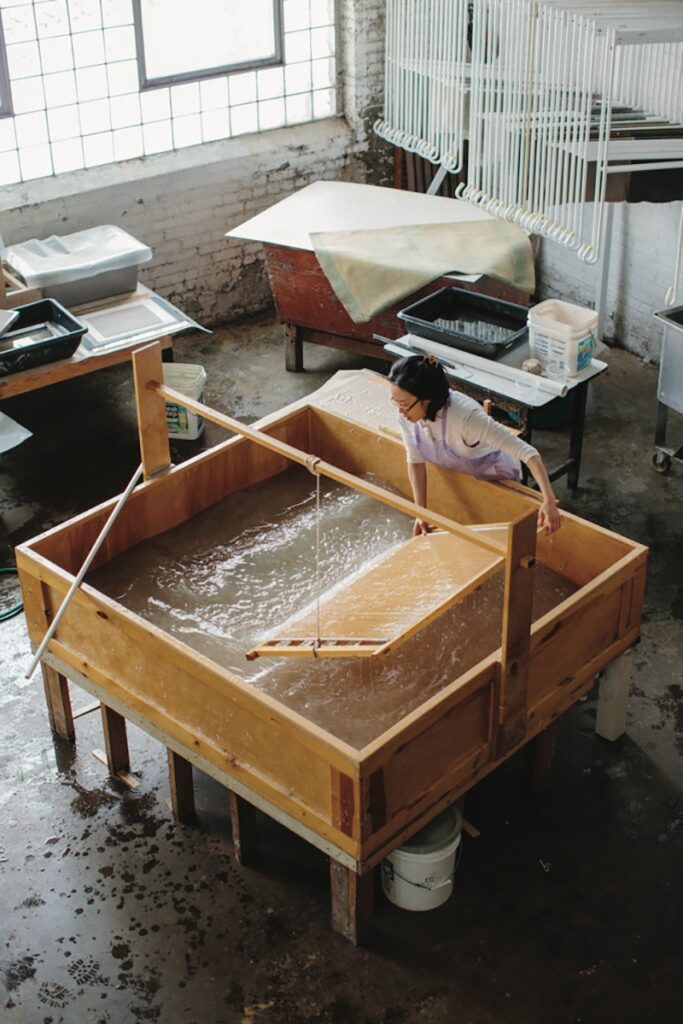
Aimee Lee hanji making in the studio (Courtesy of Aimee Lee)
Lee eventually built a hanji studio, and used every avenue she could to disseminate the practice of hanji making, including writing, giving lectures, and putting together YouTube videos.
She sees the process of creating hanji, and hanji itself, as emblematic of Korean people’s resilience.
“In the process of texturing and fusing … you have to crumple up the paper, massage it, throw it around, and really work it in a way that it changes the nature of it, but because of the long fibers, they can flex, rather than tearing. It causes a shift in being a crisp sheet of paper to more pliant, draping, almost like fabric, in the way that Koreans have been, for centuries, people have tried to eradicate them, or enslave them. … It just makes them stronger. It’s forced them to create other ways of surviving.”
She carries this forward in her work, and has applied it to her personal life.
“A lot of my work and life has involved sorting out when and how to push back against systemic, individual, institutional, and societal injustice,” she said in a later email. “Working with hanji is a way of insisting that I am seen, because there is a whole culture/history/craft/tradition that has been ignored. And gathering my students and mentees is a way to share that work.”
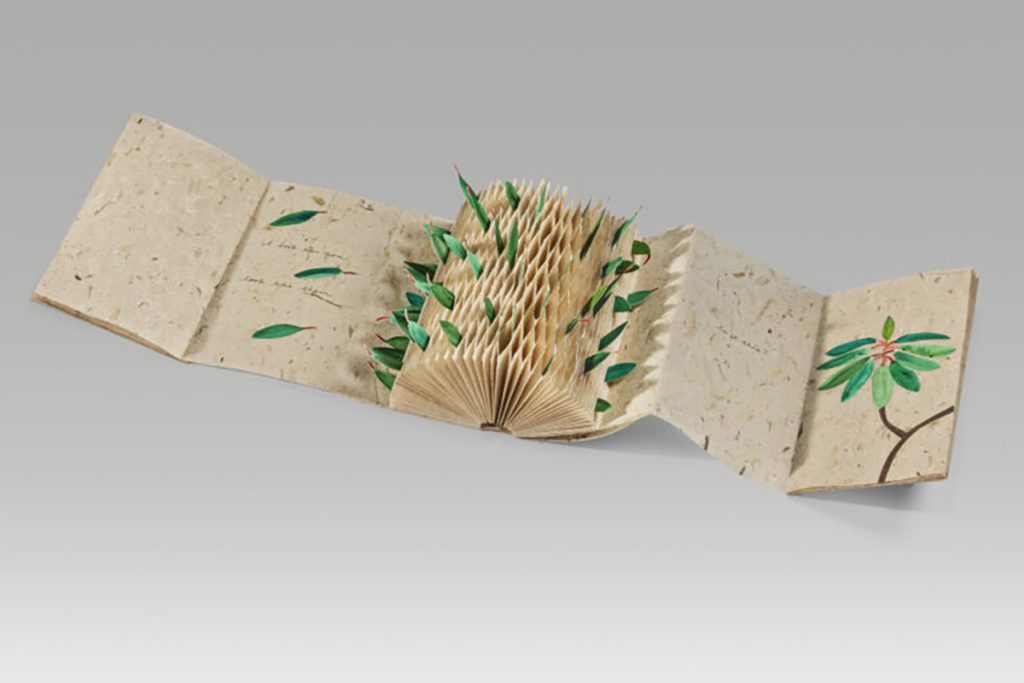
Aimee Lee, Unity, 2024, Acrylic on paper, pen on milkweed bast hanji, 8.75 x 5.1 x 1.75” closed, 11” wide open (Courtesy of Aimee Lee)
Lee will be giving a talk about her hanji work on March 14 at the Bainbridge Island Museum of Art. Tickets and more information are available here.