


By James Tabafunda
NORTHWEST ASIAN WEEKLY
A two-story building at 606 12th Avenue South in Seattle’s Little Saigon that stood for three decades, is now rubble.

A large Volvo crawler excavator demolishes the concrete walls of the Pearl Warren building on Feb 6, 2026. (Photo by James Tabafunda)

Photo by James Tabafunda
The Northwest Asian Weekly captured the scene on Feb. 6 when the loud, intermittent strikes of a hydraulic breaker echoed as a large Volvo crawler excavator chewed through the concrete walls of the Pearl Warren Building.
Water sprayed from the excavator’s hoses at the point of demolition, keeping dust from drifting toward neighboring buildings. Within days, the parking garage walls had been reduced to rubble, the garage floor left intact as a staging area for trucks hauling the debris.
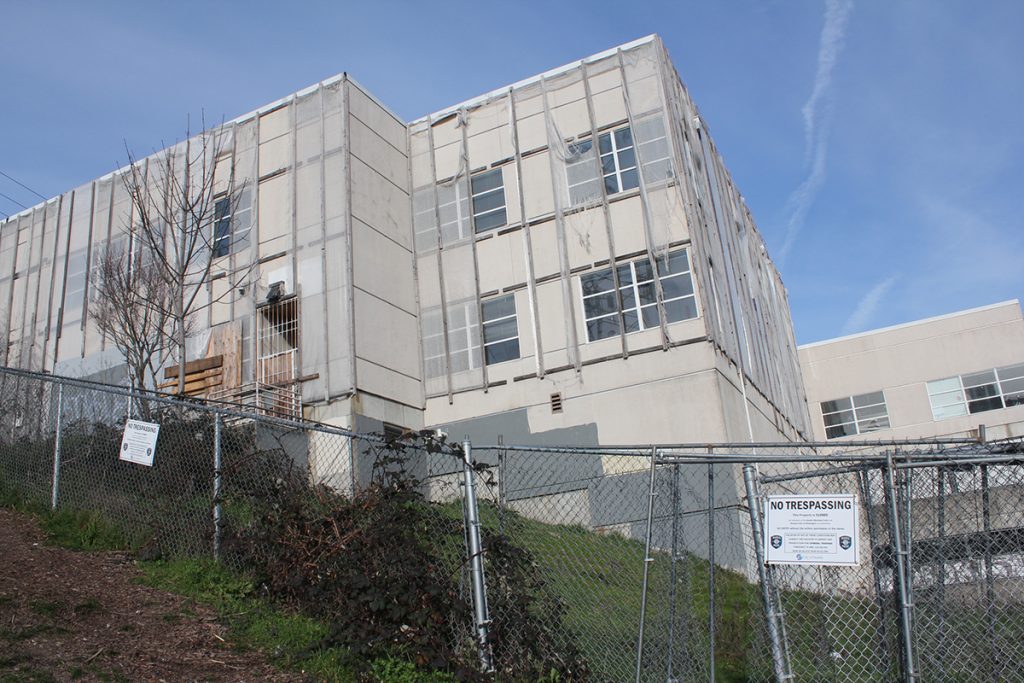
The Pearl Warren Building (Photo by James Tabafunda)
The building, named for Pearl Kallappa Warren, a Makah Tribal member who co-founded the American Indian Women’s Service League in 1958, opened the Seattle Indian Center in 1960, it once housed offices of the Seattle Indian Services Commission (SISC) from 1995 until 2017.
The demolition carries significance for the Vietnamese American community that has called Little Saigon home for decades. Quynh Pham, former Friends of Little Saigon executive director and new acting director of the Department of Neighborhoods, said, “This neighborhood is a multicultural home to many people who have found refuge here.”
A building’s troubled final chapter
The SISC bought the site in 1994 and built the Pearl Warren Building the following year. Chartered in 1972, the SISC is one of the city’s oldest public development authorities.
From 2017 to early 2025, the building housed the Navigation Center, a 74-bed, low-barrier homeless shelter operated by the Downtown Emergency Service Center (DESC). Community members and business owners watched as the space right outside the shelter became associated with public drug use.
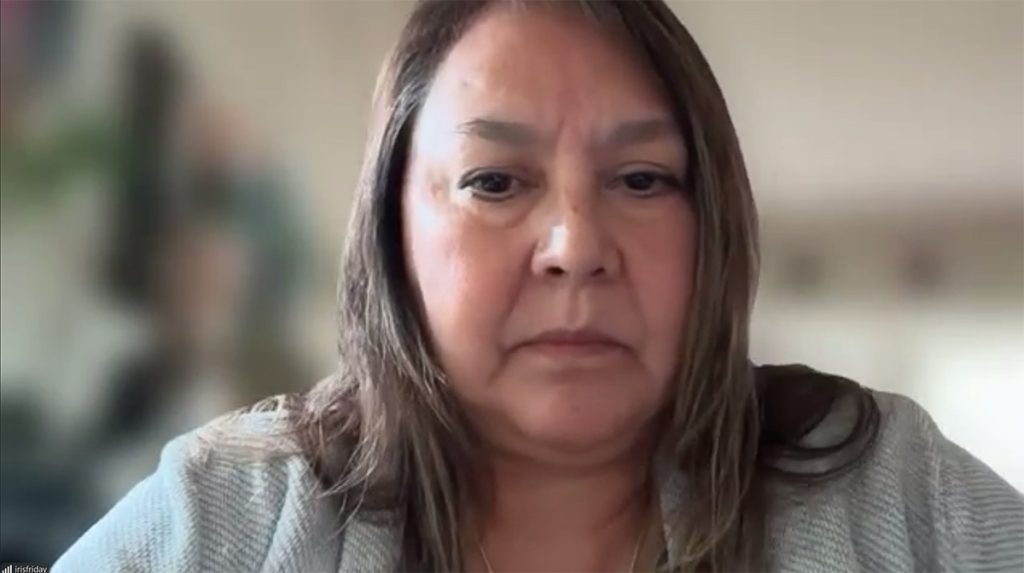
Iris Friday, Seattle Indian Services Commission interim executive director and a nationally recognized Native housing expert formerly with the U.S. Department of Housing and Urban Development.
Iris Friday, SISC’s interim executive director and a nationally recognized Native housing expert formerly with the U.S. Department of Housing and Urban Development, acknowledged the shelter’s impact but said the commission is focused on renewal. “We want to be a good neighbor,” she said. “We want to make sure this is a place that everyone can be proud of.”
The shelter’s closure was announced in March 2024 by Deputy Mayor Greg Wong. It closed a year later, in March 2025, with the remaining clients transferred to DESC’s STAR Center.
After the shelter closed, the vacant building deteriorated rapidly. Vandals broke windows, stole copper pipes and wiring, and left hypodermic needles and other trash throughout the building.
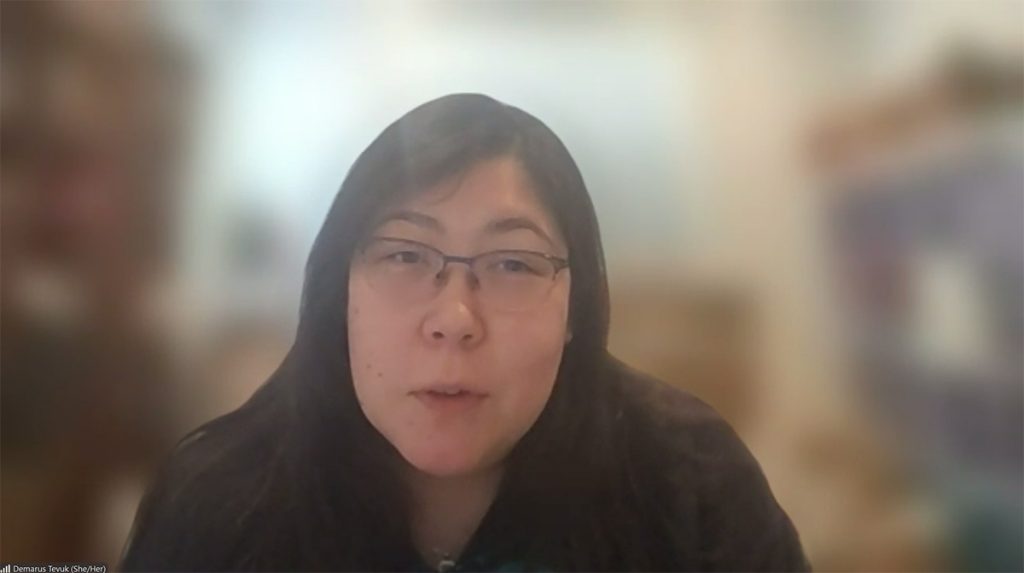
Demarus Tevuk, Seattle Indian Services Commission development manager.
“We welded the door shut and boarded up the windows, but people still found ways to break in,” said Demarus Tevuk, an Inupiaq woman from Nome, Alaska, who serves as SISC’s development manager.
SISC deployed 24-hour unarmed security in November 2025, but Tevuk said it was not enough for a building with several entry points. She said, “Security would go in and tell people ‘You need to leave.’”
“Our neighbors have been calling us … because they can see into our building and let us know if they see people in there, if they see fires there,” Tevuk said. “They’re helping us monitor the site.”
An emergency push
The drive to demolish came from multiple directions. In September 2025, Mayor Bruce Harrell announced $500,000 in his proposed 2026 city budget for the demolition at the City of Seattle and Tribal Nations Summit, as part of more than $9 million in investments supporting Native communities.
In January 2026, Seattle Police Chief Shon Barnes filed an emergency petition to demolish the vacant Navigation Center. “We’re going to put together what I call a ‘whole of government’ approach to some of these particular areas,” Barnes said in a KUOW interview on Jan. 22.
On Oct. 23, 2025, the International Special Review District unanimously approved a Certificate of Approval for demolition. The board determined the building was not a contributing historic structure because it was built in 1995, lacked significant architectural features, and was not originally within the district’s boundaries.
“We upgraded to a mini mesh fence for security of the lot and to keep people out of the lot,” Tevuk said. “We’re really concerned about safety so that’s why we’re willing to pay extra to make the site really secure.”
A vision rooted in community
Once the debris is cleared, the 1.1-acre site will become home to the Native Village and Gateway, a 162-unit mixed-use development that represents the most ambitious project in SISC’s 54-year history.
“The future for this site as a Native-led housing and community space represents a powerful shift to this neighborhood, where Indigenous people have been historically pushed out. We look forward to supporting a project that centers Native leadership while contributing to a vibrant, shared neighborhood,” Pham said.
The project calls for a minimum of six floors of affordable housing with most units priced at or below 80% of Area Median Income. It will include commercial space, a culturally relevant childcare center, an economic empowerment center, and public art such as Coast Salish welcome poles.
The project was shaped by two community studies. A 2019 housing needs assessment surveyed 447 Native people in King County and found that affordable housing, economic development, and childcare were the top priorities. A 2022 Native Neighborhood Community Study, which Tevuk served as lead researcher, asked 768 Native people what they envisioned for a Native neighborhood in Seattle.
Community members “feel isolated from each other,” Tevuk said. “They don’t know where to go to make friends. They want to just be themselves and not have to explain anything and just be around people that understand what it’s like to be Native.”
Friday, a Tlingit woman, said the project will carry forward the vision of the late Bernie Whitebear, the activist who founded the United Indians of All Tribes Foundation and secured land for the Daybreak Star Indian Cultural Center.
“We’re able to carry his vision forward, to have this Hall of Ancestors, which will serve as a community gathering space and an acknowledgment of our past leaders,” Friday said.
The design calls for bold Coast Salish art on the exterior. At six or seven stories near the intersection of Interstate 5 and Interstate 90, it will be visible from both freeways. “It’s going to pop. It’s going to be beautiful,” she said.
Funding and uncertainty
SISC has pre-development funding in place. The city’s $500,000 covered demolition costs, and in December 2025, SISC received a $2 million Equitable Development Initiative grant for the project’s economic empowerment component.
Federal support also exists. Friday attended a roundtable with Sen. Patty Murray in February on affordable housing. Tevuk said federal funding will cover the initial phase of pre-development.
But challenges lie ahead. Tevuk said that a nationwide slowdown in housing permits, rising construction costs, and tariffs could affect the timeline. She said, “I think our project will face the same struggles that everyone is facing.”
“We’re in the pre-development stage, and that means we’re going to be working on getting the larger capital funding together,” she said.
The value of a new Native neighborhood
The Pearl Warren site is one piece of a much larger vision. Three housing developments led by SISC and the Seattle Indian Health Board are planned around the intersection of South Weller Street and 12th Avenue South. A fourth permanent supportive housing development led by Chief Seattle Club is located in nearby Yesler Terrace.
“This is an opportunity for the native community to come together and actually have our own little tiny neighborhood. We don’t have anything like that in the city of Seattle,” Friday said.
“Everyone is spread out, and we have to go to different areas to get services or come together as a community.”
Friday views the much larger vision as an important effort in getting the Native community back into Seattle. “It’s sad that everyone’s had to move out,” she said.
Friday also spoke about the legacy of the Gang of Four—the multicultural coalition of activists including Bob Santos and Bernie Whitebear who fought together for Seattle’s minority communities. She said, “I think that spirit of collaboration really goes back … how they all worked together to support the community and worked together so that we could move things along as one voice instead of individual voices. Together, our voices are stronger.”
“It’s a new chapter and a new opportunity to create a cultural icon for the entire community,” Friday said. “It’s going to be that cultural icon that we can all be proud of.”
SISC plans to apply for building permits in the coming months and break ground in 2027.
For more information on the Seattle Indian Services Commission, go to www.seattleindianservices.org. For more information on Friends of Little Saigon, go to flsseattle.org.