


By James Tabafunda
NORTHWEST ASIAN WEEKLY
Long before Joe Nguyen represented the people of the 34th Legislative District, he was a boy born in White Center who learned what fear felt like the night they saw a stranger from their billiards hall.
His parents scraped together enough to open the small pool hall. “We were robbed one too many times … It was actually very memorable because somebody followed us home one time,” he said. They soon sold the business. It became too dangerous.
That boy—the son of refugees, a kid who lived in public housing, who later mopped floors as a janitor at his own high school—now runs the most powerful business organization in the Seattle area.
Nguyen, 42, officially assumed the role of president and CEO of the Seattle Metropolitan Chamber of Commerce at the end of January, leading an organization that represents about 2,500 companies and 750,000 workers.
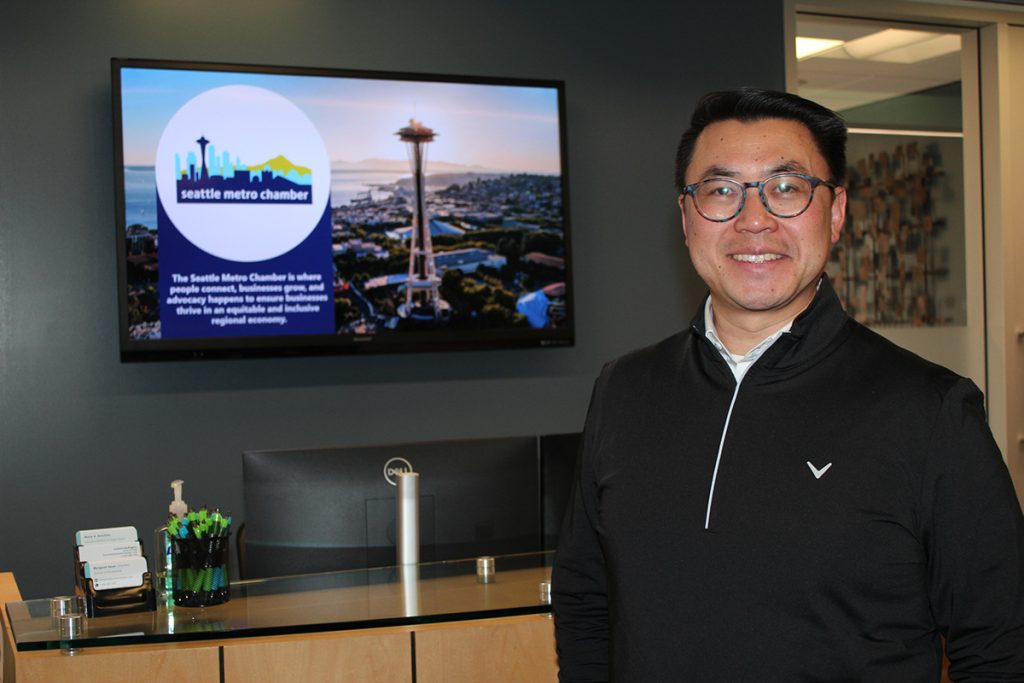
Seattle Metropolitan Chamber of Commerce President and CEO Joe Nguyen. (Photo by James Tabafunda)
A son of refugees charts his course
Nguyen’s story is an immigrant family’s story—one of small businesses, hard work, and great adversity.
His parents came to the United States as Vietnamese refugees and settled in White Center, the unincorporated area south of West Seattle known for its tight-knit immigrant communities. His mother worked as a seamstress.
They later opened a restaurant on Capitol Hill called Ginger Lime, but the timing was not right. The recession hit, costs were high, and the regulatory burden proved to be a challenge. “It was always scary having the health inspectors come in because you never know what new rules were going to be in place,” Nguyen said.
His sister is a civil engineer. “Because she’s worked with so many developers, she’s been able to have this niche market that helps with water diversion,” he said. “That’s really her business, helping people navigate these regulatory environments.”
The family’s relationship with small business has always been deeply personal.
Nguyen graduated from Seattle University in 2006, earning bachelor’s degrees in finance and humanities. He got a job at an investment bank, but found the work unfulfilling. A trip to Vietnam for his father’s funeral changed everything.
“There were things in my professional life I was really stressed about, then I went to a third world country where people sat on a dirt floor and had no money, but were generous beyond belief,” he said in his official Seattle University 2020 Alumnus of the Year profile. “It made me realize I didn’t have to live the life I was living to be happy. So I went back to Seattle and quit my bank job.”
Nguyen rose through the technology industry, holding leadership roles at Expedia and Microsoft. His professional life, he said, became “more a means to an end and that end is serving the community.”
The one chosen to take over the chamber
Nguyen’s arrival at the chamber was met with praise.
He was a Bernie Sanders delegate. He took no corporate PAC money when he first ran for state Senate in 2018. The Stranger named him “the AOC (Rep. Alexandria Ocasio-Cortez) of Washington State.” He later spoke in support of a payroll tax and a state capital gains tax—two levies the chamber has fought against in the past.
Yet, when the chamber announced last December that he would replace departing president and CEO Rachel Smith, the choice drew praise from business leaders and politicians alike.
Teresa Hutson, chair of the chamber’s board, said Nguyen “brings an incisive, results-oriented approach and the ability to work across sectors to advance a strong, competitive economy for the Seattle region.”
“Joe is collaborative, pragmatic, and smart as hell, with a deep understanding that a strong business community goes hand-in-hand with taking care of people,” King County Executive Girmay Zahilay said. “We both come from low-income backgrounds, and that shapes how we lead.”
For members in the Asian American community who supported Nguyen as a progressive champion and now question whether he has switched sides, he is direct.
“Economic justice is one of the most important things,” he said. “What we’re seeing right now is this fracturing that’s happening.”
“If I’m able to help bridge the gap between the progressive community and the business community and the political community to really inspire positive change and positive growth, I’m really excited to be in that role.”
A meteoric rise through public service
Nguyen won his Senate seat in 2018, defeating Shannon Braddock with 57.4% of the vote. He became the first Vietnamese American state senator in Washington and the first minority to represent the 34th Legislative District.
In the Legislature, he chaired the Environment, Energy, and Technology Committee and served as vice chair of the Ways and Means Committee. He supported legislation on affordable housing, criminal justice reform, and climate policy.
In late 2024, Gov. Bob Ferguson announced that he was appointing Nguyen director of the Washington State Department of Commerce, where he oversaw a $7.9 billion budget and more than 100 programs including housing, energy, and economic development.
He spent roughly a year in the role before the chamber came calling. “Sometimes opportunity knocks, even when you haven’t invited anyone to your door,” he wrote in his farewell email to Commerce employees.
A champion for the Chinatown-International District (CID)
Nguyen’s connection to Seattle’s CID is personal, not political.
“My father helped build the Vietnamese church that was in that area,” he said. “We used to go shopping at the grocery store there. We went to Uwajimaya for candy so that is a place where I personally am uniquely connected to, and I really have a vested interest in making sure that it’s successful.”
Nguyen acknowledged the CID has been fighting for survival and promised direct engagement, even if it falls outside the chamber’s traditional scope.
“You’re going to see a lot of effort and engagement in that space, even if it’s not the main priority of the chamber,” he said. “It is mine. And you’re going to see a lot of advocacy there.”
The chamber runs the Community Business Connector program, which serves Black, Indigenous, and people of color, as well as immigrant-owned small businesses across King County. With the 2026 FIFA World Cup bringing six matches to Seattle this summer, the chamber has partnered with the Asian American Foundation on grants to help businesses prepare for the expected wave of 750,000 visitors.
“We want to really highlight all the great restaurants and small businesses that we have here,” he said. “Everything from technical assistance to helping people make sure that they’re in the right spot. PR and communications can be a big deal as well.”
An economy on the edge
Beneath Nguyen’s optimism lies a sobering insight.
He has cited data showing the Puget Sound region’s GDP growth is roughly double the national average and second only to Silicon Valley. But the growth is dangerously concentrated in technology.
“If you concentrate all this growth in one particular area, it makes it a little bit risky for us,” he said about Seattle’s fragile economy.
He has studied Midwestern boom towns that struggled when their dominant industries looked elsewhere and warns Seattle cannot afford complacency.
“What I saw was basically people taking these industries for granted, not paying attention to the future, not expecting things to go away, and then it all kind of happens,” he said.
Nguyen is pushing the chamber to “make strategic bets” on specific industries—clean technology, artificial intelligence, quantum computing, and the space economy—while fighting to keep the tech giants already here.
“It’s important for us to really provide an ecosystem that is going to be beneficial for our businesses, for our communities because whether you like big business or not, they have an impact on a number of things in a positive way,” he said. “We really want to make sure that we keep as stable as possible.”
Building bridges now and in the future
Nguyen reflected on what it means—as a Vietnamese American, as the son of refugees—to lead Seattle’s business organization.
“A lot of times when you look at the immigrant communities as a whole, oftentimes their first foray into a community is largely small businesses,” he said. “So the ability to take over an organization that is doing so much for all of our communities, in itself, is very humbling.”
Six weeks into the job, he is leading the chamber—carrying with him the memories of a billiards hall in White Center, the Ginger Lime restaurant, and a conviction that economic prosperity should reach every corner of the region he has always called home.
For more information on the Seattle Metropolitan Chamber of Commerce, go to www.seattlechamber.com.