


By Carolyn Bick
NORTHWEST ASIAN WEEKLY
In the 1970s, refugees began arriving from Southeast Asia and and fleeing to the United States from the Khmer Rouge genocide in Cambodia. Fifty years on, these original immigrants and refugees and their descendents still face many challenges, due to the complex and interwoven social and financial hardships they have faced for decades.
One of these challenges lies in education—ranging from access and outcomes to representation in classrooms and textbooks, as well as the overwhelming lack of (and sometimes misapplied) data about Southeast Asians.
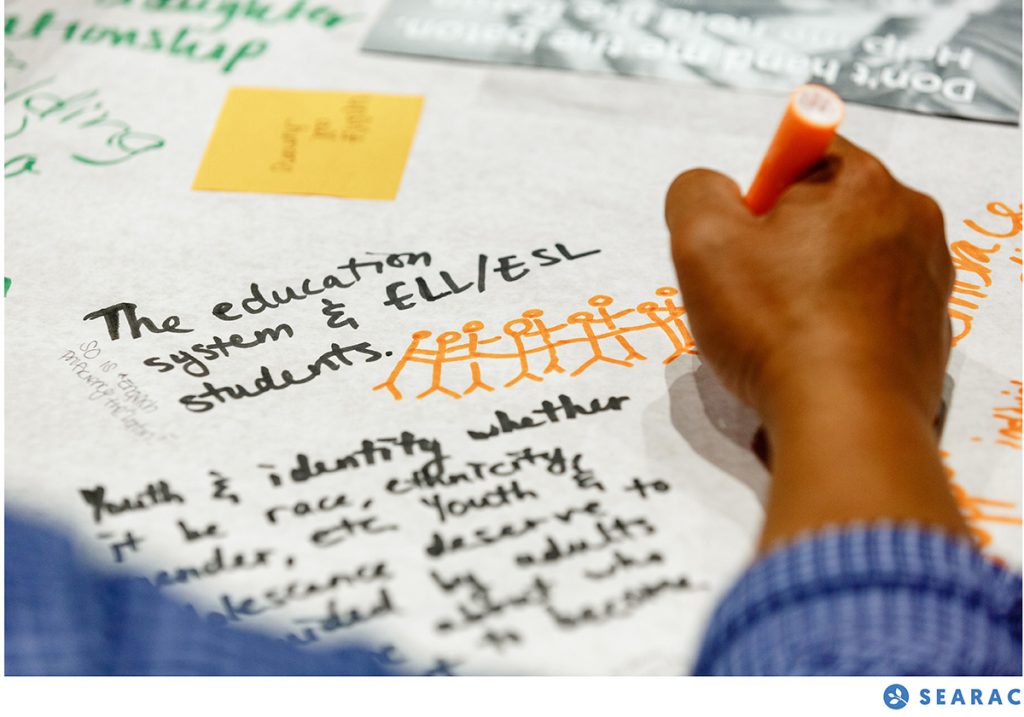
The Southeast Asia Resource Action Center (SEARAC) recently released Rising Up: The Southeast Asian American Educational Journey, a report about the progress within education of the many communities under the Southeast Asian umbrella. The organization, founded initially in 1979 as the Indochina Refugee Action Center, has for the past five decades served to advocate for the Southeast Asian community.
Of the approximately 1 million school-aged Southeast Asians, about 653,000 are between the ages of 5-17, while 353,370 are between the ages of 18-24. For the report, SEARAC’s executive director, Quyên Đinh, said the researchers ended up creating its own definition of Southeast Asians, which allowed for a more diverse and representative dataset. This is because U.S. Census data is geographically based, doesn’t account for diasporic movements, and sometimes even miscategorizes Southeast Asian groups, Đinh said.
The report says that “Southeast Asian American communities include, but are not limited to, the Cham, Hmong, Khmer, Khmer Kampuchea Krom, Khmer Loeu, Khmu, Lahu, Lao, Iu Mien, Montagnards, Phutai, Pnong, Tai Dam, Tai Deng, Tai Lue, Vietnamese, and ethnic Chinese communities with Southeast Asian heritage.”
“Our definition really is a social political identity comprised of history experiences of those who left Vietnam, Cambodia, and Laos in the 1970s, during U.S. occupation and involvement across our three diaspora countries, and the subsequent largest wave of refugees from those three countries who have come to America, comprising the largest refugee ever resettled in America,” Dinh explained. “And despite community engagement processes, one key reason why it’s so flawed is that they do not identify Hmong as Southeast Asian, but instead East Asian. And this, to the community, was really a slap in the face … What [Hmong veterans] shared is that, ‘We fought in the U.S. war with the United States, with CIA agents. We are clearly part of the Southeast Asian diaspora and not the East Asian diaspora.’”
Among the issues SEARAC highlighted in its report is the effect of immigration enforcement crackdowns on both students and teachers, and pointed to the important information hiding in lumped-together data. The organization also noted that continued stereotyping in the classroom not only fosters bullying, but also leads to poorer educational and mental health outcomes.
Immigration enforcement and federal policy
Southeast Asian students, particularly in places like Minnesota—which has a high concentration of Hmong immigrants, refugees, and their descendents—shared with researchers that they are afraid for themselves and their family members. What was a simple annual check-in with Immigration and Customs Enforcement (ICE) before President Donald Trump took office a second time has since morphed into the harrowing possibility they or their loved ones may be disappeared, detained, and deported. This has happened to some young people and their families, Đinh said. Even going to school seems dangerous, and some families, the report notes, are opting not to send their children to school to keep them safe.
“For some families, this is actually a conversation that they haven’t had, and that it’s only because of these escalated enforcement actions that young people are learning for the first time that they are under threat,” Đinh said. “And that for some of our young people, their parents, or their uncles have actually been deported to countries that they have never known, and that young people are now trying to not just get through school, but adjust to having their families be completely dismantled. And the social-emotional trauma that comes along with that is one that lasts for many, many years and goes through their adulthood.”
Đinh said that researchers have already touched on the immediate impacts on children in SEARAC’s 2018 report, Dreams Detained, which includes stories of how young people who are still in school must become primary caregivers for their siblings, after their parents have been deported. This most recent report builds on what SEARAC researchers found in Dreams Detained, and underscores the damage federal deportation actions do to school-age children and families, particularly because the Trump administration has allowed immigration action in school areas.
“It’s a continuation of that trauma that we’re now seeing under the administration, but scaled up to a degree that we’ve never seen before,” Đinh said.
The report notes that the administration has also systematically dismantled language access programs in educational environments. It has also sharply cut a competitive grant specifically serving colleges and universities with undergraduate populations composed of at least 10% Asian American, Native Hawai’ian, or Pacific Islanders and where at least 50% of students receive federal financial aid.
Disaggregated data
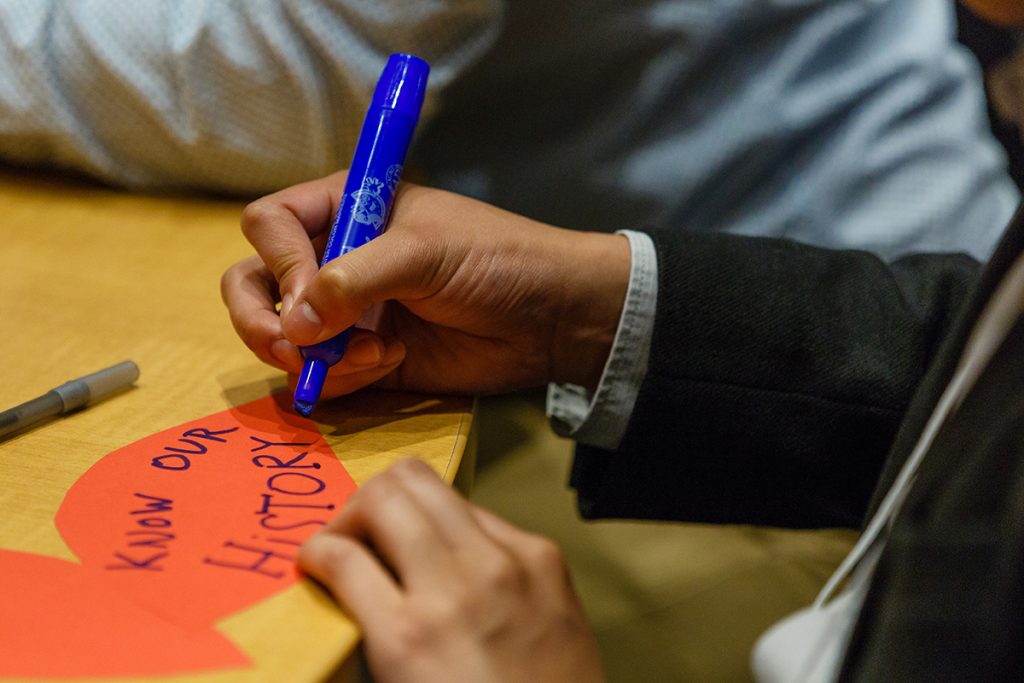
Without disaggregated data, Southeast Asians are often lumped into the “Asian American” category. This, Đinh explained, hides many important differences, including diasporic experiences that shape students’ educational and career paths. The data the report relied on comes from the University of Washington, and was released last year.
“We highlighted the inconsistencies across Southeast Asian education attainment, particularly for the Vietnamese community [in Washington state], whose max scores were surpassing other Southeast Asian communities,” Đinh said. “One reason why we were able to highlight Washington is because it is one of five states in the country that does collect and report data on Southeast Asian students. Also a hard-earned community victory to be able to do that.”
As the data regarding Vietnamese students suggests, the report isn’t all bad news. For instance, Đinh said, the data shows that college enrollment rates for Southeast Asian communities is on par with the national average, “which is very different from what we saw from generations before.”
That said, this progress is inconsistent across communities—which would be impossible to know without disaggregated data. In addition to the Washington-specific data about Vietnamese students, Đinh said, the SEARAC report notes that in Minnesota, “Hmong students were the only student population to have shown an increase in high school completion, which is a really, really great indicator.”
“But for us, equity is really when all of our communities are experiencing the same outcomes. And that has not happened yet,” she continued.
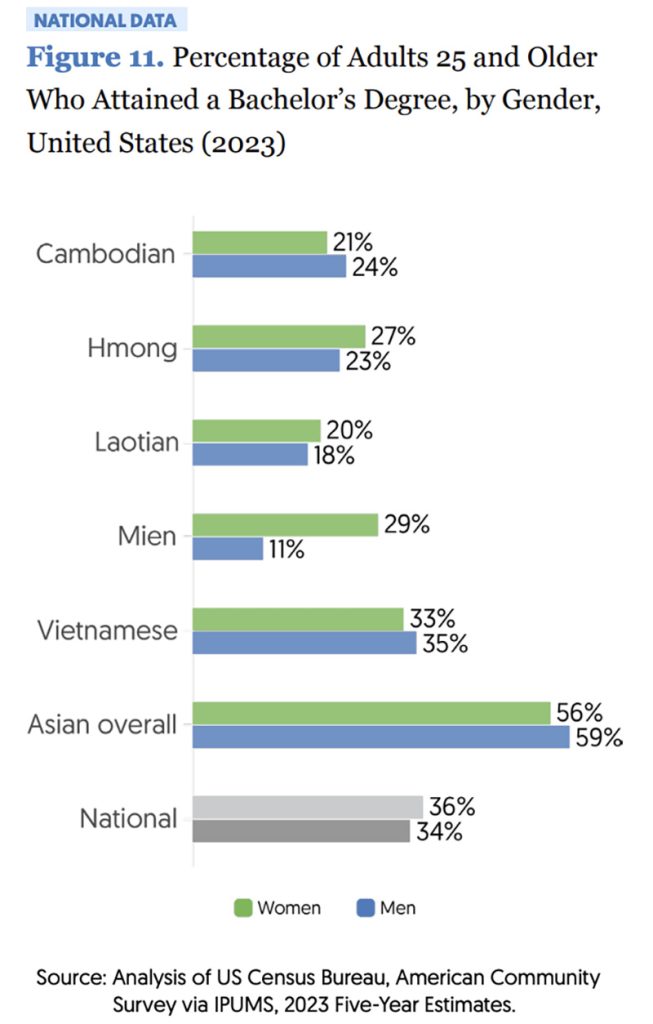
She also noted that educational equity is still incomplete, because—despite an overall higher rate of enrollment in secondary education—women still outpace men, especially when it comes to attaining a bachelor’s degree.
The report notes, for instance, that nationally, women 25 and older in “Hmong, Laotian, and Iu Mien communities have higher rates of bachelor’s degree completion than men. In Cambodian and Vietnamese communities, however, men aged 25 and older are more likely to have completed a bachelor’s degree.”
Racism and stereotyping
But even amongst kindergarteners, researchers found that Southeast Asian American girls did better than their white counterparts, while Southeast Asian American boys did not.
“Gender differences arise in part because of unique challenges that Southeast Asian American boys face in achieving educational success. Educators often stereotype Southeast Asian American boys as gang members, which can create pressure to demonstrate ‘toughness’ in reaction to the ‘model minority’ stereotype,” the report explains. “As a result, Southeast Asian American boys are more likely to be disciplined in school and experience higher arrest rates than boys from other Asian American communities.”
“On average,” the report continues, “Southeast Asian girls have higher educational attainment than boys—but often at a cost. A national review of ninth graders found that Southeast Asian American girls reported the second-lowest sense of belonging in school across all ethnic groups and socioeconomic statuses.”
Researchers also found that Southeast Asian students experience a higher degree of bullying than their white peers, particularly during the initial years of the COVID pandemic. ICE’s current targeting of Southeast Asians and their families has only exacerbated the anxiety and fear many students face.
Students also don’t often have teachers who understand the difficulties they may face in navigating both intergenerational trauma and cultural differences within their own families.
“As a result,” the report notes, “only 43% of Southeast Asian American youth surveyed report feeling comfortable talking to a parent or caregiver when encountering a difficult emotional situation—the lowest rate among any Asian group surveyed.”
Needed classroom supports
So how can educators take this data and put it to good use to help achieve educational parity amongst Southeast Asians?
In addition to cultural competence in the school system and the classroom, researchers highlighted the importance of Southeast Asian American-specific studies, heritage language learning, and spaces where students feel they are among peers of a similar background.
“Our communities know the solutions that are required for young people to be seen and supported. And I think that’s one area where this report is really unique and compared to others, and that it really highlights the best practices of visibility through data disaggregation,” Đinh said. “We need political leadership to really protect and to scale up these solutions, especially as our federal government is really dismantling the federal support that schools are able to provide to our young people in their communities. And now, more than ever, we really need to stand up for our young people to be seen, to be supported, and for them to belong in a multiracial America.”
Washington state for the second year failed to pass a bill that would have required teaching Asian American & Native Hawaiian/Pacific Islander (AA&NH/PI) histories, as well as Latino and Black histories, in schools. Legislators ran out of time to hear the bill before the Feb. 17 legislative cutoff. Educational advocacy group, Make Us Visible Washington, plans to reintroduce the bill in the 2027 legislative session.
Đinh said that schools should also focus on collecting disaggregated data.
“It is only by seeing our communities’ needs that we will be able to create targeted interventions to stop these persistent gaps from growing,” she said. Things like cultural competency and Southeast Asian-specific learning are “all solutions that our young people, our teachers, and our schools have actually been calling for without investment that’s really needed, either at the school district level or the state level, especially now when federal funds are being decreased.”
“And finally,” she said, “I think it is just a reminder to really think of and see the Southeast Asian students that are within your schools that maybe you have been overseeing, neglecting—not intentionally, but possibly unintentionally, and … take a step back and to see if those young people are also being prioritized in how we see belonging and how we see visibility for all students of all races, including Southeast Asian Americans.”
Leave a Reply