


By James Tabafunda
NORTHWEST ASIAN WEEKLY
With a stack of petitions bearing more than 1,000 signatures in hand, Gary Lee walked into Seattle City Hall’s council chambers on March 24 to make an important delivery. His message to city leaders: Keep the surveillance cameras on, and put up more of them.
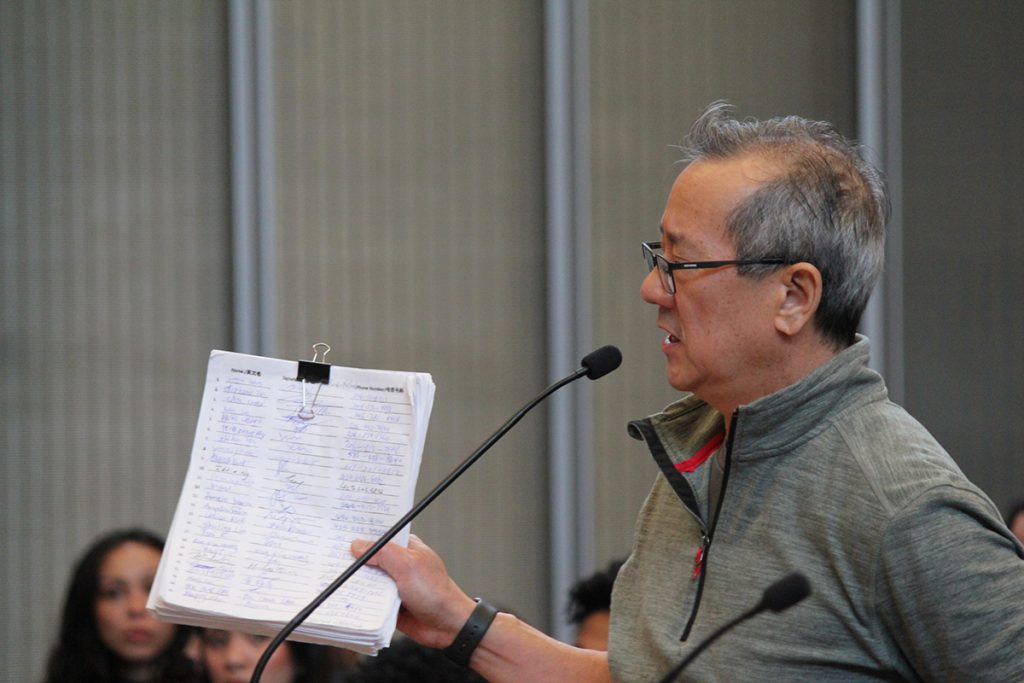
Gary Lee, co-chair of the Chinatown-International District Public Safety Council, presents the petition to the Seattle City Council. (Photo by James Tabafunda)
Lee, co-chair of the Chinatown-International District Public Safety Council (CIDPSC), presented the petitions to the city council on behalf of Chinatown-International District (CID) residents, senior citizens, business owners, and community leaders who want to make a public statement in support of closed-circuit television (CCTV) cameras in their neighborhood.
“I’m submitting this to you, over 1,000 signatures to keep it going,” he said. “And that’s what we’re hoping for.”
The petition delivery comes five days after Mayor Katie Wilson announced at a March 19 news conference that she would pause expansion of the city’s technology-assisted public safety pilot, which centers on the Real Time Crime Center (RTCC) and its network of police CCTV cameras, pending an audit. The decision immediately galvanized CID advocates, who fear the existing cameras could eventually be scaled back or shut off.
A neighborhood’s plea for protection
The petition, which carries 1,032 signatures, reads in part: “In 2025, the CID community petitioned to have the City of Seattle CCTV cameras installed in the Chinatown International community. In 2026, we, the local residents, seniors, business owners, and community leaders, want to show our continued support for the cameras to stay and expand into our community for public safety.”
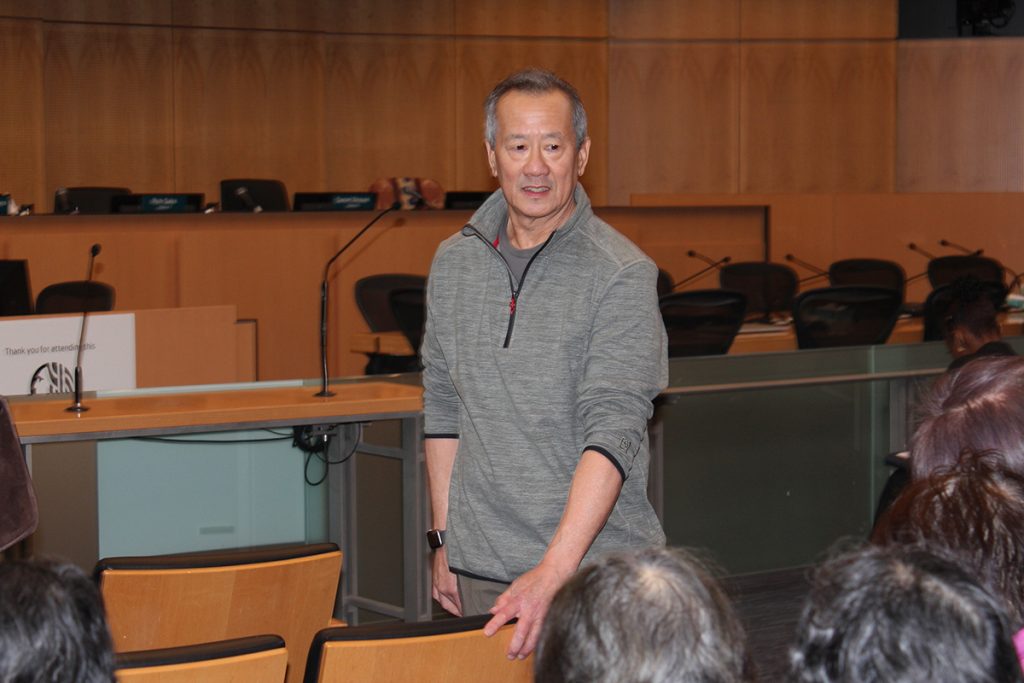
Gary Lee, co-chair of the Chinatown-International District Public Safety Council (Photo by James Tabafunda)
“Hopefully they will add some more cameras to the CID. I know it’s a citywide issue, but I’m not going to speak about the rest of the city,” Lee said. “We’re mostly interested in the CID to keep it running and keep it going and add more cameras.”
Lee also called on the Seattle Police Department (SPD) to make one improvement to the cameras. “I really think that SPD should make bigger signs and better signs, and let people know about the cameras and that they are under surveillance,” he said.
“I think that would definitely help.”
Seniors are concerned about public safety
Joining Lee at City Hall were about two dozen people who stood in solidarity, including Tanya Woo, a former Seattle City Councilmember who has long championed the CID.

Tanya Woo, Chinatown-International District advocate and former Seattle City Councilmember (Photo by James Tabafunda)
She said the senior residents who live in the CID are afraid to venture into neighborhood parks or common spaces because of safety concerns.
“We have 2,500 elders who live in many different homes,” Woo said. “They wanted to be here despite the rain. We walked all this way. And so we implore you to please listen to our elders. Respect your seniors.”
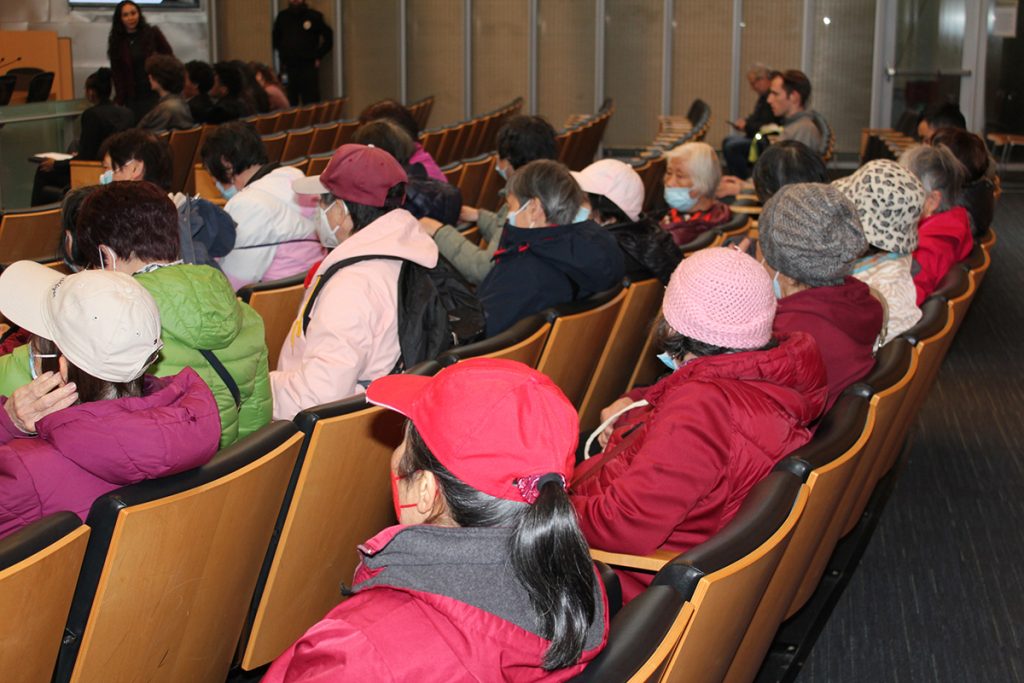
About two dozen CID seniors attended the Mar. 24 Seattle city council meeting. (Photo by James Tabafunda)
Woo also said there are several instances at 12th Avenue South and South Jackson Street—a major intersection in the CID—where surveillance footage proved critical in identifying a suspect following a stabbing or shooting. “It was great to have officers say, ‘Hey, you caught this on CCTV. We’re going to go pick up someone. We know who it is.’ It was great that we were able to find them, and that brought a lot of relief to our community,” she said.
She also raised the stakes by noting the upcoming FIFA World Cup 2026 matches at Lumen Field—temporarily renamed Seattle Stadium—this summer. “Ahead of FIFA soccer, we are getting ready, and we are hoping to be prepared for the many people who we hope will come,” Woo said. “We do have a reputation—30 minutes away from the stadium—so we’re asking for your help.”
Voices from the CIDPSC
Beth Ku, a community volunteer and fellow member of the CIDPSC, urged the mayor and city council not to let politics derail a program she says is already producing results.
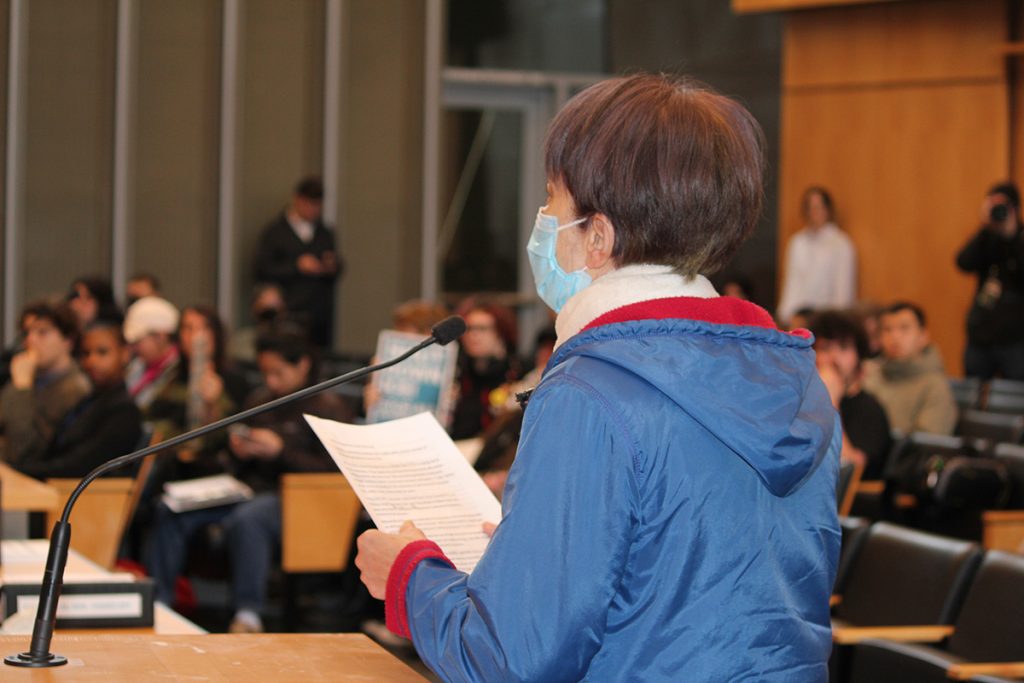
Beth Ku, community volunteer and Chinatown-International District Public Safety Council member (Photo by James Tabafunda)
“According to the police data, the use of high tech did increase the speed of solving cases by three times than the traditional way,” she said.
Ku pointed to the urgent human need behind the signatures. “We are all frustrated and feel unsafe,” she said. “Safety concerns led to a significant drop in customers, and everyone is taking precautions to avoid being a victim.”
Her message to decision-makers was direct: “The 1,032 signatures are the public opinion and the will of the CID community, urging our mayor and city leaders to listen. If you have another way to reduce crime, please also use the CCTV technology for security, which is highly efficient, and there is no good reason to remove it or cancel it.”
Mayor Wilson’s pause, not reversal
The backdrop to the CID petition is Wilson’s announcement last week. She said the city’s 62 existing CCTV cameras—deployed in the CID, parts of the downtown business corridor, and along Aurora Avenue North—will remain active. What she paused is any further expansion.
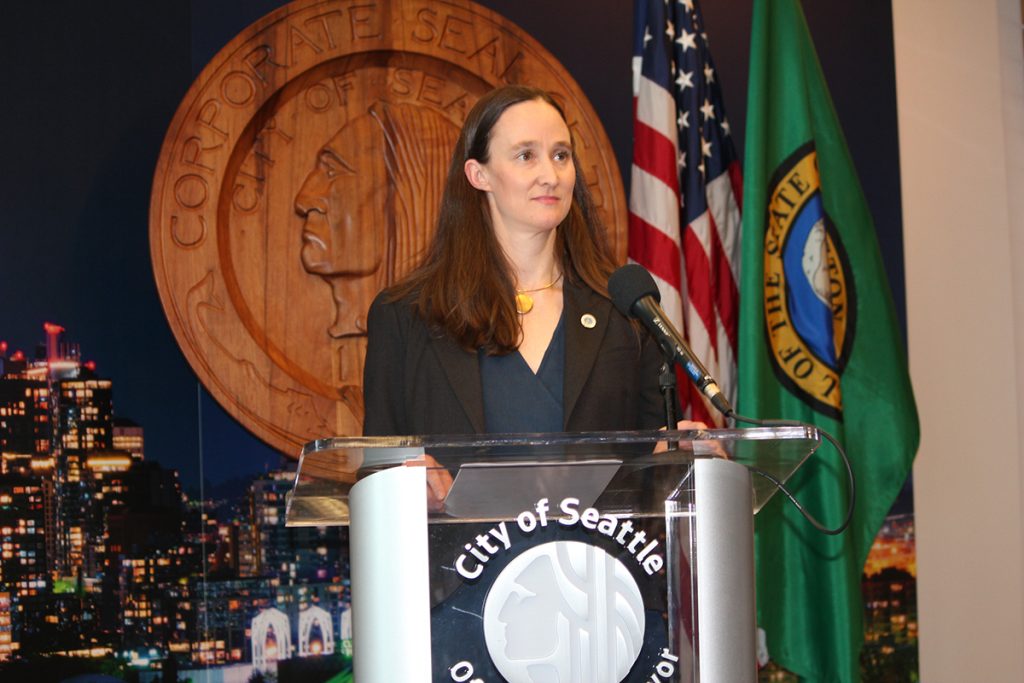
Seattle Mayor Katie Wilson announces the privacy and data governance audit at a Mar. 19 news conference. (Photo by James Tabafunda)
“I expressed my concerns about this expansion during the campaign. As we stand here today, none of the cameras that are intended for the pilot’s expansion have been installed, turned on, or connected to the RTCC,” Wilson said at the news conference. “In fact, they have yet to even be received from Axon, the vendor used by the city’s program.”
“This is a decision about more than cameras.”
“It’s about how we approach public safety, how we build trust, and how we show up for communities across this city. And it’s important that we get it right.”
Wilson said she wants to first complete a review, which her office is pursuing in partnership with New York University’s Policing Project.
A separate evaluation of crime outcomes is being conducted by the University of Pennsylvania and overseen by the city’s Office of Inspector General.
“I am pausing expansion of this pilot until we have completed a privacy and data governance audit and taken significant steps to strengthen our policies,” Wilson said.
She also acknowledged the cameras’ demonstrated utility, while placing them in a broader public safety context. “I know cameras can be, have been, and will be useful tools to solve crime in Seattle and in countless other cities across the world,” she said. “Cameras are not the one key to making our neighborhoods safe.”
The mayor offered a conditional path forward. Asked whether a clean audit would lead to expansion, Wilson said, “If the audit comes back and says everything’s totally secure, we’re not at all worried about this data getting into the hands of the federal government. I think likely my decision at that point would be to move forward with the expansion of the pilot.”
How the RTCC works—and what’s at stake
The RTCC, launched in April 2025 under then-Mayor Bruce Harrell, is a civilian-staffed operations hub inside SPD’s headquarters that monitors live feeds from police CCTV cameras. The cameras continuously capture footage of specific zones. RTCC operators activate and zoom in on cameras when relevant 9-1-1 calls come in.
Footage is stored locally for five days, then deleted, unless it is connected to a reported incident—in which case it is uploaded to Axon’s evidence.com platform and retained for investigative purposes.
Within its first two months of operation in 2025, the system was used in 600 incidents and was actively aiding 90 investigations. SPD Chief Shon Barnes reported in early 2026 that 10 of the department’s 37 homicide cases in 2025 were solved in part through the RTCC camera network, contributing to what Barnes called the lowest homicide count in Seattle since before the COVID-19 pandemic.
An uncertain road ahead
For Gary Lee and his neighbors, the uncertainty surrounding the audit timeline is frustrating. He said he is unclear about the administrative process underway, but said that is precisely why the community mobilized.
“I don’t really know what’s going on,” Lee said. “I think they’re supposed to have some sort of audit and they’re going to evaluate it for a while. So I really don’t know what the details are. That’s why we’ve come out here and said, ‘Hey, you know, what is going on? We don’t understand what you’re doing here, but we want you to keep it.’”
He said the cameras have already changed how residents feel. “I think people feel a lot safer than before because they feel that there is some surveillance out there and hopefully that some crimes will be solved if they are attacked out there.”
The CID community will be watching closely as the audit continues and as the city council weighs in. Wilson said the council’s role remains important.
“I hope the city council will pressure her and say, ‘Look, you know, this is important,’” Lee said.
Wilson scheduled a town hall for March 27 at Town Hall Seattle to allow further public input on the surveillance issue.
For more information on the town hall, go to townhallseattle.org/event/seattle-surveillance.
Leave a Reply