


By Carolyn Bick
NORTHWEST ASIAN WEEKLY
“But where are you really from?”
More than half of all Asian Americans whom researchers surveyed reported getting this specific question, or that the person speaking to them assumed they did not speak English, when they told researchers that they regularly experience race-based discrimination every month.
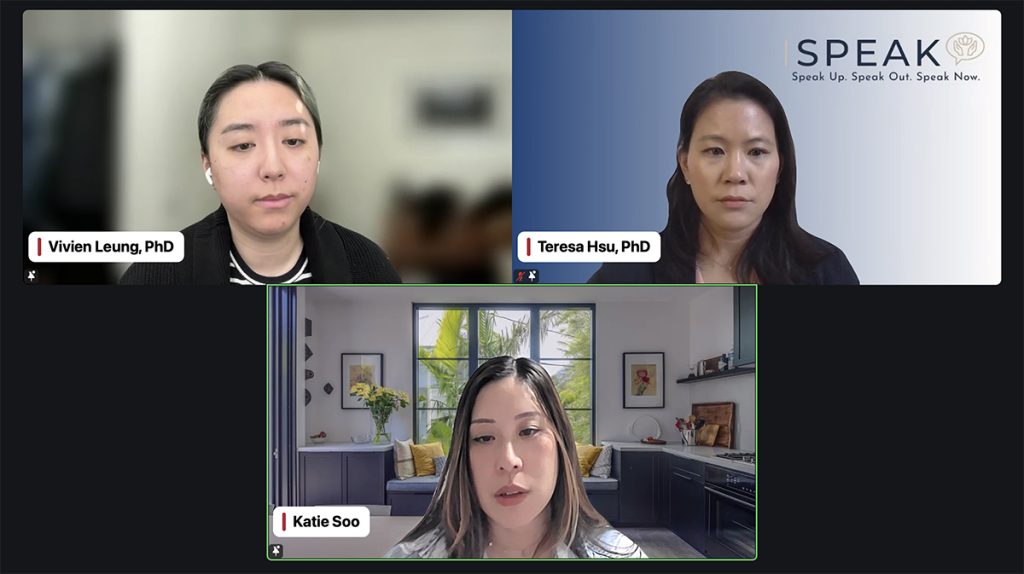
“We found this to be a unique experience among Asian Americans—that Asian Americans in general are reporting a lot of this kind of interaction in a given month,” Dr. Vivien Leung, a professor at the Santa Clara College of Arts and Sciences, said, speaking to attendees at a March 25 meeting alongside clinical psychologist Dr. Teresa Hsu and moderator Katie Soo, a tech entrepreneur who serves as board chair for the Asia Society of Southern California. The meeting was the second part in a four-part series addressing the results of a wide-ranging survey the Committee of 100 and NORC at the University of Chicago conducted last year. The first part focused on how federal rhetoric and specific word choices keep anti-Chinese sentiment alive.
“U.S.-born and foreign-born Asian Americans both receive this kind of stereotype. … We can also see that when we look at Latinos and African Americans, for instance, this isn’t quite the same trend that we’re seeing,” she continued. “For Asian Americans regardless of nativity folks are receiving this kind of treatment or these kinds of comments. … This means that both U.S.-born and foreign-born Asian Americans regularly get assumptions about being foreign.”
These kinds of questions and other assumptions based on how Asian Americans look have detrimental, far-reaching impacts, the study found—including lower voter turnout amongst Asian Americans, increased risk of mental health issues, and people being targeted because of their appearance. It’s all part of the perpetual foreigner stereotype.
The “forever foreigner”
There’s a special kind of “othering” when people assume a person will never belong, based solely on how they look, Leung said.
“The ‘forever foreigner’ manifests a lot differently, because race in the United States continues to be … based on appearance, based on phenotype, and so that’s not something that folks can really escape,” Leung said. “Regardless of the length of time you spend in the United States, [you feel like] you are always going to be an outsider [and will never be] able to really escape that because, just based on looks, you already appear to be a foreigner. It’s not something that you can really escape, because of the way that race is kind of perpetuated in the United States.”
This kind of racialization, Leung said, works on two fronts: “It’s about assumptions about belonging—so, who is an insider to American culture—and also the ‘superior-inferior,’ in terms of racial hierarchy.”
“Asian Americans are simultaneously valorized as this model minority who has a lot of income. We’re all going to college. We’re getting these well-paying jobs, but despite that valorization that some groups may prop us up on, we’re seen as perpetual foreigners who can never actually fully belong in the United States,” she explained. Asian Americans are seen both as a model minority and as people who don’t belong to the “American” crowd. “You could be born and raised in Georgia and still field that question every day based on your appearance.”
“That manifests a little differently for Black Americans, for instance,” she continued, by way of comparison with another group who faces routine stigmatization and oppression. “Black Americans look culturally like they belong to the United States, face very different structural discrimination from that of Asian Americans, but nobody would look at somebody who is Black and assume that kind of foreignness right out the gate, unlike what Asian Americans face.”
Hsu said that this “hits at this person’s rightful place in society, and there’s a little bit to the mechanism for distress that hits a little bit differently as well because there’s almost this helplessness.” An Asian American person can prove their intelligence and their abilities—they can even prove their birthplace in the U.S.—but, because of this stereotype, it won’t matter. They can never “prove” they belong.
Psychological toll
The report notes that feeling like a perpetual outsider nearly doubles a person’s chance of experiencing psychological distress, as measured by the Kessler Psychological Distress scale, a six-item questionnaire to measure distress, anxiety, and depression over a period of a prior 30 days.
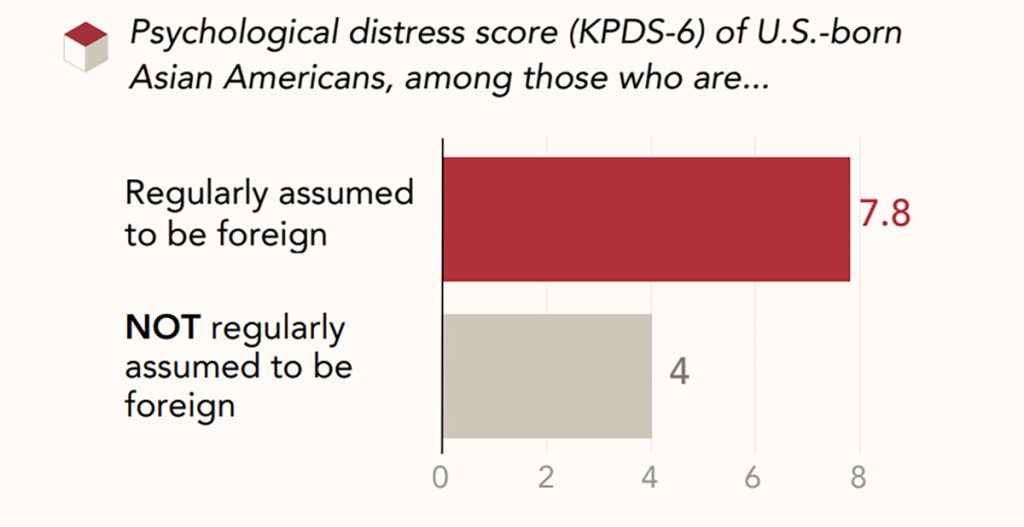
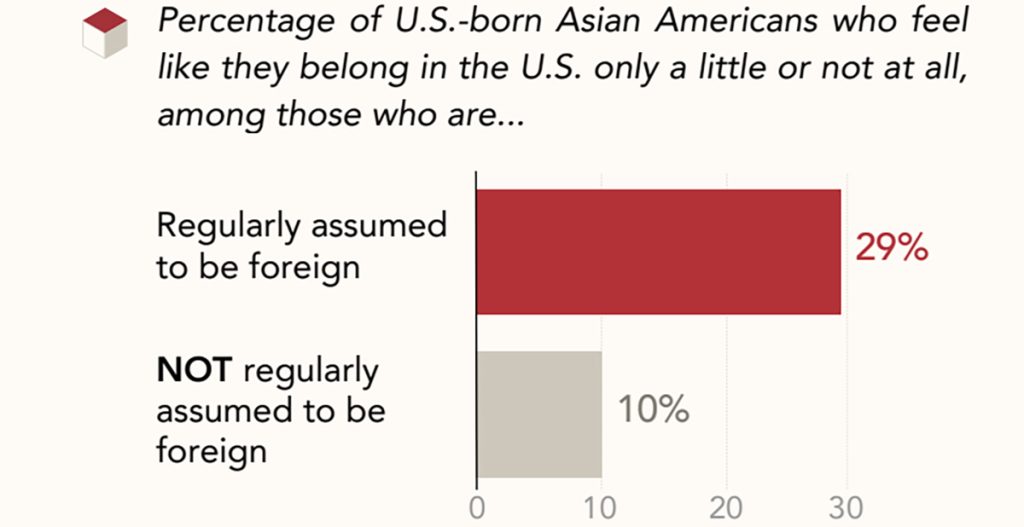
Hsu said that such distress “is kind of a given if there’s a constant suggestion that you don’t belong. The way that trickles down and manifests, though, can be in different ways.”
“I can share a personal example,” she continued. “During COVID-19, I was working at one of the hospital systems and a patient had refused to see me. Another way in which this can work is how teens move about in spaces like schools. So, for example, the CDC found a couple years ago that Asian American teens are bullied more than any other race in U.S. high schools.”
Even though researchers can, to some extent, measure the psychological toll of this treatment, Hsu noted that the questionnaires are still Euro-centric that don’t capture the continued toll of feeling like a perpetual outsider.
“Things like, for example, racial trauma, which captures that continuous cumulative toll, isn’t even in the psychological diagnostic manual. There’s things like PTSD, post-traumatic stress disorder—but that suggests something a little bit more discreet, and it doesn’t quite capture something like racial trauma,” Hsu explained. “So unfortunately, even though the community is aware of how harmful this is and how this can manifest in more severe ramifications, within the psychology community, it’s still got to catch up. It still doesn’t have enough information to say, ‘Well, how depressed do people get? How severe does this occur? Because it’s not even recognized in the diagnostic manual right now.”
Low voter turnout and historical policy
Researchers also found that the feeling of not belonging contributed to a lower voter turnout amongst both Asian Americans and Pacific Islanders than whites and Blacks—and, in turn, politicians didn’t particularly bother to court either voter base, despite the fact that Asian Americans are one of the fastest-growing groups in the country. Politicians’ lack of outreach only fuels this feeling that Asian Americans will never belong in the U.S., thus contributing to lower voter registration and turnout.
“If you feel like you don’t belong, what impetus do you have to participate in civic life? This also has effects not only on presidential vote and turnout in elections, which are really important, but also on representation,” Leung said. She also pointed out that Asian Americans are “chronically” underrepresented in political office, despite making up about 7% of the U.S. population. “But … we only represent not even 2.5% of political offices held nationwide. Not only are you getting withdrawal from the public in terms of voter engagement, you’re also getting withdrawal from folks who don’t feel like they want to run for office—again … if you feel like other people do not accept you in the United States, if you feel like you are an outsider, what impetus would you have to try to run for office, try to kind of engage in public life?”
This creates a sort of feedback loop, Leung said, amongst other “elites.”
“When we’re asking Asian Americans, ‘Have you been contacted by parties or candidates in an election cycle?’ that number is extremely low,” she continued. “If elites are seeing that Asian Americans are not responsive or not very likely to vote and also not likely to run … this contributes to a cycle of exclusion that further self-perpetuates.”
On the policy side of things, this perpetual foreigner stereotype shows up in myriad ways, Leung said, all the way from the Chinese Exclusion Act of 1882, to Japanese incarceration during WWII, to the scrutiny many Chinese Americans underwent for their political campaign contributions in the 1990s, to the more recent targeting of Chinese American scientists and researchers.
“It’s particularly insidious because these kinds of questions of foreignness … nobody is taking them as offensive. Nobody is kind of thinking about this question as, ‘Okay, that’s not how we also treat other people,’” she continued. “Why is it that it’s only for this group? Do we receive these kinds of comments?”
And if politicians and other elites don’t see Asian Americans as a responsive electorate, they are less inclined to stand up for them and less inclined to be receptive and responsive to issues Asian Americans are facing, Leung said. It’s part of why the racist “Kung flu” rhetoric was so hard to stamp out, during the initial phase of the COVID-19 pandemic, even though politicians took the time to condemn it.
“It’s a bit of a chicken and egg problem,” Leung said. ‘They only really feed into each other and kind of contribute to this kind of cycle of exclusion.”
She also noted that there is a gender-based stereotype attached to being Asian American.
“Sometimes when we’re looking at experiments where people are trying to pick and choose candidates, Asian American male candidates are seen as less masculine, as less powerful,” she said. “And Asian American female candidates face not only, again, that racialized sexism but that sexualized racism as well.”
Making change
One of the things both policymakers and the psychology community can do, Hsu said, is to practice both cultural humility and cultural responsiveness, but “a lot of the work can be around advocacy as well.”
For instance, she said, “Even that example that I gave around racial trauma, part of the challenge is that if something is not in our diagnostic manual, there are fewer research dollars given to study it more. So it’s cyclic. … We don’t have a lot of research on racial trauma, specifically to begin with. And so then we can’t make it into the diagnostic manual, but because we can’t make it into the diagnostic manual, then we can’t get more research based on it.”
“So,” she continued, “bringing attention to all of those types of things—it’s incredibly important. And I would say that as kind of a first step to all of this.”
Leung advocated for continued outreach as the number one step.
“Show that kind of good faith effort, right, because I think it’s just completely lacking in a lot of spaces, even in predominantly Asian American places like New York and California,” she said. “The second is also to remember that … Asian Americans are also a very diverse community, so what impacts one national origin group may not be what impacts all. Be careful and cognizant that this is a population that has very different needs. … It cannot just be organizations clamoring for a minute of their time. Politicians really need to, again, go back to that good faith effort of reaching out to communities and community leaders.”
Leave a Reply