


By Carolyn Bick
NORTHWEST ASIAN WEEKLY
When she was young, Lilly Kodama’s mother, Shigeko Kitamoto, would tell the family’s farmhand, Felix Narte, not to buy the little girl candy or ice cream on their regular trips to the grocery store.
“And you know that I had an ice cream cone in my hand and candy in my pockets when we came home,” Kodama, now in her 90s, said with a small chuckle. “I remember I liked to go to the Filipino bunkhouse because during their lunchtime … they let me eat some of their food. And then the other nifty thing was, these are grown-up men and they were eating their food with their fingers. And I thought that was pretty nifty.”
Lilly was born to the Kitamoto family in the house she still lives in on Bainbridge Island, back when the island was mostly farmland. Her father was a salesman for Friedlander’s Jewelers, while her mother grew raspberries, carrying on her own family’s farming trade. The family employed several Filipino workers as farmhands, all of whom were like family, and many of whom helped to babysit Kodama and her siblings.
But in March 1942, that changed. The family was just one of the first 227 people from Bainbridge—and ultimately 125,284 across the nation—whom President Franklin Delano Roosevelt and the United States government forcibly removed from their homes and sent to what Kodama and other survivors call “concentration camps” until the end of WWII. Roosevelt and the government labeled these families, including children, enemies of the country, based on their heritage alone, after the Japanese government attacked Pearl Harbor in December 1941.
On Sunday, March 29, Kodama will participate in a Q&A, after the screening of filmmaker Andrew Inaba’s “Origins,” a film featuring Kodama and other camp survivors. The Bainbridge Island Japanese American Exclusion Memorial Association (BIJAEMA) will screen the film as part of its 84th anniversary event honoring the families whom the U.S. government forcibly removed from their homes on Bainbridge. The BIJAEMA will also host the Ireichō, the Book of Names. The book is part of a national monument called the Irei Project.
March 1942
Kodama remembers the night before she and her family left for Manzanar, an incarceration camp located in California. She was just seven-and-a-half years old.
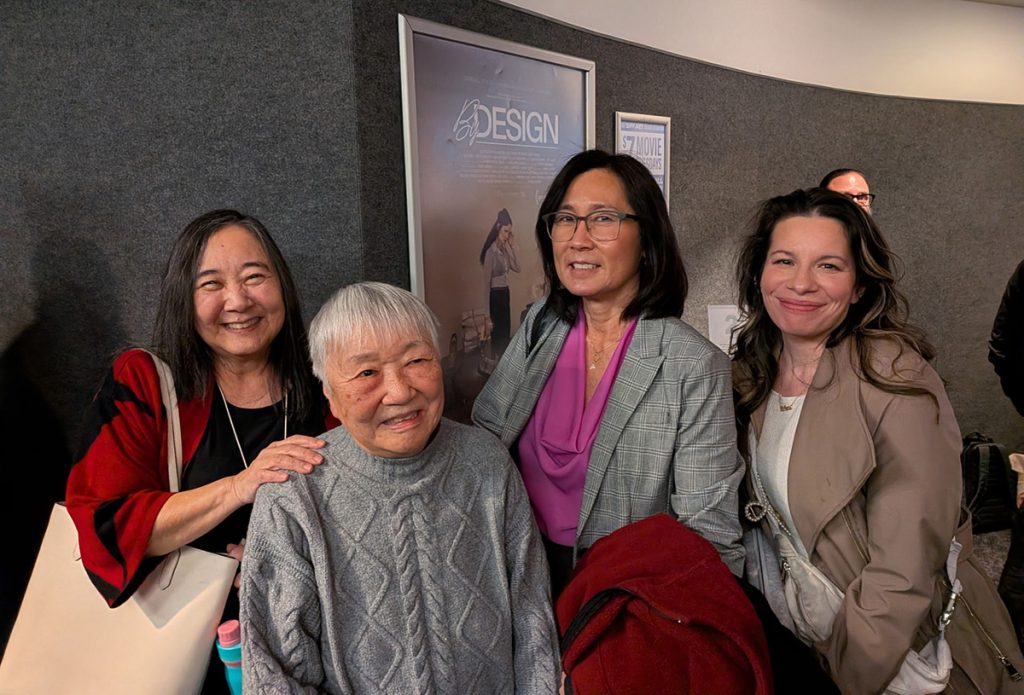
Lilly Kodama (second from left) is an incarceration survivor. She was just 7 years old when her family was sent to Manzanar.
“I just remember my mother telling me that we’re going to take the ferry to Seattle the next day and it’s going to be like a vacation, and I remember being so excited because that was such a special event,” Kodama recalled. “I remember not being able to sleep because I could hardly wait for morning to come.”
“You have to [remember], we didn’t have television or iPhones, and I had no idea that anything terrible was going on in the world, or anything like that,” she continued. “When we gathered at the ferry dock … I saw the entire Japanese American community there. Whenever all the Japanese people gathered together, it was for a special event like celebrating a picnic as a group, so I thought there was some kind of gathering that was special. And then I remember seeing real soldiers with real guns, and I thought that was pretty exciting.”
At the time, Kodama was too young to grasp what was happening. From an education perspective, she counts herself lucky that she was so young—neither she nor her classmates had to repeat any school, largely because they really just needed Dick & Jane books and perhaps a math book for the entire course of their time there. She also remembered feeling lucky that, from her 7-year-old perspective, she got to play with her cousins every day.
“I was excited, because my cousins lived right next door and I had playmates every day. When you grow up on a farm, the only time you have playmates or time to play is during recess at school and here I had playmates every day,” Kodama remembered. “As long as we were with our mamas, I don’t remember wondering what it was about. We were only children, as I said. We were not cognizant of what was happening in the world. I think our mothers tried to make life as normal as possible.”
Now, as an adult, Kodama understands that what happened to her and her family was anything but a vacation. It’s part of why she participates in remembrances and ceremonies honoring Japanese American families who suffered in the camps, as well as their descendents.
No one, she believes, is either entirely good or entirely bad, and nothing is perfect—and yet, people must continue to speak about what has happened.
“We have to learn from our mistakes, and we hope that happens—but I don’t know. We don’t seem to be able to stop any wars,” Kodama said. “But it’s important to tell the truth about what’s happened. … There’s always going to be some good and some bad, no matter what.”
The Irei Project
Duncan Ryuken Williams isn’t descended from a Japanese American incarceration camp survivor. The scholar and Buddhist priest found his way to remembrance action and documentary work almost by accident, when his graduate school advisor died.
“As I was helping the family sort out his office and things like that, I came across these documents that had his family name on it—Nagatomi—but I could tell it wasn’t his handwriting,” Williams recalled. “It turned out it was his father’s wartime diary and sermon notes. His father was a Buddhist priest, and so I needed to, as a way to assist the family, translate the text. … They couldn’t read the Japanese diary. That was back in 1999 or so, and so since then, I had been approached by many different families asking if I could translate … WWII-era camp diaries.”
Over the course of many years, Williams translated many such accounts of incarceration by Japanese American Buddhists. He eventually published a book, “American Sutra,” based on these translations that revealed Japanese American Buddhists were at the forefront of leading a defense of religious freedom and an insistence that they could be both American and Buddhist.
But the book is just part of what came of Williams’ work. The other is the Irei Project, a living, three-part national monument project Williams launched alongside his wife, Sunyoung Lee, and several other collaborators.
Lee, a publisher, had the original idea to make the project a book to make it interactive and to encourage engagement. Eventually, Lee, Williams, and a team of creatives came up with the three-part monument that changes, in order to mirror the changing nature of the present. The monument is made of the Ireichō (Book of Names), the Ireizō (the online story archive), and the Ireihi (sculptural installations at different camp sites).
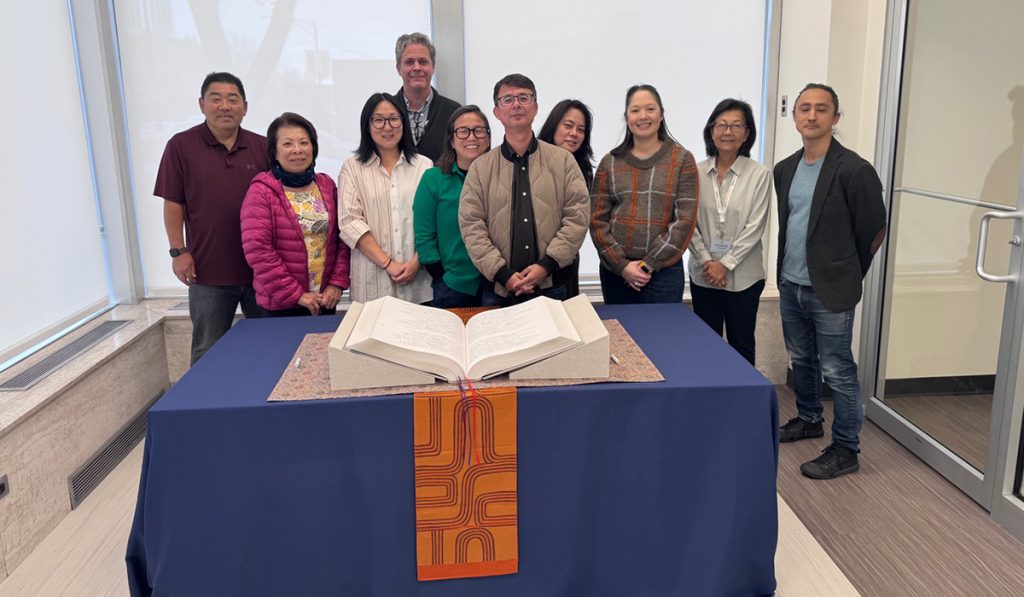
Duncan Ryuken Williams (front and center in tan jacket) and guests gather around the Ireichō.
Williams said the shape of the project shows that history not only informs the present, but lives within it. He specifically pointed to the changes the Ireichō, the Book of Names, is constantly undergoing, as it moves around the nation.
“Generally, if you think of named monuments, you think of … granite walls or other kinds of large-scale displays, and the more permanent it is … or the larger it is by scale, that seems to designate significance,” Williams explained. “What we thought was, using the Buddhist principle of impermanence and interdependence … what if the value of the monument came from change or impermanence? Every day, different people are stamping the book—and physically, the markings are changing the book all the time. It’s also an intimate act, when you do that. It’s about the connection or intimacy with the names, as opposed to just looking at a name from afar.”
The Ireizō, the online archive, consists of interviews with and the stories of camp survivors that Densho has collected. Densho is a Seattle-based documentary archival organization that collects and records the testimonies of incarceration camp survivors. On the Ireizō, people can click on a person’s name and not only see their birthdate and where the federal government sent them, but also hear their names spoken aloud.
“You get a sense of the person behind the name,” Williams said. “We’ve been encouraging people to record and submit recordings of people’s names on the website, so the website itself is also a kind of interactive monument—a kind of sonic or sound-based monument of people saying names.”
Williams said that the Irei Project group will start to unveil the first sculptural installations next year. The first installations will be located at Poston Camp in Arizona, Heart Mountain in Wyoming, and Jerome Camp and Rohwer Camp in Arkansas. They are all inspired by the Ireitō, the monument Reverend Nagatomi built at Camp Manzanar for Obon, the major Japanese summertime festival that honors both the spirits and one’s ancestors. The monument’s name means “Spirit Consoling Tower” or “Tower to Console the Spirits.”
“It’s his handwriting, the three characters on that monument, and he writes about in his diary why he built the monument and what the kind of philosophy behind monument building is from a Buddhist point of view. … As a Buddhist priest, there were so many funerals and memorial services for those who didn’t survive that first year in camp, and [because] the government didn’t care about it, the community would build a monument,” Williams said. “He also said that it’s not just that you build monuments to console the spirits of the departed, but you build it to console the spirits of those who are left behind.”
“Our philosophy around the Irei Project,” he continued, “is, let’s build a monument to this history, but let’s do it in a way that also thinks about … how [history] might be connected to healing in the present moment.”
The past as prologue
Williams feels strongly that the past is not left in the past, and that the nation still has to contend with its “racial karma.”
“There’s certain things that, whether we like it or not, it’s part of our history that we need to contend with. And in our generation, in our era, in our time, in our way, we can all make small efforts to hopefully build an America that is multiple and in both in terms of where people come from, and their faith traditions as well,” Williams said. “I think that’s the kind of America we’re trying to build with this book. So, in the grand scheme of things, we’re in the smaller scheme of things. We’re just trying to make sure we get to the goal of every single person being at least honored one time. But I think we can say in the bigger picture, that’s what this project, and many other important projects that different groups are doing, are all trying to head towards.”
Kodama sees the same thing happening to immigrants today as what happened to her family and other Japanese American families in 1942. She specifically pointed to 2017, when President Donald Trump instituted the so-called “Muslim ban,” and last year, when he specifically targeted Venezuelans.
“I think the same kind of falsehood is doing the same kind of thing,” Kodama said of Trump’s targeting of specific groups of immigrants. “It’s because people want to be accepted and belong, and when the president believes in white supremacy, there’s people who believe that, too—but they didn’t want to admit that in public. But if the president of the United States says it, that’s okay.”
But in her self-described “old age,” Kodama said she’s become softer and more gentle-hearted towards other people, even if they espouse views she disagrees with.
“I was pretty judgmental about lots of things that I learned that I should not judge, because we don’t know what people have gone through in their lives to make them believe what they do or feel the way they do,” she said.
“People are people”
Kodama said that Narte’s son—also named Felix Narte—still lives close by. She sees him often.
“Felix, Jr. lives in the house that his father built … and I live in the house I was born in,” Kodama said. “We’re still neighbors and still friends, and still feel like family.”
She remembered how Felix Narte, Sr. took care of the farm while the family was incarcerated, and even tried to take care of the family as best he could.
“When we were away in the camps, he put my mother’s electric washing machine on the farm pickup truck and drove it all the way to Minidoka so that my mother and my auntie, who had babies, could have a washing machine to wash the diapers and baby clothes, because they didn’t have washing machines for them in the camps,” Kodama said. “He was pretty special.”
Kodama said that despite the Japanese Army’s brutal treatment of Filipinos, Japanese farming families hiring and being close with trusted Filipino farmhands wasn’t unusual.
“Many other Japanese farmers had the Filipino men look after their place while they were gone, too. It says so much about community and people getting to know each other because you know, there’s no love lost between Japanese people and Filipinos because of the Bataan Death March, but I don’t think that even entered their heads,” Kodama reflected. “People got to know each other, and people are people.”
The Bainbridge Island Japanese American Exclusion Memorial Association (BIJAEMA) will hold its 84th anniversary memorial event to mark the first forced removals and incarceration of 227 Japanese Americans from the island on Sunday, March 29 and Monday, March 30. Because BIJAEMA’s visitor’s center is under construction, the events will be held at the Bainbridge Island Museum of Art and the Bainbridge Island Performing Arts Center. BIJAEMA will hold the Commemoration of the 84th Anniversary of the Day of Forced Removal at 11:00 a.m. on Monday, March 30. Those interested in attending can find more information here.
Leave a Reply