

By Carolyn Bick
NORTHWEST ASIAN WEEKLY
“What kind of ancestors do we want to be?” Erin Shigaki asked a small group of protestors, gathered just outside the King County International Airport. Shigaki, a yonsei, or fourth generation Japanese American, and local artist, raised her voice a little, even as she spoke through a microphone, in an attempt to be heard over the noise of the airport—which participates in deporting undocumented immigrants—behind her.
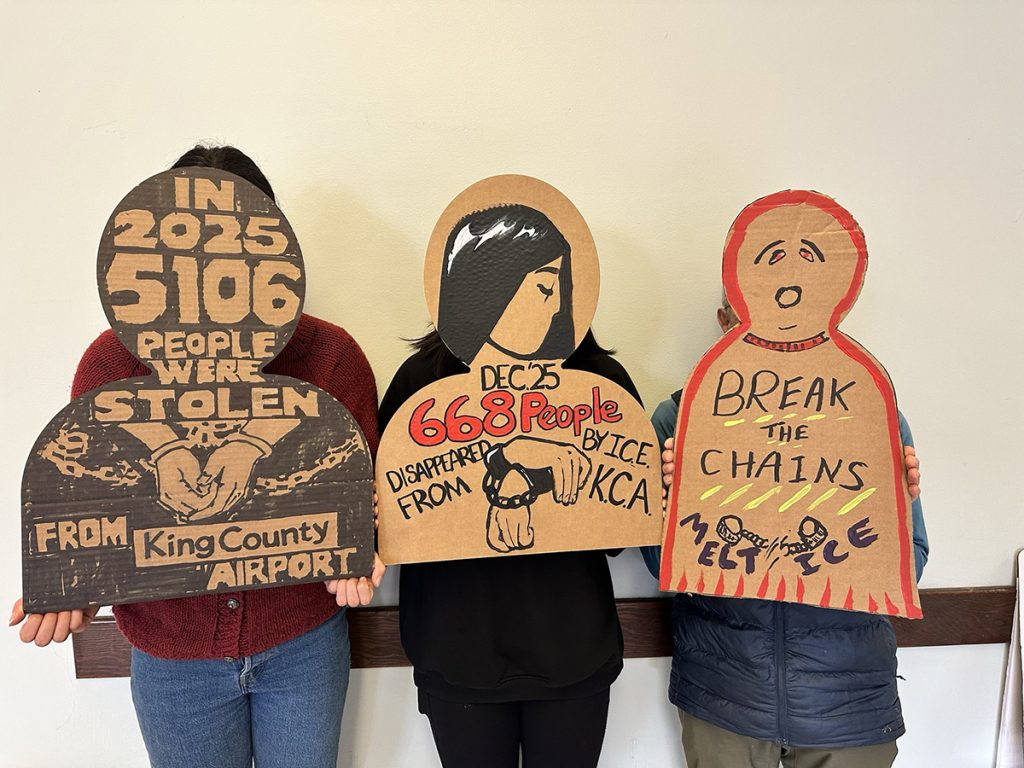
Art created by local artists depicting figures in wrist and ankle shackles. Each figure displays data gathered by La Resistencia and Tsuru for Solidarity volunteers. The Solidarity Day at NWDC also included taiko drumming, the altar built for victims of ICE and GEO, and a procession from one gate to the other. Photo courtesy of Tsuru for Solidarity and La Resistencia.
As part of its Day of Remembrance activities on Feb. 19, Tsuru for Solidarity partnered with La Resistencia to hold a press conference outside the airport, followed by an active protest later in the day against ongoing federal immigration enforcement, detention, and deportation at the Northwest Detention Center in Tacoma.
Day of Remembrance
The Day of Remembrance commemorates the day President Franklin D. Roosevelt signed Executive Order 9066, which ordered the incarceration of Japanese and Japanese Americans during WWII. The order saw more than 120,000 people imprisoned in camps across the United States. This year marks 84 years since Roosevelt signed the order.
Tsuru for Solidarity, which fights against detention and deportation, is made up of the descendents of those incarcerated during the war. Fellow immigrants rights group La Resistencia is led by undocumented immigrants and people of color who have experienced oppression at the hands of the U.S. immigration system.
“We honor our ancestors today by standing as a united front with our neighbors who are the targets of state violence now,” said Stan Shikuma, the national chair for Tsuru for Solidarity. “The violence in this moment—neighbors snatched out of their homes, peaceful protesters murdered by masked and armed agents, children locked in cages, family members disappeared—all exists within the same continuum of history that enabled the incarceration of our community eight decades ago.”
Kai, a member of Tsuru for Solidarity and a recent arrival to Seattle from Chicago, highlighted the parallels between what the U.S. government did to Japanese and Japanese Americans during the war, and what it is doing to swathes of undocumented immigrants now.
“Japanese Americans were forced into American concentration camps, where they were hidden away in hopes they would be forgotten. They were held in horrific conditions with their captors hiding terrible human rights violations. They were sometimes even deported,” Kai said. “Does this sound familiar? Instead of being taken away on trains, people today are taken away on airplanes. To be Japanese American and fight means something different for everyone. But a uniting motivator is the countless similarities between Japanese incarceration and current ICE detention and deportation today.”
Ongoing deportations
Despite a 2019 County executive order preventing the airport from participating in deportations—an order that came after La Resistencia-led efforts and public pressure on former County Executive Dow Constantine to prohibit these flights—the Ninth Circuit Court of Appeals struck down the order as unlawful in 2023. The airport has commenced deportation flights again.
Tsuru for Solidarity participates in La Resistencia’s Flight Watch program, which monitors these deportation flights coming into and departing from the airport. Program volunteers witness the conditions people whom Immigration and Customs Enforcement (ICE) agents capture and deport face. La Resistencia also receives information from people who have been detained and deported.
Margaret Sekijima, a member of Tsuru for Solidarity, described some of these conditions.
“Sometimes, ICE guards check people’s hair and inside their mouth. Then the shackles. … People have to hobble to the bottom of the stairs,” she said. “They cannot use their hands to hold the stair rails as they’re going up. The stairs are steep and easily wet and slick. They cannot catch themselves if they trip.”
After they are on the plane, she said, they are restrained for the duration of the flight. This means that, in the event of an emergency, “people cannot help themselves. They cannot put on their oxygen. They cannot save themselves. There are not enough keys and enough guards to unlock those locks so people can get out.”
Rufina Reyes, who leads La Resistencia, said that the number of flights has jumped from one a week in 2023 to three per week in 2025. Last year, she said, program monitors counted more than 5,000 people whom immigration agents deported from the King County airport.
“That’s over 5,000 lives that have been impacted by detention and deportation—5,000 community members that were displaced,” Reyes said. “We have faced many obstacles in our observations, and we will not stop and we will continue putting pressure on the King County International Airport until they live up to the promise of transparency and monitoring of these flights.”
She thanked the Japanese American community for using “such an important date such as today to not only honor the pain and trauma that was inflicted on the Japanese American community during World War incarceration but also draw attention to the unnecessary repetition of history that is happening today.”
Sekijima urged listeners to call their electeds—not only to tell them what happens on these flights, but also to urge them to work against these deportations. She highlighted the 5 Calls system, which streamlines the work constituents have to do to get legislators to listen.
She also emphasized that, even if an elected is of the same mind as a constituent, the constituent must call, and call multiple times. She said that she just sat in on a town hall with Rep. Pramila Jayapal, who explained to a constituent that the number of calls they get about a particular issue is collected as data to support a stance legislators can take on something, to best represent the public voice.
So, Sekijima said, “call your electeds and tell them when something terrible happens on one of these flights.”
“The injuries and even the deaths are going to be the responsibility of any official who looked away,” she continued. “We will not look away. We will take action. We will be the ancestors we want to be.”