


By Samantha Pak
NORTHWEST ASIAN WEEKLY
Although the term “South Asian” refers to eight countries, many people still often associate it with just India.
With its mission to bring together “a diversity of South Asian literary voices to surface and deepen conversations around key issues in South Asia and its diasporas,” literary nonprofit organization TRASAL is working to broaden people’s views and knowledge of the region which includes Bangladesh, Bhutan, India, the Maldives, Nepal, Pakistan, Sri Lanka, and Afghanistan.
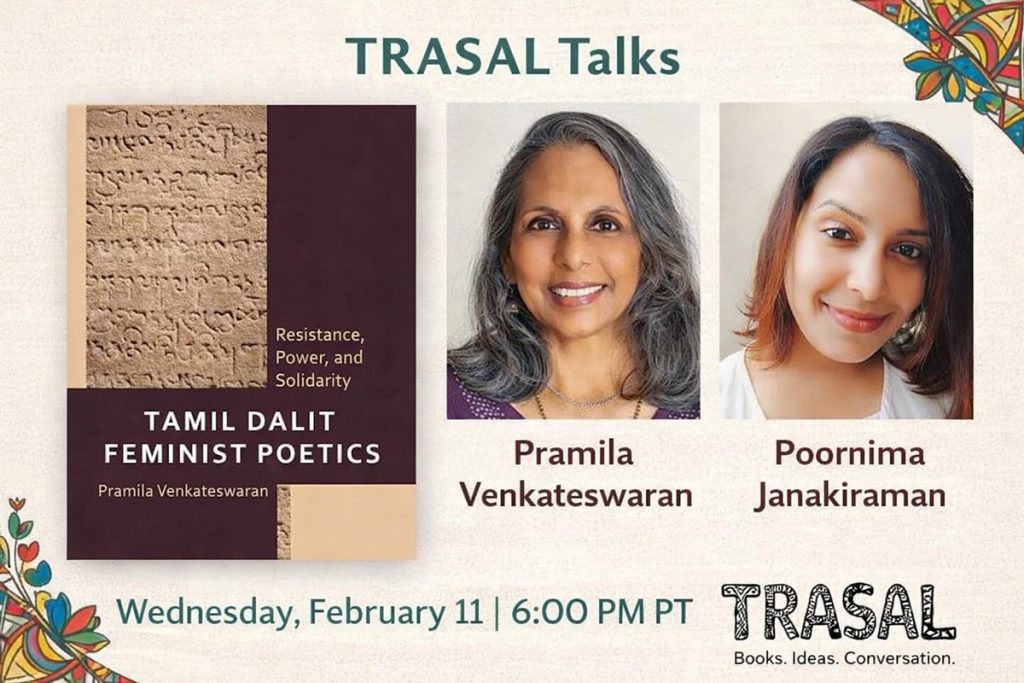
Its latest initiative, TRASAL Talks, is a continuation of this work as they expand their literary offerings in Seattle. The virtual book talk series—which will feature renowned and emerging writers in conversation on South Asian histories, politics, culture, identity, and diaspora—launches later this month, with the inaugural event set for 6 p.m. on Feb. 11. The first in a monthly series, the talk will spotlight award-winning poet and former Suffolk County poet laureate Pramila Venkateswaran, author of “Tamil Dalit Feminist Poetics,” in conversation with entrepreneur Poornima Janakiraman.
In addition to this month’s talk, both Venkateswaran and Janakiraman have been involved in TRASAL—which was founded in 2023—over the years. This includes being part of the organization’s literary collective.
“I’ve been part of TRASAL since its inception, and part of the board of directors,” Venkateswaran said. “So I’m very excited to take part in the book talks.”
Janakiraman added that she is honored to be part of the first book talk event for TRASAL.
Furthering their mission
TRASAL founder and executive director Alka Kurian said they are delighted to kick off the series with Venkateswaran’s book as it focuses on Dalits, who in the traditional Indian caste system, have been categorized as “untouchable.”
“So, we are very excited to kickstart this book talk by centering on this specific form of disenfranchisement and marginalization,” Kurian said. “And the reason why we are even more excited is because it looks at Dalit poetry through a feminist lens. And second, in the book Pramila has also translated poetry from Tamil into English. So this book, in so many ways, encapsulates not only our mission, the overall mission of our organization as a nonprofit, but also what it is that we want to achieve through multiple events that we have been doing.”
She added that there are very few organizations in the Seattle area, other than the South Asia Center at the University of Washington and the Roundglass India Center at Seattle University, that offer these kinds of conversations around books. Kurian said they are trying to detach themselves from these academic spaces and organize book talks that are accessible year-round. This is one of the reasons they are holding them online—so folks can attend no matter where they are. Kurian said she hopes TRASAL Talks become a permanent marker in people’s calendars. And technology dependent, they would also like to convert their book talks into a video cast so people can watch them on their own time. TRASAL will also be looking at books covering other South Asian countries, or within the diaspora, as well as a range of topics and genres.
In addition to the book talks, TRASAL holds regular book groups throughout King County at Elliott Bay Book Company in Seattle, Island Books in Mercer Island, and the Sammamish Library. TRASAL also posts book reviews on their website and produces the annual Jaipur Literature Festival in Seattle, which is an extension of the festival held in India. Kurian said they often partner with community-based organizations to make these things happen.
Digging deeper on lesser known topics
Venkateswaran said the book talks will dig deeper beyond a book review, so people can really understand and get to know more about the book, the author, and their intentions for approaching their particular topic. And as for her topic, Venkateswaran hopes readers will learn more about the Dalit experience, primarily in Tamil Nadu, because it’s something much of the rest of India—not just the English-speaking world—is still unaware of.
“I felt that there was such little knowledge about Tamil Nadu and the history of Tamil Nadu, and in a very, what you call activist and intellectual tradition, and also the very long Tamil tradition,” she said. “So I really wanted people to know about that and how Dalit poetics really fits in with this long tradition of Tamil writing, and also women’s writing.”
Janakiraman admitted that before reading Venkateswaran’s book, she wasn’t aware of what was happening with these groups in India because she had been looking at things from a place of privilege. But now, she has started thinking about how she can use her privilege to help other people. She said this is one of the reasons why these book talks are important—because of representation.
“Because no one can talk about us the way we can talk about ourselves,” she said. “I think having different authors speaking about their experiences from those regions, it’s very different than someone else speaking for us. I think that’s very important…This is something that we need to do to not just represent ourselves, but also empower folks who are from those regions as well, or who are part of that community as well. It could be LGBTQ like no one talks about it in India, but we need to talk about that.”