


By James Tabafunda
NORTHWEST ASIAN WEEKLY
Seven months after pledging to rebuild community trust, Seattle Police Department (SPD) Chief Shon Barnes unveiled plans to expand a neighborhood officer program to three specific areas, including 12th and Jackson.
He announced at the SPD’s 2025 Year in Review on Feb. 2 that the city experienced an 18% overall crime reduction in 2025, while exceeding recruitment goals and implementing the policing strategy he promised at his July 9 swearing-in.
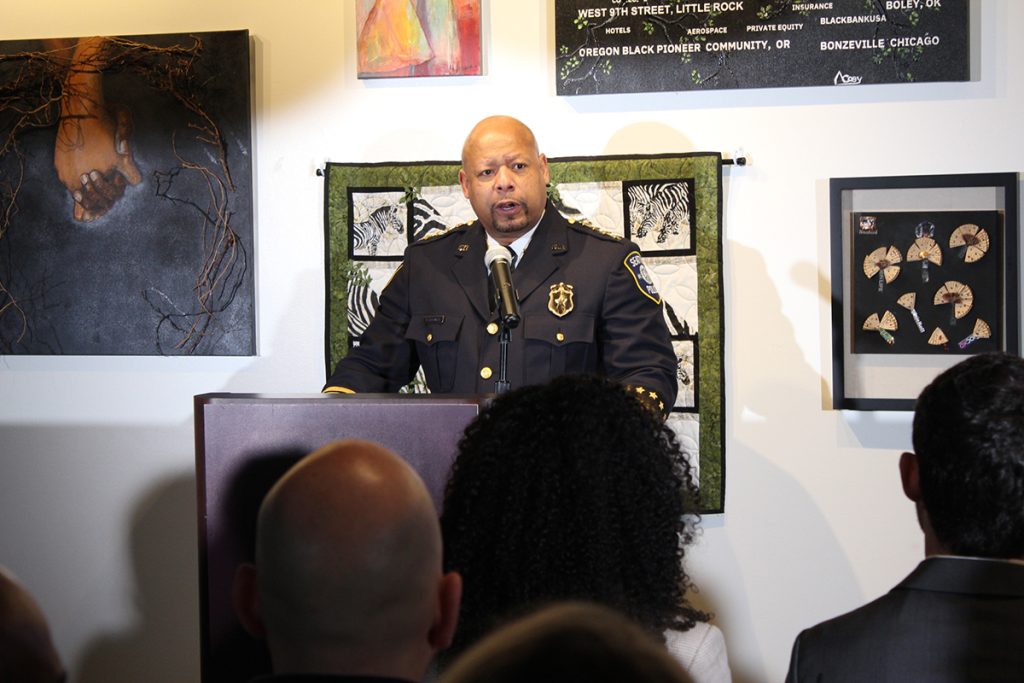
Seattle Police Chief Shon Barnes gives his first State of the City Address at the North West African American Museum on Feb. 2, 2026. (Photo by James Tabafunda)
Speaking at the Northwest African American Museum—the same venue where he was sworn in as the SPD’s 38th chief—Barnes told more than 60 community members, elected officials, and SPD leaders that homicides fell to their lowest level in more than five years and the homicide clearance rate improved from 57% to 86%, exceeding the national average of 61%.
The speech, delivered on the 66th anniversary of the Greensboro Four sit-in, allowed Barnes to demonstrate early success of his Seattle-Centric Policing Plan, the strategy he introduced following his swearing-in.
“This is the first lap in a long marathon toward public safety,” he said. “I stand before you encouraged not only by what we accomplished in 2025, but by the partnerships we strengthened and the new ones we will create in 2026.”
Barnes drew a connection between the 1960 civil rights protest and police reform, citing four Black North Carolina A&T State University freshmen—Ezell Blair Jr., David Richmond, Franklin McCain, and Joseph McNeil—who challenged segregation at a F.W. Woolworth lunch counter. Barnes earned his doctorate from the same institution.
“Progress is never accidental,” he said, noting the student protesters’ nonviolent action reflected “extraordinary people choosing extraordinary resolve.”
Crime statistics exceed early projections
Courtesy: Seattle Police Department
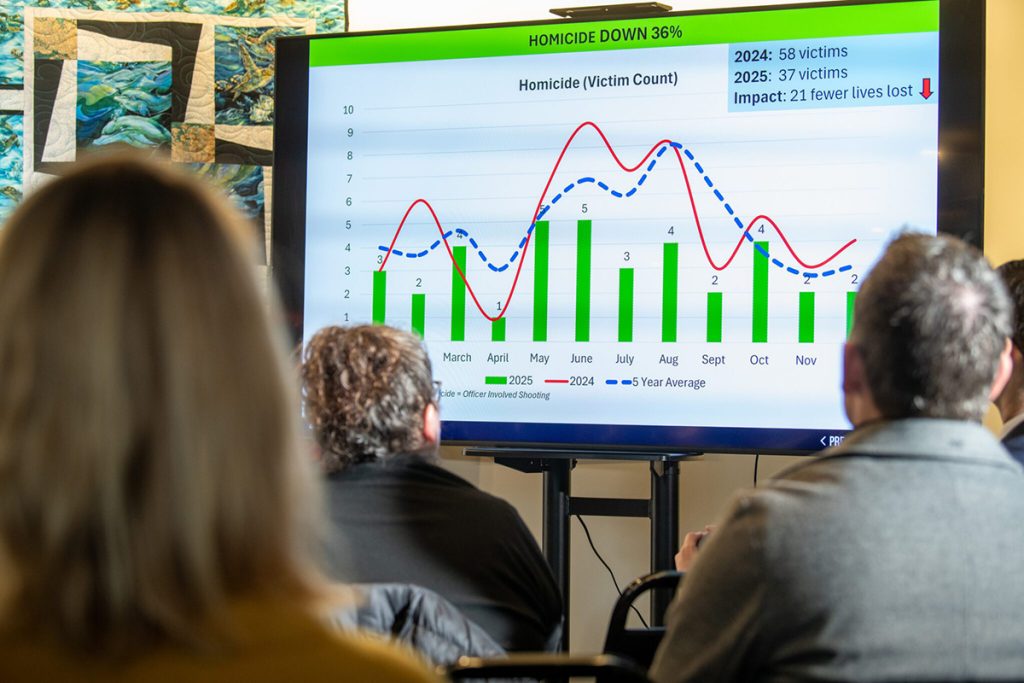
Seattle recorded 37 homicides in 2025, down 36% from 58 in 2024 and representing the lowest total since before the pandemic. The Real Time Crime Center assisted in 17 homicide investigations and contributed to 10 arrests.
Barnes said the department brought “some measure of closure to 32 of 37 families that were affected by homicide,” calling it “a dramatic improvement” over 2024.
The reductions exceeded trends he reported at his July 9 swearing-in, when then Mayor Bruce Harrell announced violent crime had declined 13% and property crime had fallen 9% during the first five months of 2025.
Gun violence decreased noticeably, with shooting victims falling 36% and reports of shots fired declining 12%. Officers recovered more than 1,500 firearms, a 74% increase over 2024.
“We cannot simply talk about homicides without talking about gun violence,” Barnes said. “Only eight of our homicides last year did not occur by firearms.”
He said that while more analysis is needed, he believes removing firearms from those who should not possess them is connected to the reductions. He noted 206 firearms were stolen from cars in 2025.
“While we respect the rights afforded by the Second Amendment, we also know that some individuals carry weapons illegally or with harmful intent,” Barnes said. “Every firearm recovered represents one less opportunity for someone to be affected by gun violence.”
Property crimes showed similar declines across multiple categories. Auto theft dropped 24%, with 1,821 fewer vehicles stolen. Burglaries fell 18%, affecting 1,571 fewer victims. Vehicle prowls decreased 7%, and aggravated assaults declined 8%, representing nearly 320 fewer incidents.
The auto theft reduction followed implementation of a threshold analysis system that triggers a response protocol (crime bulletin, special emphasis patrols, community education, and investigative action) when four vehicles are stolen within a quarter-mile radius over seven days.
Seattle-Centric Policing plan takes shape
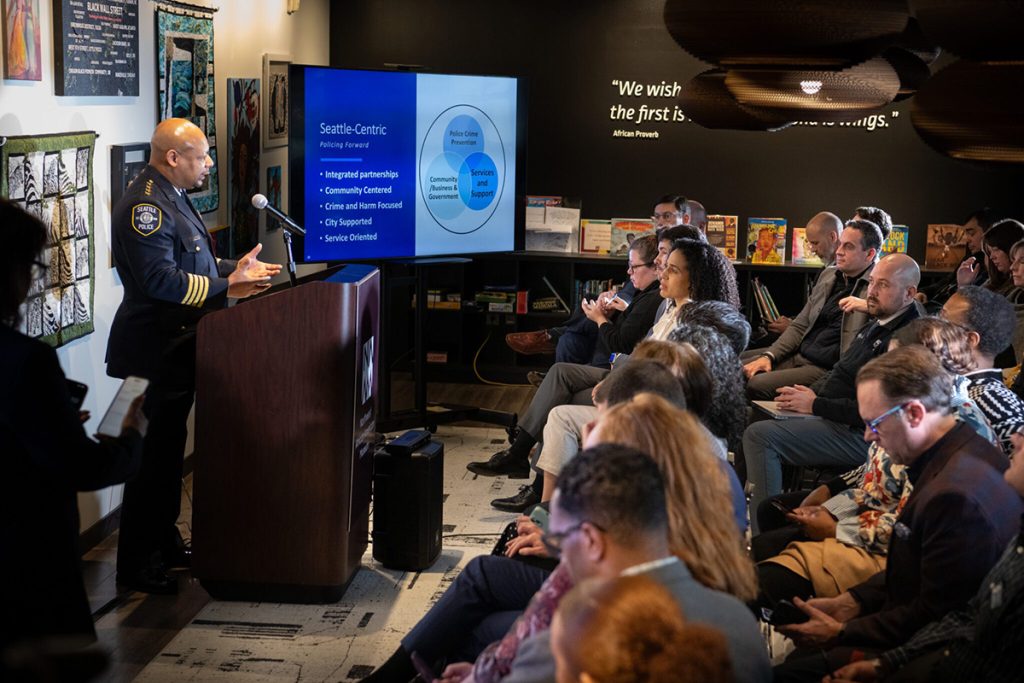
The crime reductions reflect implementation of his Seattle-Centric Policing strategy, which he announced at his first community forum at Rainier Beach Community Center on July 10.
The plan relies on data-driven mapping to identify priority areas in each precinct and coordinates police efforts with city departments, businesses, schools, and community organizations.
The approach applies the SARA problem-solving method—scanning, analysis, response, and assessment—across seven community problem categories. The department launched “Our City, Our Safety” meetings in each precinct with accountability reports.
“These are not just slogans. These are the expectations of myself and of the leaders that you see in the back of the room,” Barnes said.
He emphasized officer proactivity, defined as “being intentional about when and where you police—too little and crime is unchanged and too much, people feel oppressed or overpoliced.”
Barnes described an accountability structure requiring sergeants to answer to lieutenants, officers to sergeants, captains to assistant chiefs, and the chief to the community.
“In this department, everyone is accountable to our community, and that begins with me,” he said.
Neighborhood officer program expands to 12th and Jackson
Barnes announced the department will expand a pilot neighborhood officer program that achieved a 9% property crime reduction at Magnuson Park to three historically troubled areas in 2026.
“The neighborhood officer program that I spoke about will be expanded this year to include Third and Pine, Belltown, and 12th and Jackson, areas that have historically been challenges for us,” he said. “We want to get to your neighborhood eventually. But as we add in new officers, we have to fill our patrol efforts so we can answer those calls in a timely manner. But I’m also concerned about proactivity, especially in some of the areas that have historically been problems for us.”
The 90-day Magnuson Park pilot produced a 4% reduction in 911 calls and resulted in 64% of all arrests in that area, including recovery of one handgun and arrest of one homicide suspect. The program became a permanent North Precinct assignment.
Courtesy: Seattle Police Department
Barnes said the expansion addresses community requests to restore walking beats, a priority he identified while collecting input from community members during his first month as interim chief.
“That’s one of the things that I heard in some of those meetings. ‘Chief, I remember a time when you knew your neighborhood officers, people walked the beat. You had someone you could trust.’ And that is a big part of what we did last year.”
Recruitment exceeds swearing-in goals
The SPD hired 167 officers in 2025 with only 62 officers leaving the SPD, the lowest since 2016. The net increase of 94 officers exceeded any recent recruitment total and surpassed projections from his swearing-in.
“We hired more officers than any other time that we could find,” Barnes said.
At the July 9 ceremony, Harrell announced the department had hired 94 officers and projected hiring 150 by year’s end. The final total exceeded that goal.
Barnes pledged at his swearing-in to achieve “full staffing” by 2027. The department employed 1,123 sworn officers as of August.
The Seattle Police Officers Guild contract—approved two months ago—set starting salaries at $118,000, the highest in Washington state. The department reduced its hiring timeline from 5-9 months to 3-5 months.
More than 3,300 people applied for entry-level or lateral officer positions in the first three quarters of 2025, compared with 2,700 in 2024.
Response times remain challenge
Barnes acknowledged that response times improved modestly in 2025.
“I often hear about response times, so I want to speak about that briefly,” he said. “You simply cannot do more with less. Our officers are required to complete more paperwork than they have any other time in modern history that I can think of. They are expected to provide good customer service, not to rush their calls, while also remaining visible and proactive in our community. In 2025, we saw some improvements in response times, but it’s not good enough.”
Community partnerships central to strategy
The crime reduction strategy coordinates multiple city departments through initiatives including the Summer Park Safety Plan. Barnes emphasized continued support for the Law Enforcement Assisted Diversion program.
“We want to partner with other city departments in our collective effort to reduce crime,” he said. “We will continue to support programs like LEAD (Law Enforcement Assisted Diversion) and any other initiative that supports sustainable crime prevention.”
Barnes said the city’s population grew by more than 110,000 residents during the past decade, while violent and property crimes declined.
“Many of our cases are solved because someone stepped forward,” he said. “They pointed us in the right direction and provided information when no other leads existed. This level of trust signals that we are improving in the most important category of all: community trust.”
He closed his address by thanking SPD officers, detectives, and leaders. He also thanked City Council members, City Attorney Erika J. Evans, King County Prosecutor Leesa Manion, and Mayor Katie Wilson.
Wilson, who took office in January, announced in December 2025 she would retain Barnes. In a statement, Wilson wrote she would work with Barnes “to make SPD a place where professionalism, integrity, compassion, and community partnership are at the center.”
“I understand that the road to public safety is not straight,” Barnes said. “There’s going to be peaks and valleys. There’s going to be turns and things that you don’t see. But we are committed.”