


By Irfan Shariff
NORTHWEST ASIAN WEEKLY
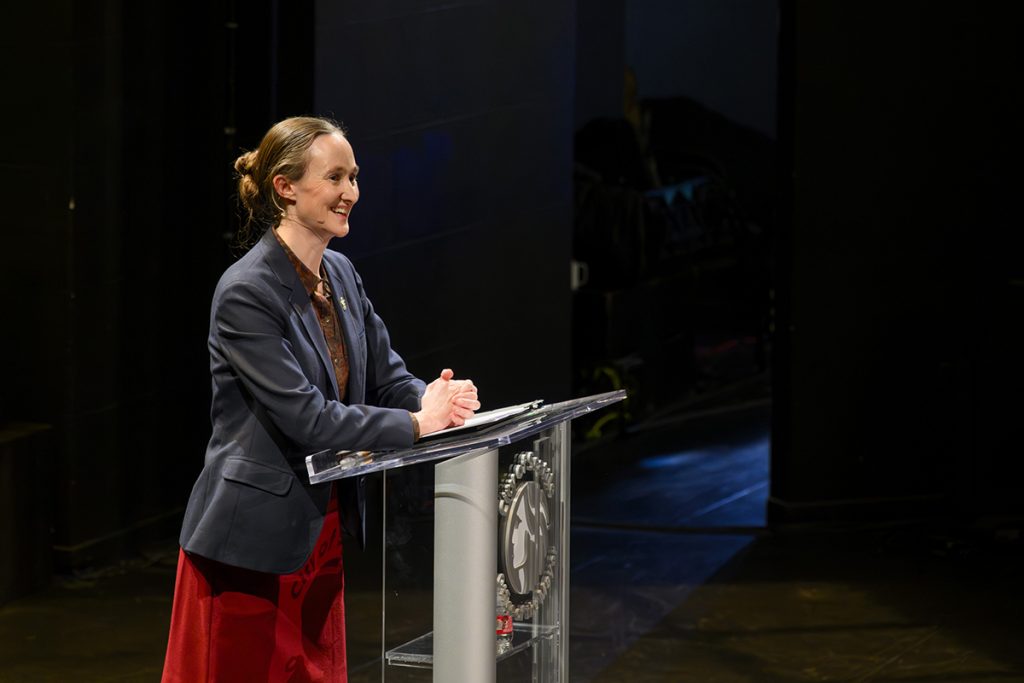
Mayor Katie Wilson gives her first State of the City address on Feb. 17, 2026. Photo courtesy of City of Seattle.
Mayor Katie Wilson delivered her first State of the City address to a crowd of approximately 300 leaders, press, and Seattleites on Feb. 17—Lunar New Year, “a time for renewal, for family, and to welcome the spring.”
Wilson reminded the crowd that whoever you are and wherever you’re from, “this is your city.” She spoke to four citywide issues: homelessness, public safety, affordability, and small business development.
Against the backdrop of the recent shootings in Rainier Valley, Chinatown-International District (CID), and Pioneer Square, she promised to reestablish the Seattle Police Department (SPD)’s late-night presence in the CID, which she said “was effective before it was discontinued last year.”
“We are also examining options for legal action against building owners who refuse to take responsibility for chronic nuisance properties with long histories of creating dangerous environments for neighboring residents and businesses,” she said. These are properties that are often scenes for drug, gang, or gun-related crimes. Last year, the City Council approved to expand SPD’s power to cite property owners and address these issues.
Earlier in February, Wilson initiated a sweep of an encampment in Ballard after extending the deadline to find appropriate housing for people experiencing homelessness. She believes that by doing this, the City was able to help people make the transition to housing without further displacement.
“I’m committed to minimizing harm to people living in encampments at the same time as I take seriously the City’s mandate to keep public spaces open and accessible for their intended use,” she said.
Last year, Wilson said, there were at least 4,000 unsheltered people counted in the city. She has committed to building 1,000 new units to help house them by the end of 2026.
Wilson recently attended the U.S. Conference of Mayors and met with other mayors whose cities faced a rise in federal immigration enforcement activities. “Seattle has not yet seen a surge of ICE activity here like we saw in Minneapolis,” she said, “but we’re doing everything we can to prepare.”
Work across City offices and affected communities resulted in the creation of a new web portal intended to communicate policies and resources to protect against immigration enforcement issues.
The mayor also raised concerns about the city’s increased use of CCTV surveillance systems “and how surveillance cameras could be abused to target vulnerable communities.”
Wilson, who is a renter, delved deep into the topic of affordability: “The economic squeeze has been going on for so long that it can be hard to believe we can do anything about it.”
Her affordability agenda will focus on housing, childcare, food, and creating a city where small businesses can thrive. She is actively listening to findings from the recent renter survey, which launched in 60 languages and closes on Feb. 20. Six-thousand renters have already responded. To combat growing food deserts and rising food prices, the City is considering a public grocery store.
Wilson recently spoke with leaders in the CID. She said that one woman described the issue of a business waiting two years for a permit. The long wait is costly for businesses and some end up never opening.
“When I hear them talk about their challenges,” Wilson said, “what I most often hear about are the same as the challenges all of us face: affordability, public safety, and homelessness.”
To revitalize neighborhoods, the mayor is setting her sights on reopening several community centers across the city where “you can connect across generations and cultures, without having to spend any money if you don’t want to.”
To view a recording of Mayor Wilson’s State of the City address, watch here.