


By Carolyn Bick
NORTHWEST ASIAN WEEKLY
Following weeks of immigration enforcement action in Minneapolis, Minnesota, that has included everything from immigration officers killing two U.S. citizens, detaining children, and entering homes without judge-signed warrants, Congressional Democrats refused to pass a spending package that includes full funding for the agency immediately responsible for it all: the Department of Homeland Security (DHS).
Though Congress reached an agreement on Feb. 3, ending the partial government shutdown the impasse had created, the package legislators agreed upon only funds DHS through Feb. 13.
In order to highlight both current events and federal actions, the National Council of Asian Pacific Americans (NCAPA) held a webinar on Feb. 4. Speakers discussed the overall political climate, and its effects on the AAPI community.
Immigration
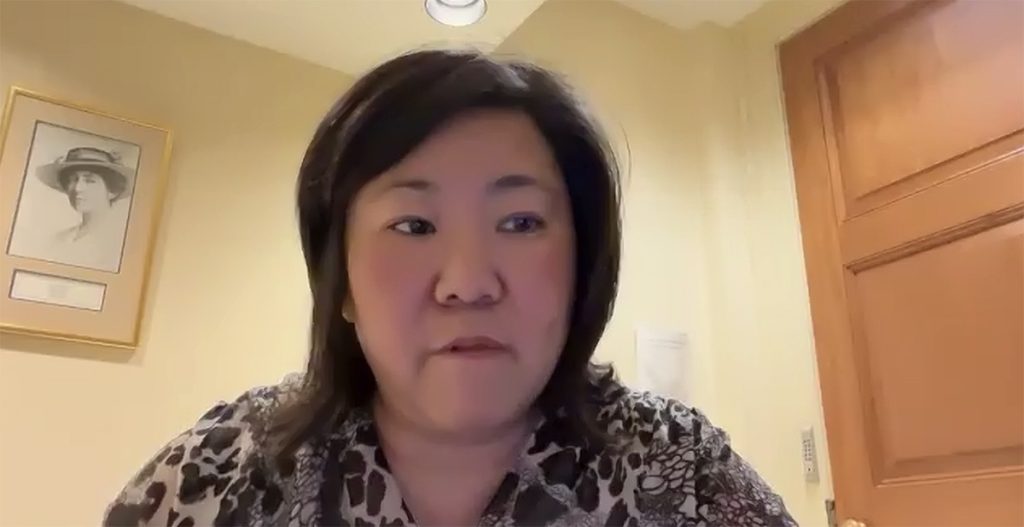
Rep. Grace Meng (D-NY)
“President Trump’s big, ugly law (One Big Beautiful Bill) from last summer essentially gave ICE (Immigration and Customs Enforcement) [$75 billion] to terrorize our communities. … That is seven times ICE’s annual budget,” said Rep. Grace Meng (D-NY). “We’re seeing exactly what this agency is doing with that slush fund every day in our cities. Masked thugs are barging into private homes without warrants and kidnapping people off the streets based solely on their accent or appearance. … We can’t allow these so-called federal agents to act with impunity.”
Meng said that neither ICE nor DHS nor Customs and Border Protection (CBP) has been communicative, and briefly spoke of a constituent of hers whom immigration agents had sent to a detention center, despite the fact that she is legally allowed to be in the U.S.
“She was literally plucked off the line because she wears a hijab and has dark skin … and eventually sent to [detention] in Louisiana,” Meng said. “We worked very hard with her family and we finally got her back home. … [ICE doesn’t] give us advance notice. They don’t give Republicans advance notice, either. Not that I know of. But if your groups and your members hear something, nothing’s too small. They should not hesitate to reach out to our office.”
She also noted that immigration agents are harassing Minnesotan Hmong and other Southeast Asian communities in their places of work, worship, supermarkets, schools, and even in parking lots.
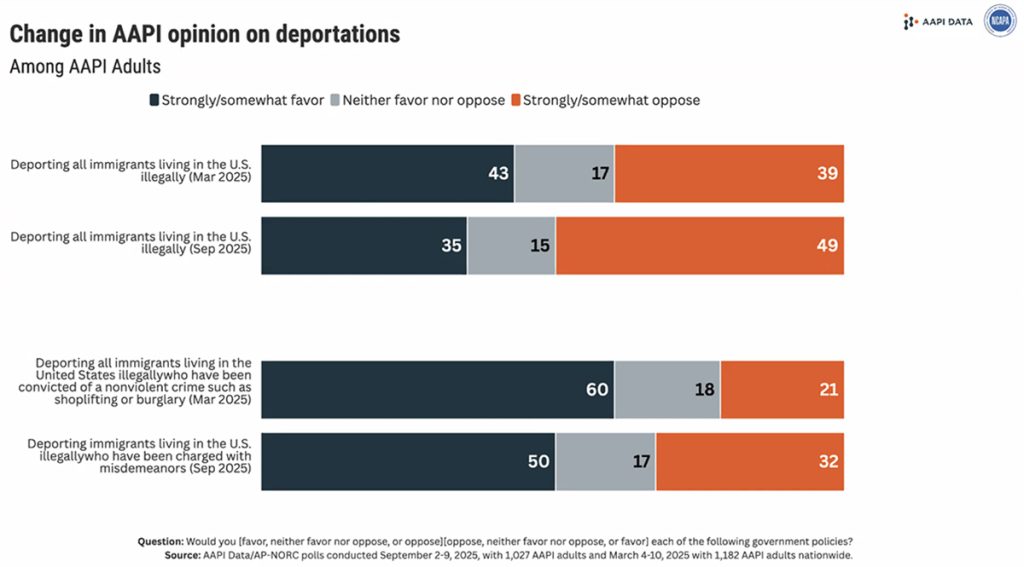
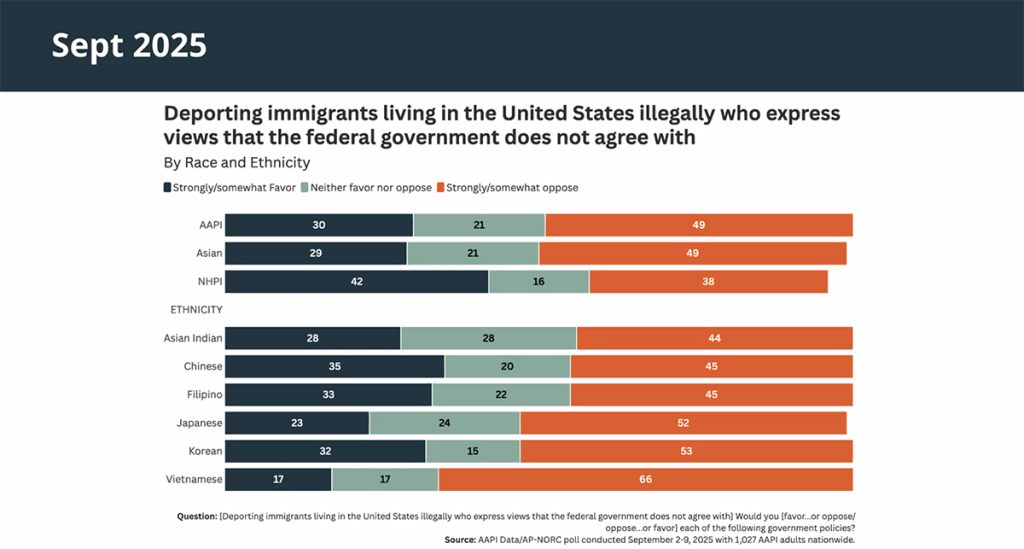
Karthick Ramakrishnan, a researcher at University of California (UC) Berkeley and the founder and executive director of AAPI Data, presented some of his organization’s findings concerning how opinions of President Donald Trump and the federal government as a whole have shifted.
Overall AANHPI sentiment about Trump and the federal government has largely become more negative, but there were distinctions in the broken-down data.
For instance, between March and September of last year, the AANHPI community’s opinions on deporting undocumented immigrants shifted more towards opposing the practice. However, when asked about deporting undocumented immigrants who express views the federal government doesn’t agree with, more Native Hawai’ian and Pacific Islanders (NHPI) favored that policy than opposed it.
Southeast Asia Resource Action Center’s national deputy director, Kham Moua, said that the Trump administration has deported the highest number of Southeast Asians than any other president in a fiscal year, and the highest number of Hmong than any other president. (Moua did not present data in his brief remarks, but data from U.C. Berkeley shows that the U.S. deports more Asians under Trump than under Biden.)
Moua said that immigration agents are going door-to-door and racially profiling people, and that there has been a significant uptick in detentions, followed by a swift removal to Texas. This presents a number of issues, including finding language-appropriate services and lawyers who can meet their specific needs.
“One of the major challenges for this community is that there’s such specific needs because about 80% of Southeast Asian Americans who are facing removal are facing removal because of some prior contact with the criminal legal system,” he explained. “They’re looking specifically for attorneys who have both knowledge in the immigration system, but also the criminal justice system and how those … intertwine. It’s been particularly difficult.”
Legislation and federal rhetoric
Association of Asian Pacific Community Health Organizations (AAPCHO)’s policy and advocacy director, Adam Carbullido, said that there are certain pieces of legislation to keep an eye on, because they will substantially impact immigrant communities. These pieces of legislation include making English the official language of the country, which removes language access requirements, and a so-called “public charge rule,” taking away citizenship eligibility protections for immigrants who would use public benefits, like Medicaid. Rep. Pramila Jayapal is co-sponsoring legislation to help combat the latter.
Sina Uipi also addressed the public charge rule, and talked about how “not neutral” federal rhetoric has harmed the Pacific Islander community. Uipi is Empowering Pacific Islander Communities’ national policy and advocacy director in D.C. Her family came to the country from Tonga and Samoa looking for economic independence.
“The framing public charge dehumanizes and demoralizes Fijians by labeling them as economic burdens and disregards the essential work and care they provide to the care economy in the U.S.,” Uipi said. “It denies their dignity and reinforces a moral hierarchy that marks them suspect and undeserving. It also negates the purpose, sacrifice, and opportunity of why they migrate here in the first place to gain access and become economically independent. … It also erases the contributions they make to the care economy and remains highly undervalued and rarely recognized as economic value.”
She pointed out that a large number of Fijians work as nursing and hospice providers and as in-home caregivers.
“To put things into perspective, they’re the last people to care for people before they pass away, and they do so with the utmost love, care, and respect,” she continued. “They pour in, too, the physical and emotional labor that comes with it. The ways in which they approach this work is important to recognize. You can’t put a price on that kind of humanity and dignity.”
She said that many Fijians send money back home to their families, and that the “public charge narrative erases this reality, too.”
“Those remittances address financial scarcity and come in second to tourism to help sustain the economy and support families,” she said. She also highlighted that “historical context always matters, and the U.S. has played a significant role as an imperial power that has structured the migration and marginalization of Fijians. During World War II, Fiji served as a refueling space for the U.S. military. Fijians and many Pacific Islanders have contributed to this and continue to do so as we remain to have the highest recruitment rate of service members enlisted in the military.”
Mannirmal Kaur, the Sikh Coalition’s senior federal policy manager, also highlighted additional federal actions that make the current situation dangerous for immigrants.
Kaur highlighted delays and federal efforts to shut down accountability offices within DHS. For example, she said, despite the coalition months ago filing civil liberties inquiries on behalf of people whom ICE has detained, the coalition just last week received a letter from DHS regarding their inquiry. “So about 10 months out just telling us that they wouldn’t be doing anything further on that matter.”
“It’s hard to overstate the egregiousness of the kinds of violations that are more likely to go uninvestigated when we don’t have these kinds of offices,” she continued. “And when they go uninvestigated, they’re more likely to happen again.”
Young Woo Han of the National Korean American Services & Education Consortium (NAKASEC) agreed that ICE funding has allowed immigration enforcement capacity to grow. He also pointed out that the federal government’s attempts to “dismantle the integrity and infrastructure” of the midterm elections are “well underway,” referring to the federal government’s possibly illegal seizure of ballots in Fulton County, Georgia—despite the fact that the Constitution enshrines states’ authority over elections, and the U.S. legislature has passed several laws on the basis of that enshrinement. (Trump continues to claim that he actually won the 2020 election. Fulton County has sued the Trump administration to retrieve the ballots.)
Han said that NAKASEC is trying to “inflict higher disruption costs on the system of oppression while minimizing concession costs for them,” and that the organization is part of efforts to organize around key dates, including the midterm elections, Labor Day, World Cup events, and May Day.
“These aren’t just moments of visibility,” he said. “They are opportunities to anchor long-term base building and narrative change. … It goes without saying that the midterm election will be also one of the more critical fights this year, not only in choosing a candidate that shares values and visions for the immigrant community, but also with the election integrity.”
Hidden impacts
Linda Phan, director of policy at the Asian Pacific Institute on Gender-Based Violence, said that the combination of immigration crackdowns and increasingly hostile federal rhetoric means the “destabilization and dismantling of public safety systems that victim advocates in communities alongside Congress has spent decades building to protect survivors,” including access to legal protections and immigration relief. She said that the current climate has had a chilling effect on reporting abuse and seeking help.
“Abusers are really using this moment to weaponize against immigrant survivors. Advocates are hearing abusers tell immigrant survivors, ‘If you call the police, I will call ICE,’” Phan said. “We have heard really heartbreaking stories of children who are being sexually abused, being told that their parents could be deported if they disclose. … Those threats really carry a significant amount of weight.
Survivors who currently live in abusive situations also often rely on their abusive partners for food and shelter, and the current climate is making it even more difficult for them to prepare to leave than it is under normal circumstances.
“Right now, many survivors in our communities are running through the risk scenario of reporting a crime. So if they’re thinking, ‘If I call law enforcement, will my partner be detained?’” Phan explained. “‘What will happen if we lose someone who’s bringing the income that the children are depending on?’ … It’s no surprise that survivors are choosing not to call because seeking help really feels dangerous at this moment.”
She also said that immigration agents are detaining and deporting those brave enough to seek help.
“You’ve already heard about [agents] picking up folks at immigration courts, but we’re also seeing ICE presence at domestic violence courts … [and] patrolling outside of DV shelters,” she said. “These are locations that have long been recognized as sensitive and protected. And honestly, when enforcement occurs in these spaces, it really does undermine the very protections Congress enacted to encourage reporting or cooperation and really seeking accountability for abusers.”