

By Samantha Pak
NORTHWEST ASIAN WEEKLY
When it comes to children’s books, Dow Phumiruk believes in representation.
And while organizations such as We Need Diverse Books have helped to create a more inclusive literary world, with more Asian American stories, there is still a gap in Southeast Asian representation—a gap the 57-year-old Thai American wants to fill.
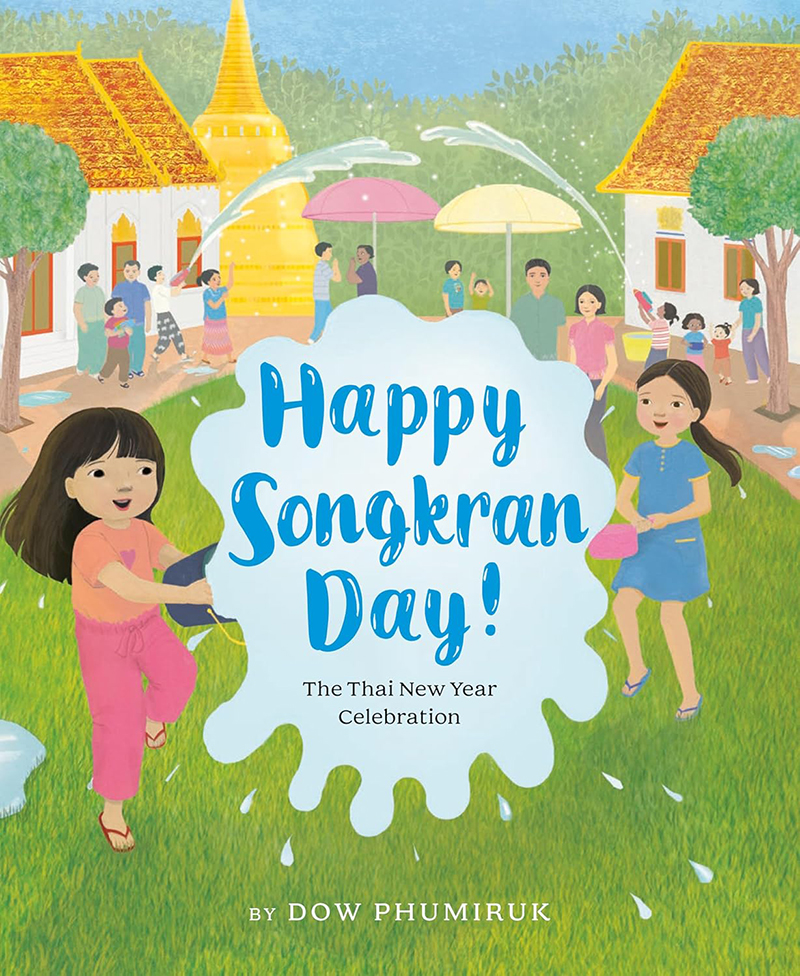
One way she is doing this is with her latest children’s book, “Happy Songkran Day.” The story follows a young girl named Tida as she and her family prepare to celebrate the Thai New Year, which starts April 13. Tida can’t contain her excitement, and her enthusiasm leads her to make a number of mistakes, including spilling satay sauce on the special sabai (shawl) her sister is supposed to wear to perform at the upcoming festival. Fortunately for Tida, the new year is a time of forgiveness and washing away the past, and with her family’s help, she learns how to slow down. The book, which Phumiruk wrote and illustrated, comes out Feb. 17.
“I think that’s probably the biggest holiday that I could think of for Thailand,” she said about choosing to highlight Thai New Year in her book. “And it’s such a fun one, with the whole giant water festival. So I felt like that one would be a fun first one to bring to our audience.”
The Bangkok-born and Denver-based author and illustrator added that she hopes “Happy Songkran Day” does well enough that she can do another book highlighting Thai holidays such as Loy Krathong, which honors the Goddess of Water and River and includes floating candles down a river.

Dow Phumiruk
Phumiruk—who went to school to become a doctor, focusing on pediatrics, and teaches medical students—has been illustrating professionally since 2015, after she got an agent. This second career path was inspired by her children. When her daughters were young, Phumiruk stayed home with them for about four years, an unusual choice for people in medicine, she acknowledged. While she was home, they explored arts and crafts quite a bit, which made her realize she really loved art, taking her daughters to the library, and that she wanted to pursue writing and illustrating children’s books professionally. Phumiruk said while juggling both careers can be tricky, she loves it very much.
Including “Happy Songkran Day,” she has published 20 books—some she has written, some she has illustrated, and some, like this latest one, where she has done both—and she is currently working on her 21st book. For the books (and one short story for a middle grade anthology highlighting Southeast Asia’s mythical creatures) she’s written, Phumiruk focuses on Thai culture, fables, and mythology.
“Because I’m from Thailand, I can bring these stories to our communities, our country. And again, kids need to see themselves in stories,” said Phumiruk, who moved to the United States at the age of 3. “We need representation for all children, and because we haven’t seen that very much for Southeast Asians, I think this is an opportunity for me to make this bigger, to grow this category of books.”
More than an opportunity, Phumiruk said this is almost her duty to bring these stories to children, recounting a school visit she once did, during which she met a young Thai boy who came up to her and couldn’t stop hugging and talking to her because of their shared Thai heritage.
“It just warms my heart for him to feel seen,” she said.
Phumiruk added that her favorite part about writing “Happy Songkran Day” has been bringing attention to Thai culture, and knowing that one day, kids all over the country—and even the world—will get to see themselves or learn about the Thai New Year celebration, because not many people know that there’s a New Year’s in April. And hopefully, she said, “kids will enjoy it and learn about other cultures like this.”
She also brought up a commonly used metaphor in children’s literature of windows, mirrors, and sliding glass doors, coined by Rudine Sims Bishop: The windows being looking at and learning about a culture or family that is not like your own; the mirrors mean seeing yourself reflected in stories; and the sliding glass doors are when you walk through and experience a culture yourself.
“Kids seeing themselves in books, kids seeing authors that are Southeast Asian, I think that’s so big for them,” Phumiruk said. “They can know that this is a path that they can choose, that their stories are just as important as everyone else’s. It’s worthy of being in a book. I feel like this really helps kids feel more comfortable in their own skin.”