


By Carolyn Bick
NORTHWEST ASIAN WEEKLY
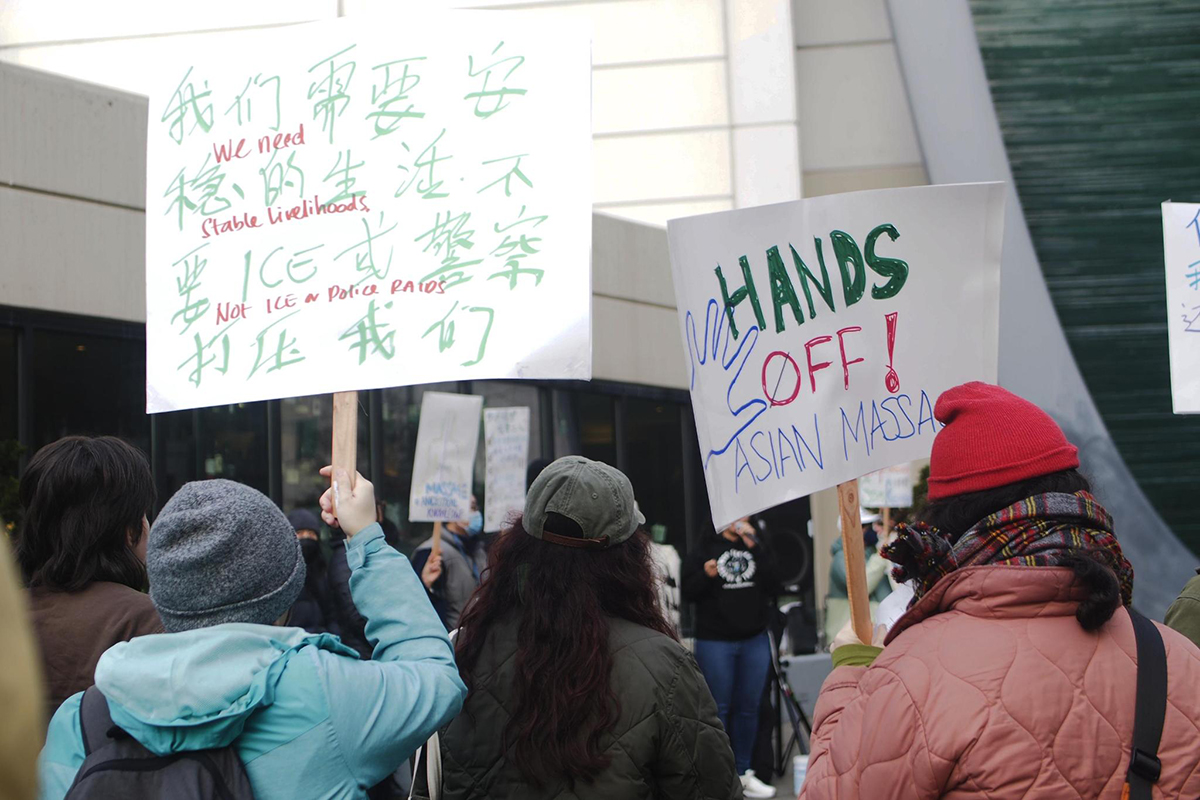
Protesters gather outside Hotel Murano in Tacoma during a protest of the state’s Human Trafficking Summit on Jan. 9. (Courtesy of MPOP)
Shouts of, “No raids, no rescue!” and “What do we want? Workers rights! When do we want them? Now!” filled the air just outside Hotel Murano in Tacoma, during a protest of the state’s Human Trafficking Summit on Jan. 9.
Massage Parlor Organizing Project (MPOP) organized the protest against the summit. MPOP is a grassroots organization of migrant Asian massage parlor workers that formed in 2018 and expanded in the wake of the 2021 Atlanta, Georgia massage parlor shooting. The shooting was an anti-Asian hate crime.
The summit included the Department of Homeland Security (DHS)—the department under which Immigration and Customs Enforcement (ICE) works—and shut out service providers, after initially both inviting them via flyer and noting that “victims services” would be included in the speaker lineup. The rejection letter claimed that the summit was only for law enforcement and “regulatory agencies.”

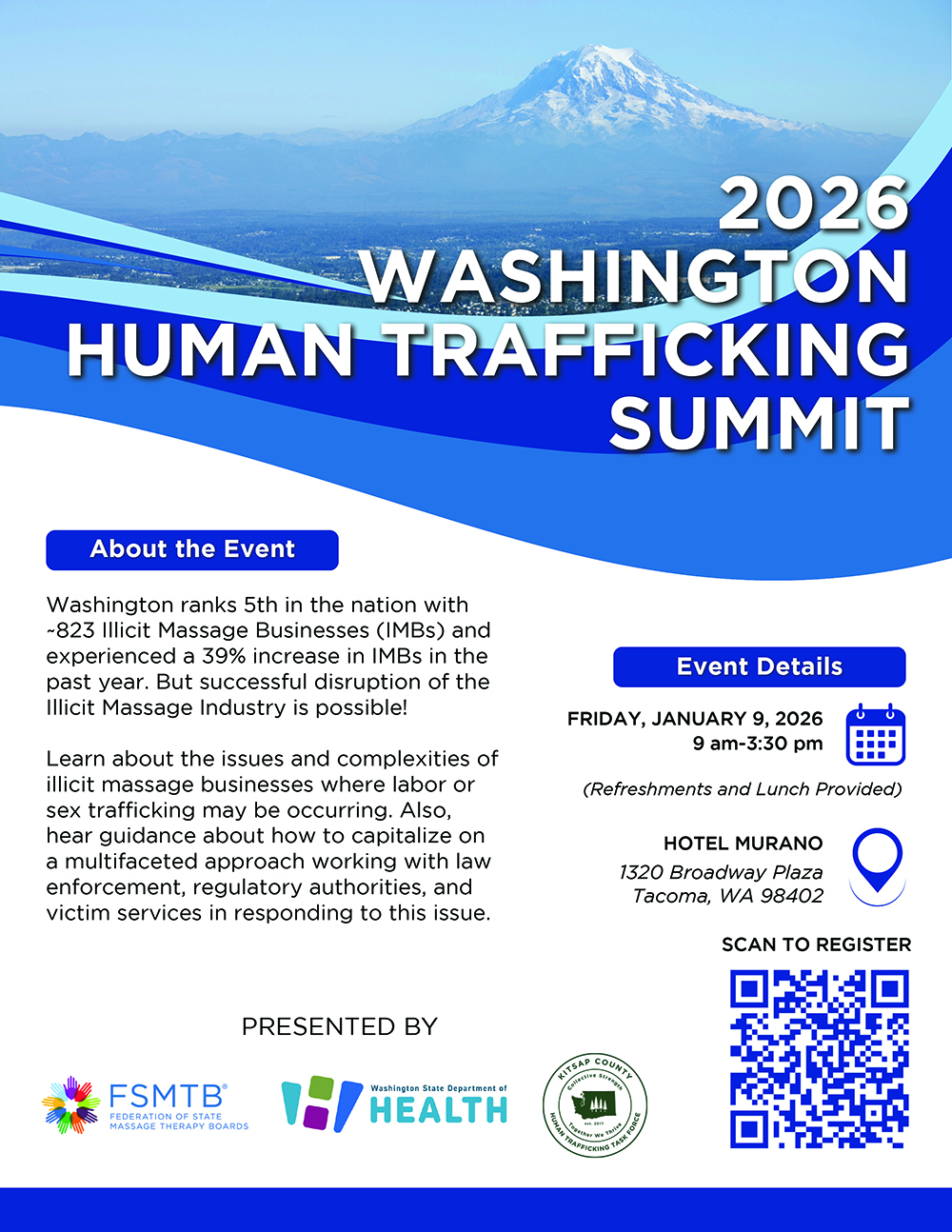 Private nonprofit organization Federation of State Massage Therapy Boards (FSMTB) and the Kitsap County Sheriff’s Office are listed as co-hosting the summit. Originally, the Washington State Department of Health (WADOH) was listed as a co-host of the event, but WADOH public information officer Roberto Bonaccorso told Northwest Asian Weekly that “we were never a sponsor of the event. Our logo was used without authorization, and we have requested that it be removed from all promotional materials.”
The FSMTB did not answer any of the Northwest Asian Weekly’s questions, including why it used the WADOH’s logo without permission. The organization instead sent a post-summit news release that also did not answer any questions.
Notably, however, this differed from what the rejection email claimed, as the news release stated that the summit included “state regulators, law enforcement, and professionals working to address illicit massage businesses and human trafficking … The value of interagency collaboration was highlighted along with representation from victim service providers and a trauma-informed approach.”
It is unclear whether the summit included input from survivors—though advocacy groups have raised concerns about continued ICE enforcement involving Asian massage parlor workers over the last year.
“Today, it is these immigrant Asian women who are the topic of conversation at the Washington State Human Trafficking Summit,” JM Wong, a co-founder of MPOP, said during the protest. “And today, these same immigrant Asian women—who care for their families, who work long hours, who are harassed by ICE and the police, who are survivors of sexual harassment and assault, and who are told they are ‘illicit’ because they cannot access the existing massage licensure exam—are not invited into this anti-trafficking summit that claims to rescue them.”
Wong said that law enforcement strategies that involve stings, raids, and further criminalization of Asian immigrant massage workers “can lead to devastating immigration consequences.”
“Other Washington state agencies, including the Department of Licensing and the Health Care Authority, have been discovered to leak sensitive immigration data to ICE, likely resulting in arrests and deportations of Washingtonians,” Wong continued. “Governor Bob Ferguson has reiterated in Executive Order 2509 that the state will protect the rights and interests of all Washingtonians, ensuring that every agency works together to defend immigrant rights.”
MPOP included several demands in the course of the protest, including that there be “a separate cultural body work designation that honors ancestral legacy and practice, not medicalized massage.”
Partnership with DHS
Former ICE agent, Doug Gilmer, is listed as one of the summit’s speakers. Gilmer testified to Congress last March in favor of expanding deportations and surveillance of immigrants. In his testimony to Congress, Gilmer targeted the “illicit massage industry,” and said that the illegal industry was “largely controlled by the Chinese.”
On the summit’s program, Gilmer’s title is “Resident Agent in Charge,” heading up Homeland Security investigations for the Department of Homeland Security’s Center for Countering Human Trafficking. Gilmer is listed online as having retired from the department in 2024.
The FSMTB has been partnering with Gilmer since at least 2022.
The FSMTB has campaigned against “illicit massage businesses,” but has not in published materials explicitly targeted Asian immigrants. However, on a podcast in which she promoted the nonprofit’s toolkit meant to help identify human trafficking in higher education, FSMTB Executive Director Debra Persinger said that “[f]or [FSMTB], the predominant population are immigrants from Asia … in particular, from China. … It’s their own people who are advertising.”
She said that Chinese immigrants will see advertisements from Chinese-run businesses in Chinese newspapers guaranteeing them a massage license, and that these immigrants are pulled into human trafficking schemes this way. She said that they don’t actually learn anything, they just memorize keywords.
“Like, if they see the word ‘ankle’ and then the word ‘medial malleolus,’ or something like that,” Persinger said, “That’s all they memorize. There’s no context to it at all. So it’s just this rote memory situation.”
The organization also supports the Polaris Project, which some have noted appear to actively and openly stigmatize and stereotype Asian-run businesses under the guise of anti-trafficking endeavors.
Legislative barriers, language barriers, and persistent stigma
The goal of the protest, MPOP’s press contact JingHeng Chen told the Northwest Asian Weekly, was to raise awareness that the FSMTB is a private, nonprofit entity, not a public one.
“They have ties with the DHS, and they have a lot of other ties with other anti-trafficking organizations that pretty explicitly target Asian-run businesses and stigmatize them,” Chen said. “We wanted to let [WADOH] know that this is dangerous, and it puts migrant Asian massage workers in harm’s way. They are the most scapegoated workers in the massage industry.”
Chen said that MPOP also wanted to highlight their demands to the WADOH, and call on them to work with MPOP. In 2024, Chen said, the group tried to get the WADOH to improve language access for the FSMTB exams. Chen said the department “stonewalled” them.
When asked whether MPOP had attempted to work with them regarding language access, Frank Ameduri, a public information officer with WADOH said that “the massage licensing exam is a national exam, and it is not administered by DOH. While we have advocated for additional language options, DOH cannot make changes to the exam.”
Ameduri said that “we asked the people administering the national test if additional languages could be added; my understanding is that wasn’t possible that time.”
“There are solutions going forward,” Chen said, “and those include addressing the economic stability that compounds vulnerability to trafficking, instead of using carceral anti-trafficking solutions like the police arresting and raiding people.”
Chen also pointed out that legislative actions and political rhetoric concerning Asian-run massage parlors have made it extremely difficult for immigrants to obtain massage licensing, because there is no language accommodation.
In 2012, the Washington State Senate passed a bill whose stated aim was to increase support for investigations into illegal trafficking at massage parlors.
Notably, however, before its passage, legislators removed from the bill accommodation language that would have given “an appropriate alternate form of examination for persons who cannot read or speak English to determine equivalent competency.”
In a written statement, MPOP noted that even though the language of the legislation didn’t specifically reference Asian-run massage parlors, “discussions surrounding the bill rhetorically associate these spaces with sites of illicit activity, identifying Asian massage parlors as the problem to be solved. During public hearings and senate testimonials, Asian foot spas and massage parlors are frequently provided as examples of these illicit businesses.”
For instance, MPOP wrote, Keisler said that “[i]t would be of concern to me if I was working in an area of a profession that was becoming tainted. It seems to me that’s what’s happening with reflexology—that it’s becoming linked with prostitution and human trafficking. And I don’t know that I’d want to be in that business until we clean it up.”
Reflexology is deeply rooted in Asian medical practices, particularly traditional Chinese medicine.
Keisler later said that “many of the individuals who are in this field come from a culture from the Asian countries, and may not be able to communicate fully with our current website or current materials.”
During his testimony on the matter, Jason Schmidt, who owns Bellevue Massage School, appears to attribute human trafficking to cultural differences.
“The main problem here is the fact that what’s caused this has been [the Great Recession], and the fact that there’s cultural differences in the Asian community,” Schmidt said. “They have different laws, and lack a lot of laws. They don’t understand the laws. And the communication—a lot of them don’t speak English.”
Years later, in a 2019 interview with The Seattle Times regarding Operation Emerald Triangle—a major illicit massage parlor bust involving parlors in the Chinatown-International District, Beacon Hill, and Sodo—Seattle Police Department Sgt. Tom Umporowicz said that “[t]his is Chinese organized crime, plain and simple.”
The article tied the Asian-run massage parlors to a “sophisticated criminal network that brings Chinese women into the U.S. through hubs in California and New York and funnels millions of dollars back to China.”
The article also noted that the 26 Chinese women police removed from the parlors were undocumented and spoke little to no English.
“When you’re undocumented and you’re vulnerable and you don’t know the culture, you’re easier to exploit. This is not news,” Umporowicz told the Times.
Summit protest
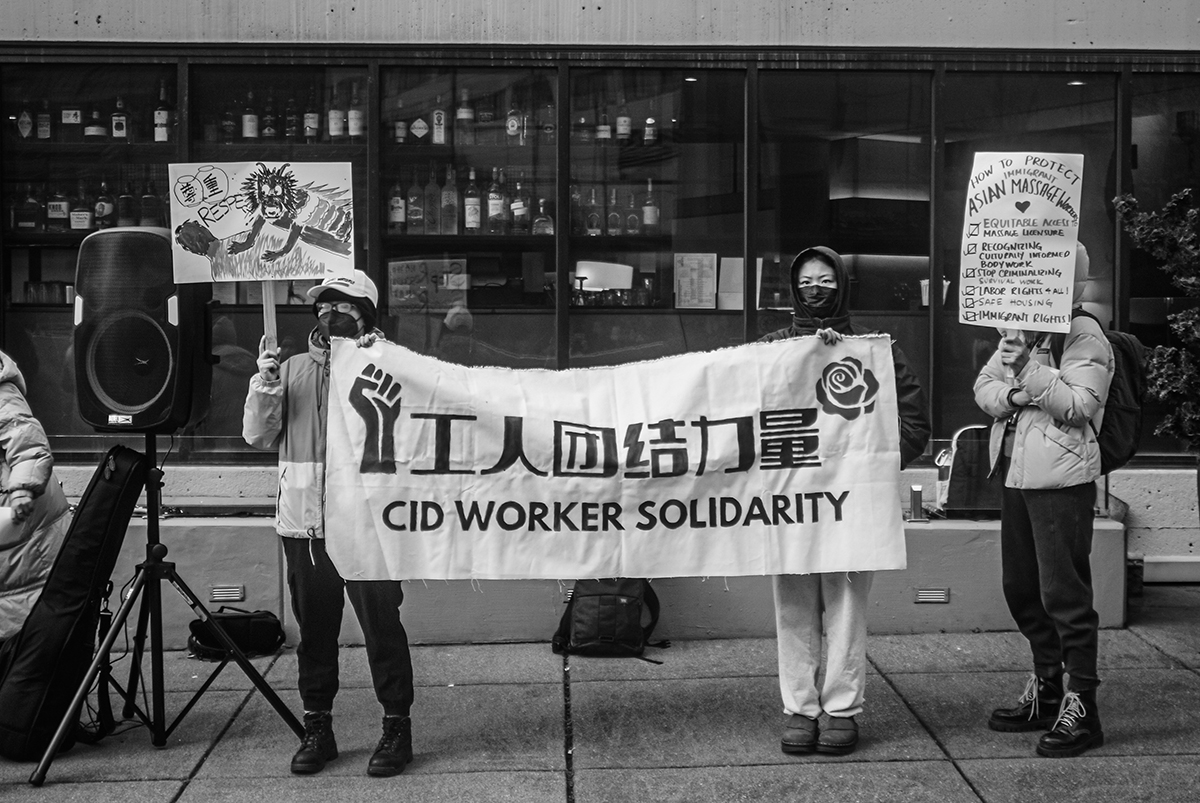
Protesters gather outside Hotel Murano in Tacoma during a protest of the state’s Human Trafficking Summit on Jan. 9. (Courtesy of MPOP)
The Jan. 9 protest included speakers from a variety of organizations, including immigrants’ and sex workers’ rights organizations, as well as licensed massage therapists (LMTs). MPOP also shared a list of demands, including equitable access to massage licensure, recognizing culturally informed bodywork, and decriminalization of survival work, as well as labor rights, safe and accessible housing, and access to immigration legal support.
Per the agenda, Dr. James Chaney, the WADOH’s executive director of health professions, was slated to open the summit.
“We asked, ‘Why is the Department of Health co-sponsoring and supporting a summit that promotes strategies developed with law enforcement, with people affiliated with ICE and DHS, or with agencies such as the Federation of State Massage Therapy Boards, which is known to collaborate closely with DHS?’” Wong said. “‘Why is the Department of Health cooperating so closely with individuals and agencies that are currently, or formerly, associated with ICE and DHS?’ This appears to be in direct contradiction to defending immigrant rights.”
Chen told the Northwest Asian Weekly that the WADOH never told MPOP that the use of the WADOH logo was unauthorized, and shared the brief email the agency sent to MPOP.
“I want to clarify that DOH is not sponsoring this event; this event is organized and sponsored by the Federation of State Massage Therapy Boards,” the email reads. “After reviewing the draft agenda and the speakers, I understand that DOH staff presenting at this summit creates the appearance that we endorse the content being presented and the decisions regarding who is permitted to attend. We did not have a hand in organizing this event and do not have authority over who is granted entry to the summit.”
The WADOH told the Northwest Asian Weekly that Chaney did not speak at the event, but that some staff attended, due to the content of the summit.
Speakers at the protest also shared several workers’ testimonies. Many workers who shared their experiences were Chinese, and several had limited English proficiency. They spoke against the idea that the lack of a license meant that a person was performing illegal sex work, or that they were being trafficked.
“The collaboration between the health department, police, and immigration authorities is a pretext to suppress Asian massage workers. Why are they cooperating? What are they thinking?” one worker wrote. “They’re thinking that by entering a parlor and checking everything, they can always arrest someone on some excuse. You don’t have a massage license? That’s illegal! Even if you have a green card, it’s useless. We’ll arrest you and deport you.”
Yet another massage therapist pointed to the deeply rooted tradition of massage in Chinese culture, and said that it was part of their upbringing. They argued for a license that recognized learned massage practices.
“From a young age, my mother taught me traditional Chinese medicine practices. I also enjoyed going to massage parlors and discussing techniques with the therapists. I was already very interested in massage, and since coming to the U.S., I’ve continuously learned while working in massage parlors, which is why I’m so skilled!” the therapist wrote. “My licensed boss and colleagues also discuss with me how to improve our techniques. But the licensing exam completely disregards my experience and recognition. If you truly want to help Asian migrant workers, give us a licensing system that recognizes our experience and skills!”
Two other workers spoke about how stricter enforcement and the fear of inspections have led to hardship.
“My boss is afraid to have me greet customers at the front desk, but my colleagues think we should take turns greeting customers,” one said. “We unlicensed workers earn less per hour than licensed workers. Their crackdown on massage parlors will only worsen the working conditions for Asian massage workers like us.”
Another said that “[j]oint enforcement will only make us more afraid,” and that “the more prohibitions, the more secretive the operations, the more exploitation, the fewer choices workers will have, and that’s when human trafficking will truly occur.”
“I want to tell the agencies in this conference: You are not protecting victims of human trafficking,” they continued. “You are contributing to human trafficking!”
Speakers also shared a statement from Corey Chin, an LMT representing a group of LMTs in Jefferson County who were opposed to the summit.
“The best way to support the safety of massage parlor workers from trafficking is to consult with them directly, without the involvement of law enforcement,” Chin wrote. “Massage parlors provide crucial work for Asian immigrants who have body work and massage training and for whom the massage licensure process is not accessible due to cost and language barriers. I am lucky to have had access to education and licensing and to be able to provide this service to my community, and I support massage workers without access to licensure in being able to do the same for their community.”