


By Carolyn Bick
NORTHWEST ASIAN WEEKLY
What happens in Venezuela doesn’t stay in Venezuela—particularly when actions by the United States raise new questions about the durability of long-standing international norms.
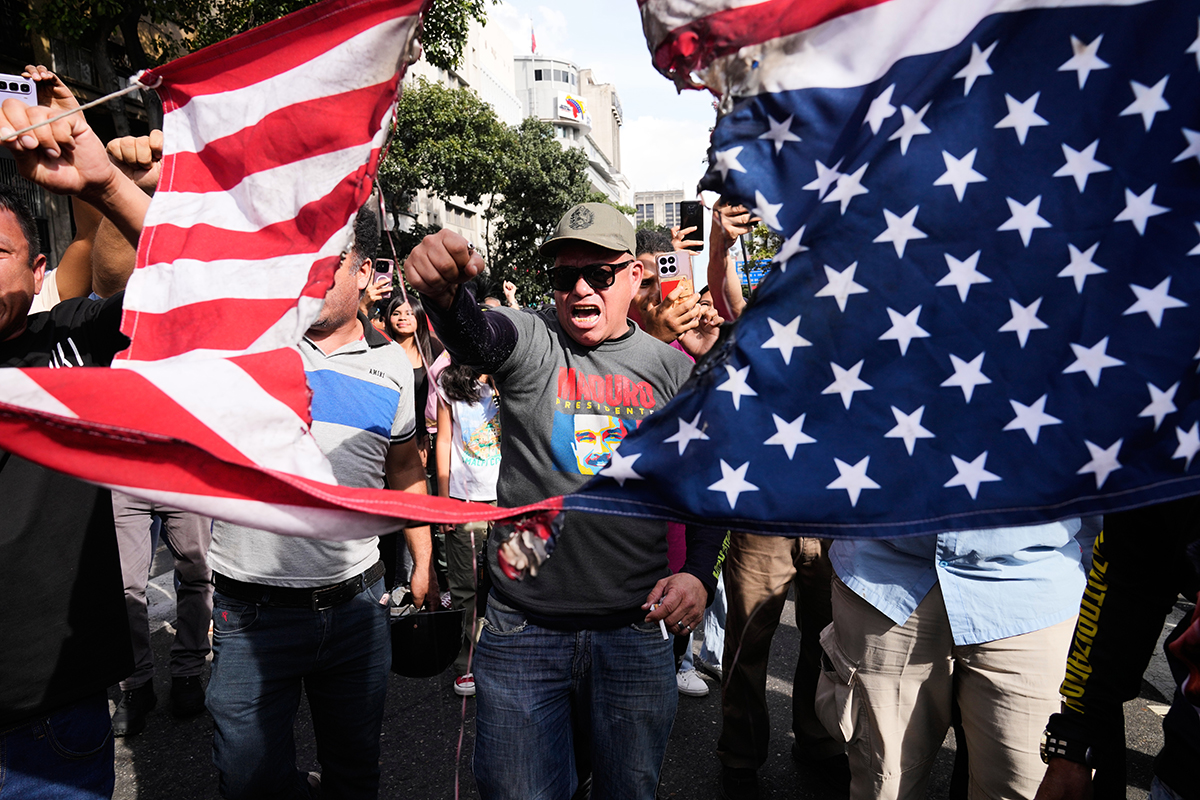
Government supporters rip an American flag in half during a protest in Caracas, Venezuela, Saturday, Jan. 3, 2026, after U.S. President Donald Trump announced that U.S. forces had captured President Nicolás Maduro and first lady Cilia Flores. (AP Photo/Ariana Cubillos)
It’s been a mere handful of days since the United States invaded Venezuela, capturing President Nicolás Maduro and his wife, Cilia Flores. The U.S. has charged Maduro with drug trafficking and narcoterrorism, and is in the process of trying them in U.S. court. Following the invasion, President Donald Trump said that the U.S. would “run” Venezuela, and Secretary of State Marco Rubio initially said that the United States has “taken over” the country.
The invasion has stirred speculation and concern regarding China’s relationship with Taiwan, and whether the U.S. invasion of Venezuela signals a green light for China to invade Taiwan.
As it turns out, it’s not quite so cut-and-dried, for a number of reasons.
Broken norms

James Lin
There is cause for concern. For one, Professor James Lin said, Trump’s actions have severely undermined norms-based international order. Lin is a Taiwan historian, and serves as associate professor in University of Washington (UW)’s Jackson School of International Studies.
“The biggest thing that I’ve seen is that the United States has historically upheld this idea of a U.S.-based international order, and the Trump administration has now declared that they do not respect the rules,” Lin explained. “In this kind of context, if the United States, which is pointing to China and saying that more aggression towards Taiwan and the South China Seas and other areas of the world is a violation of this U.S.-based international order—well, now, that’s what the Trump administration is doing.”
“It’s really hard to, on the one hand, accuse China of violating these norms, and on the other hand, violate these laws without any regard for them on your own,” he continued. “So I do think that this has a negative effect on what Taiwan is hoping to have, which is some protection from this norms-based international order.”
While this doesn’t necessarily signal to Lin that Taiwan has anything to fear in the immediate, he said it doesn’t mean that Trump’s decision to invade Venezuela won’t have repercussions for Taiwan down the line.
James Dongjin Kim
Professor James Dongjin Kim, an assistant professor in the UW’s Department of Political Science, agreed, saying that though the U.S. invasion of Venezuela may have indeed “created a permissive signal for Beijing … [and increased] China’s confidence that any aggressive action against Taiwan can be politically justified as citing the U.S. actions against Venezuela,” if he had to pick a side, he believed that China would be unlikely to learn enough from the invasion to act against Taiwan.
“That is based on my understanding of how political science theory tells us about how and when leaders learn from foreign events—and of course, whether the leaders learn from foreign events or not is depending on how much they perceive the two contexts are similar,” Kim explained.
The China-Taiwan context is different from the U.S.-Venezuela context, for a number of reasons, he continued. The biggest, he said, is the regime legitimacy comparison.
Even though Trump has repeatedly and directly mentioned oil companies and Venezuela’s oil reserves as reasons behind the invasion, Kim said, “I think almost everyone agrees that Maduro is also a bad leader, and—at least, on the surface—he was charged with drug trafficking, and narcoterrorism, and destructive weapons.”
“I think this is kind of useful for gaining some support from the domestic audiences,” Kim continued. “But I’m not sure whether China’s leaders are thinking in the same way that they can do this stuff to the Taiwan regime. So I think they will remain negative about whether they can do the same thing to the Taiwan regime.”

David Bachman
Professor David Bachman, who chairs the UW’s China Studies program, doesn’t believe the U.S.’s actions give China “carte blanche” to invade Taiwan. But this doesn’t mean that Trump’s words haven’t suggested to China something about their presumed sphere of influence in East Asia—and, because of the ambiguous nature of Trump’s words, it’s unclear.
“If we take President Trump at what his word seems to be about the United States having a sphere of influence in the Americas, then that would seem to leave the door open for China to have a sphere of influence in East Asia and maybe Southeast Asia and maybe all of Asia,” Bachman explained. “That would depend on how China interprets it and what China does. So, in that sense, it’s implying that the U.S. is going to do what it wants to do in the Americas, and maybe the reciprocal is that this means that the U.S. will not intervene as China does what it wants to do in Asia. That’s speculation. We don’t know whether that’s President Trump’s meaning or not. There are things we could point to in his speeches that seem to imply that, but nothing definitive.”
Technological defense
Bachman also pointed out that the U.S. has a significant economic interest in preventing an invasion.
Taiwan, he said, is the home of Taiwan Semiconductor Manufacturing Company, which manufactures some of the most advanced semiconductors in the world. This makes Taiwan a vital resource for the global semiconductor industry.
“So, were the United States to concede that Taiwan was part of China, and presumably allow China to gain control over Taiwan, this would have quite negative effects on the computer industry, on AI in the United States, and many other things,” Bachman said. “President Trump has implied things about China’s sphere of influence—but is Taiwan really going to be allowed to be returned to the People’s Republic of China (PRC), or turned over to the PRC? From a U.S. economic and strategic perspective, it makes an awful lot of sense that the United States not go along with that.”
That said, he cautioned, a recent study suggests it is becoming harder for the U.S. to defend Taiwan. While it is still “very expensive for China in terms of blood and treasure to take Taiwan … it’s going to become easier and easier for the PRC as well.”
Overstretched military
Kim also pointed out that the U.S. is actively talking about other geopolitical maneuvers, such as in Cuba, Colombia, and the autonomous territory of Greenland. (Trump has been talking about somehow taking over or buying Greenland from Denmark since last year, speciously claiming the island is “surrounded” by Chinese and Russian ships.)
Kim said that Trump has pursued more aggressive foreign policies, surprising many who expected a more isolationist approach, particularly given his past rhetoric (Trump previously critiqued U.S. military action in Iraq). He thinks that the U.S. is shaping up to pursue more militaristic engagements in other countries, ultimately spreading the U.S. military thin and distracting from East Asia. This could mean that, if China did decide to invade Taiwan, the United States would not have the military personnel to help defend the island.
“I think that might actually have more effects on China’s leaders’ perceptions about whether their calculus about Taiwan will be different in the future,” Kim said. “I think what is more important is how much the U.S. will be committed to Taiwan compared to other regions of the world, like Europe, Greenland, Cuba, South America, or the Middle East. And I think [the invasion of Venezuela] has a possibility that the United States will relatively underplay the importance of East Asia. And I think that might be the pathway that Chinese leaders want to see, which might increase their invasion calculus.”
Bachman took a slightly different view. Bachman noted that he is not an expert on U.S. military forces, but said that the U.S. has been “building its force presence” in East Asian countries, and that the kinds of military forces required to invade other countries Trump has floated may not be the same as those needed to defend Taiwan.
“I don’t think it fully rules out the U.S. coming to Taiwan’s defense,” Bachman said. “And certainly, I think that the Japanese Prime Minister’s saying that it’s a vital concern to Japan’s security, provides more support [for Taiwan] than the U.S. might have been expecting. … But again, what will recruitment to the U.S. military look like for the remainder of the Trump administration, depending on these kinds of activities? We don’t know that. We don’t know what retention there’ll be, whether people want to get out. So, an awful lot of unknowns here about the future of the U.S. military and its capabilities.”
However, he noted, “President Trump has suggested he doesn’t want to see U.S. troops killed defending Taiwan, or in fact, U.S. troops killed almost anywhere. So this is an overt turn in some ways to a kind of strategic ambiguity about the U.S. stance.”
Justified action
Additionally, Bachman said, now that the United States has invaded Venezuela on the fundamental principle that Maduro is a criminal and needs to be brought to justice, China could justify similar actions towards Taiwanese officials.
“China has been explicit about seeing people who are advocating Taiwan independence as traitors, and that they will be subject to Chinese domestic law,” Bachman said. “The seizure of President Maduro by the U.S. would be a direct precedent for China, perhaps launching special forces to capture Taiwan political figures, particularly those associated with the Taiwan People’s Party (TPP), who may have been more outspoken about Taiwan independence and so on. I can be willing to bet significantly that they stepped up security around President Lai Ching-te in Taiwan.”
Undermining sovereignty
The legality of Trump’s actions in Venezuela are also up for debate. But, as Lin pointed out, this gets into areas of academic debate. At the end of the day, there is no international court that can impose justice of its own accord without involving sovereign nations’ cooperation. The closest the world has to an international court is the Hague, located in the Netherlands. The Hague is the only court that can decide on matters of international legality—but this is provided sovereign nations agree to come to the table.
“A lot of international law works this way, where, technically, nations … sign on to agreements, like in the Paris Climate Accord,” Lin explained. “But really, if a nation … signs on to an international accord, and it doesn’t adhere to it, there’s not really a power that can enforce that. … It’s kind of like self-enforcement.”
In the case of the U.S.’s invasion of Venezuela, “there very well might be a violation on paper … of some sort of legal sovereignty,” which Lin predicts will play out in the U.S. courts. Lin believes Maduro’s lawyers will argue that the U.S. does not have sovereignty to prosecute him.
For China, this translates into domestic versus international affairs.
“China’s always said that Taiwan … is domestic territory, and thus, international law has no bearing,” Lin explained. “Of course, the United States rejects that, in the sense that Taiwan is internationally issued—it’s not domestic territory, in the sense that only the Chinese can decide what happens to Taiwan. So those are arguments that are based on disagreements over [Taiwan’s] sovereignty.”
But now that the U.S. is attempting to justify an invasion of an international, sovereign nation on legal grounds, even the U.S.’s continued support of Taiwan’s own sovereign independence may mean very little.
“Regardless of what position you have on whether this is international law or domestic law, I think it’s still not good for the norms of international legal frameworks,” Lin said. “Regardless of whether you believe it’s legal or not, the United States is still deciding to take its own action, and that’s not a good precedent to set.”
Further ramifications
Kim said that China may not be the only country closely watching how the U.S.’s invasion of Venezuela unfolds. North Korea may be, too.
“This is something that North Korean leaders are most afraid of: military actions … bringing the top leader of the country outside the country and taking [him] to the court,” Kim said, adding that North Korean leaders have been worrying about this for “decades.”
“They’ve [condemned U.S. action in] Libya when [the U.S.] attacked Gaddafi and also Saddam Hussein in Iraq,” he continued. “They also had an official statement condemning the U.S. actions in Venezuela.”
However, Kim pointed out, Trump’s stance on North Korea has been “very different” than his stance on Venezuela. Though the relationship may have collapsed in 2019, following a disastrous second summit between Kim Jong Un and Trump, the two leaders have in the past been friendly towards one another, despite leader Kim Jong Un’s use of torture, unjust imprisonment, and forced labor of the North Korean people, all of which represent egregious human rights violations.
“Similarly to what I said about China, I don’t think Kim Jong Un will learn that much about Venezuela. I think he’s certainly worried—he doesn’t want to be removed by the United States,” Kim said. “But I think this might open up the possibility that Kim Jong Un is more willing to sit on a negotiation table with Donald Trump and have a better relationship and have a diplomatic breakthrough to avoid this kind of worst-case scenario for himself. … I think we’re more likely to see that happen in 2026.”