


By Carolyn Bick
NORTHWEST ASIAN WEEKLY
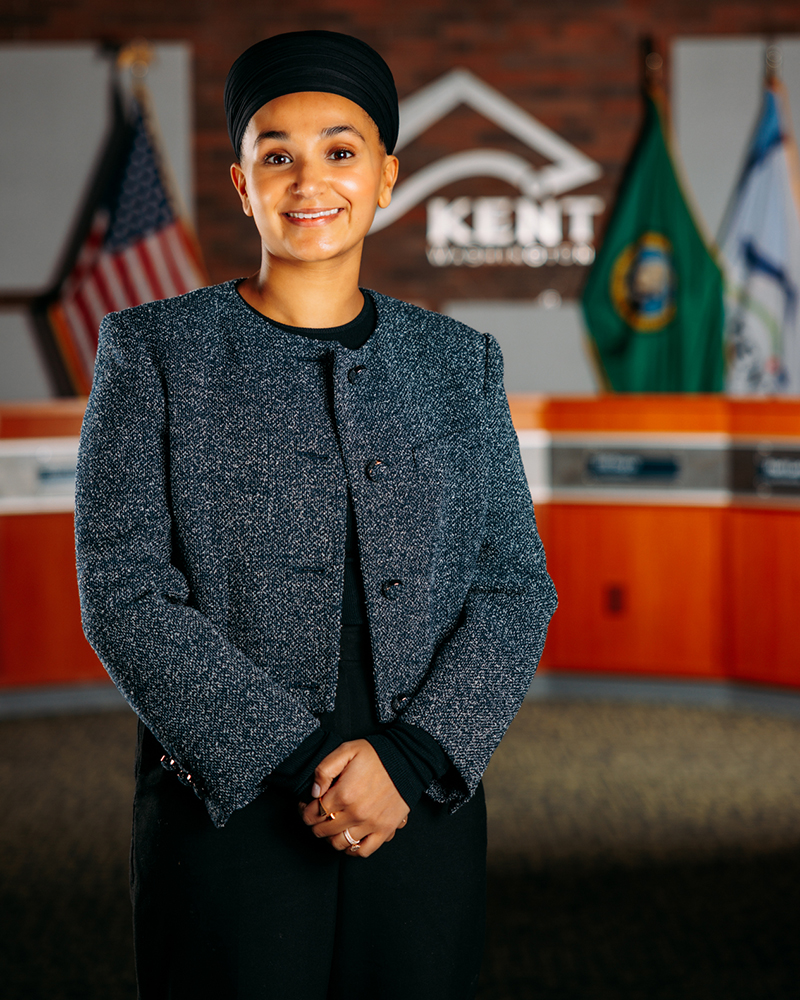
Courtesy of Sharn Shoker
Following a tough race she won by little more than 200 votes, Sharn Shoker was sworn in on Jan. 6 to represent Position Six on the Kent City Council. She faced off against Andy Song in November 2025’s general election for the seat.
The Punjabi American councilmember is a lifelong Kent resident, having moved here from California with her parents when she was 6 months old. Since then, she has attended Kent schools and served in a variety of roles, including leadership positions at the Asian Counseling and Referral Service and the Mockingbird Society.
In her first interview since being elected, Shoker told the Northwest Asian Weekly that she plans to focus on uplifting BIPOC small business owners, and hopes her election helps when it comes to visible South Asian representation in politics.
This interview has been lightly edited for length and clarity.
Northwest Asian Weekly
You’ve talked a bit about this during the election season, but I also want to ask you directly to tell me, please, about your background. I know you grew up here, but what was your childhood like and did that shape where you are today?
Sharn Shoker
I grew up in Kent. I moved here when I was 6 months old from Stockton, California, where I was born. My parents moved up to Washington state, because there was a bigger Punjabi community that they wanted to be a part of and make sure that we had folks around that we could resonate with growing up. I’ve lived here ever since.
I went to all of the Kent schools. I started off at Emerald Park (Elementary School), Meeker Middle School, and then I graduated from Kentridge High School. There was about a year where my parents moved to Covington, so I moved with them when I was 24 years old.
I got married the following year. My husband lives in Kent, so I moved right back to Kent, so it’s definitely home. My husband and I are raising our son here. My husband has a family business here as well, so it’s just a place that we’re deeply rooted, and we have a lot of friends and family here. It’s just one of those places that is truly home for my family and I.
NWAW
Was there something or someone that made you think, “I think I want to run for public office”?
Shoker
It wasn’t a specific person. It was more of the idea of being a leader and making a difference in your community—something that I saw people around me doing all the time.
There are so many people in my life who are leaders, who give back to the community, who support the community, so there wasn’t a specific person, but I’ve always admired that about the many people in my life. It always sounded like something that excited me. I got my masters in policy, because I learned very quickly when I was young that the kind of difference that I want to make does happen in policy. I really wanted to make sure that there were more voices and perspectives.
Many people in my life who are leaders rubbed off on me and turned me into somebody that really wanted to pursue policy. Folks came to me and said, “We think you would do a great job, because we don’t think you would become an elected official just to become an elected official. We think that you would truly give this your all and come at it with that desire to make a change with policy and be a community leader.”
So I decided to do it. I think it was like four days before filing last year, some folks came to me and were like, “Hey, (former Kent City Councilmember) Brenda Fincher is retiring this year. We would love for you to run.”
At this point, I was about eight months postpartum.
This is something I’ve always wanted to do. I got my degree in it. I worked in nonprofits. It was more a matter of when. I just didn’t think that “when” was eight months postpartum.
My son was 8 months old when this started. Now he’s 16 months, and I guess this will be a big part of his life. He shakes people’s hands. He will walk down a line and shake everybody’s hand, and I’m like, “Where did you learn this?”
NWAW
What was it like getting a campaign together in four days, especially since you were eight months postpartum?
Shoker
It was intense. There were seven people who were running for the seat, so it definitely wasn’t one of those positions where you didn’t really have a primary and you could wait ‘til November for it to get intense. It was intense the entire time.
We got the campaign together very quickly. I have had experience running campaigns before. One of my family friends ran for city council a couple of years ago, so when he ran, I supported his campaign.
I door-knocked for him, so I knew what it looked like, what it means to run a fundraiser—I knew all the steps that would need to happen. I took a pause from my job. I talked to my boss and I asked for a leave to focus on campaigning and being a mom because those two things were really important to me and I wanted to give it my all.
We door-knocked 12,000 houses, my team and I. I did about 10,000 of them, and 2,000 of them, my family and friends helped out with.
When it was time to raise money, my community really showed up for me and they supported me and I raised a lot of money—which I have heard a lot about.
[People have said,] “Nobody spends $90,000 on a city council race,” but I did, because that’s what it took to stand out in a seven-person primary as a young person of color who is new to this. That’s what it took, and even then we just won by (about) 200 votes, so every little thing we did mattered. It truly mattered.
It took a lot of work. I really feel like I worked 10 times harder than the other people (in the race), and barely made it out.
NWAW
Now that you’re in the position, what are the most surprising aspects of the job so far? What has been the most challenging and rewarding?
Shoker
One of my biggest things is I think that informed policy and informed decision-making comes from being informed. I’ve been taking time to meet with the city staff. I’ve met with almost all of the department directors and really getting to know what they do on a day-to-day level, what the challenges are, what the gaps are, what things look like, how we’re supporting our community, which has been so eye-opening.
I’ve also been taking the time (to meet) with community leaders and (learn) how we are perceived externally and what we can do better as a city.
Really doing my research is what the last couple of weeks have been about, because I truly think that I want to know all the nooks and crannies about the happenings internally and externally very early into my four years as being a councilmember, so that I can bring policy solutions that will be sustainable, that city staff can follow through with, that our community wants. I think that comes from that research portion, and now that I’m a councilmember, I have that access.
NWAW
What are your top priorities as a councilmember?
Shoker
I want to be supporting families—making sure that Kent is supporting families and workers and is affordable for everybody. I really want to make sure that we’re strengthening our local businesses. I see a lot of opportunity in Kent when it comes to welcoming more businesses here. [I want] to see more of that, especially new business owners, BIPOC business owners.
Public safety and community trust go hand in hand for me. And I really want to work on that and environmental stewardship, really making sure we’re taking care of our parks and our programming, and making sure that we’re taking care of our green spaces.
NWAW
I just want to break it down a little bit. You mentioned BIPOC business owners—what in specific are you thinking? And is there an element of racial justice in your focus on green space, since folks of color, Black folks, Indigenous folks, don’t actually get to live or have access to green spaces in the way white people do?
Shoker
When it comes to green spaces, yes, some communities have fewer parks, less tree cover, more pollutants. Green spaces should be walkable, safe, and usable for everyone, making sure that we have good lighting, sidewalks, transit, ADA designs.
Decisions don’t come from one person. They come from communities. So really taking the time to hear from folks about what their needs are when it comes to green spaces and making sure that those spaces really represent what residents’ needs are. Different cultures use parks differently for gathering, celebration, and multi-generational usage, which is something I’ve seen across Kent when visiting our parks and [recreational spaces]. The city does have the race and equity board. I used to sit on that. I really want to be able to have a better connection with them and get to know those folks, and see what their thoughts and ideas are around how to make sure that there’s green spaces that work for everyone.
NWAW
When it comes to BIPOC business owners, what are your ideas to help uplift them?
Shoker
Really making sure that we’re removing barriers that have made it harder for some businesses to start, survive, and grow [and] really wanting to meet with BIPOC business owners and see what those [barriers] are.
When it comes to our permitting, licensing, and compliance, making sure that Kent does a good job at this. [The city has] translation services, but seeing what the barriers are when it comes to accessing permits and licensing. And really making sure that folks know that these opportunities exist, because a lot of times, there are communities who don’t know that there are certain opportunities or supports that you can get from the city.
NWAW
What do you feel specifically are the most important issues facing Kent, particularly for folks of Asian descent?
Shoker
When I was door-knocking this summer, I was able to meet with folks and some of the things that they really talked about were language barriers. Kent is one of the most diverse cities in the nation, and there’s a lot of languages that are spoken here.
A lot of folks felt disconnected from their city government. Kent does have all of their stuff translated on their website and their translation services. But I think we just need to do more outreach as leaders in the community, to reach out to our communities and let them know that this opportunity exists and that these are folks that you can meet with and talk with.
A lot of folks just expressed that they really appreciated that I was door-knocking at their house and having a conversation with them.
There’s the things that I think that most people feel when they come from BIPOC communities, which is lower incomes, less generational wealth, and higher unemployment. I think those are things that really face us as a country, not specifically Kent.
Those are things that I really heard back from folks that they were dealing with. I don’t have all the solutions to those things, but definitely keeping those in mind when we think through policy decisions.
NWAW
How do you feel your election has influenced matters of representation in government, and do you feel that your election is important in that regard?
Shoker
I do think it’s important because I am one of the first people who have a turban, who has been elected to the state of Washington in any elected official position. And aside from that, I am a young person, I’m a mom—but we have many young moms who run for office. I hope that it is important, and I hope to make a difference so that I can really be somebody who was influential.