


By Carolyn Bick
NORTHWEST ASIAN WEEKLY
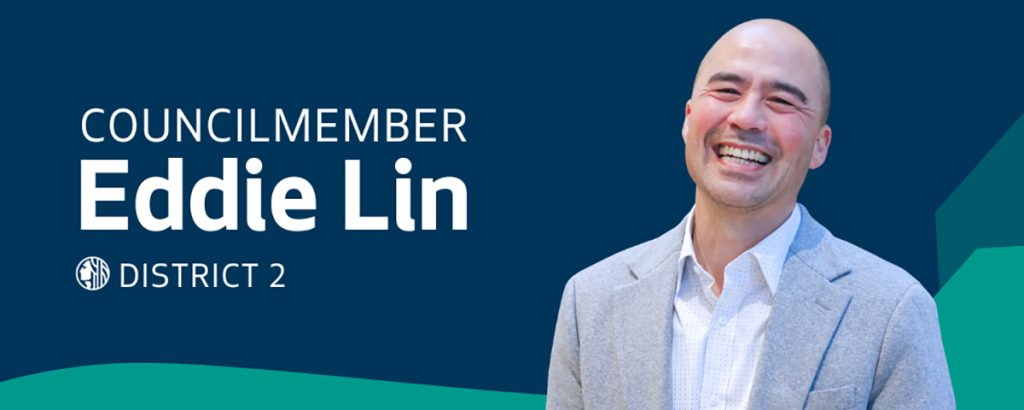
SeattleCouncilmember Eddie Lin was elected in a landslide vote to the Seattle City Council to represent District 2 last November. The council had previously passed over appointing Lin to the seat, which encompasses the Chinatown-International District (CID), Beacon Hill, Rainier Valley, Yesler Terrace, Rainier Beach, Columbia City, and Mount Baker. The Northwest Asian Weekly caught up with Lin to discuss his top priorities in office, what he’s been hearing from CID residents and community leaders, and how he thinks the city can do better with respect to protecting its vulnerable communities from federal immigration agents. The Northwest Asian Weekly conducted this interview on Jan. 23, before a Customs and Border Patrol agent shot and killed Alex Pretti in Minneapolis, Minnesota. Lin responded to the killing in a Jan. 26 interview on The Seattle Channel.
This interview has been lightly edited for length and clarity.
Northwest Asian Weekly
I am sure a lot of folks ask you about your background and what made you eventually want to run for office. And I’d certainly like to know that, but I was really curious as to whether there was one defining moment or conversation or relationship that really made you decide to pursue a career in public service in this particular way.
Eddie Lin
In terms of running for office, it was the surprise resignation of Councilmember (Tammy) Morales. And, partially, it was because we’re in the middle of our Comprehensive Plan (update). And for me, having worked with the Office of Housing—which is really important and good work—just realizing that we’re never going to be able to solve housing affordability more generally without addressing our zoning and our comprehensive planning.
[Morales] had a planning background. She was very strong on a more urbanist vision. … There was not a ton of experience on the council at the time in terms of housing and land use, so I thought I could be a real value-add there, and that I could hit the ground running because of my experience in government, and that I could be a strong advocate for District 2, which really deserves a strong voice. I felt I could provide that.
NWAW
So, tooling a little bit back as well, what were your influences growing up?
Lin
I grew up in Durham, North Carolina. My dad emigrated from Taiwan. He was Chinese and Taiwanese. He came for grad school. He met my mom there. She was a single mom at the time. She is white. She’s from Massachusetts. And so they had this interracial marriage in North Carolina in 1970, during a time when interracial marriages were very rare—shortly after Loving v. Virginia.
I didn’t have a strong Asian American community that I was a part of growing up. There wasn’t a large one there in Durham, North Carolina, and not a lot of mixed-race kids at the time. It’s much more common here and currently than it was when I grew up.
I saw my parents struggle, in a sense, to navigate their cultural differences in terms of parenting and values. They ultimately ended up divorcing. We moved up to Massachusetts where my mom grew up, and she ended up taking care of her mom.
…
Early on in my career, I worked as a legal secretary for a labor union side law firm and was pretty inspired by that and the type of work they did—not only representing workers, but they also did voting rights lawsuits. This was in 2004 in Florida, so I saw the possibilities of a legal career and where you could go with that. That’s what inspired me to go to law school … in the Bay Area.
[My wife and I] moved back up here. I went to Seattle University for law school and graduated in 2009, during the downturn. We had two kids by that time and my wife’s a public school teacher, so I needed a job. I ended up working at Perkins Coie [for eight years].
…
So I stayed there, and then I was looking to move. I actually applied for the city attorney’s office three times in 2014. And then I think again in 2017 or 2016. I got it on the third try.
When I started working there, it was when Trump took office [the first time], and I certainly felt a desire to be more active in the community. Working at the city attorney’s office was pretty meaningful. It was the best law job I had—the most meaningful one, great colleagues, great clients, in terms of working with all the different departments.
I worked with the Office of Housing the last six years, but before that, I worked with other city departments like [Seattle Department of Transportation] and [Seattle Public Utilities] and just really loved the work and serving the community in that way.
Now I’m on this current path, and again, it’s interesting when I jumped into the race—I was certainly hopeful, as many of us were, that Trump was not going to get reelected, but here we are. There was gonna be good, meaningful work regardless, but that certainly has changed the work that is facing the city, whether it’s cuts to Medicaid or Medicare or cuts to permanent supportive housing funding, or, obviously, the huge issues around ICE that are just devastating.
NWAW
I’m going to return to that in a moment, but I wanted to ask whom in the CID you’ve met, and what you’ve been hearing there when it comes to priorities needs? Where do you see gaps that need addressing?
Lin
Both on the campaign trail, and then in office, [I’m] making sure that we’re doing a deep dive into meeting with folks and making sure it’s a two-way street. We’re both hearing from folks and sharing what we know to share information and share power with the community. My goal for this office is to be open and transparent and community-driven.
I think that’s especially important for District 2, given the barriers to representation. It’s historically disenfranchised. I want to do everything I can to make sure that people that don’t typically have access to City Hall to feel represented, feel like they have a relationship with me, my staff.
In terms of who we’ve been meeting with, it’s a lot of the kind of community leaders, like representatives from Friends of Little Saigon or SCIDpda or the CIDBIA (Chinatown International District Business Improvement Association).
There are other activists and community folks that we’ve met with and continue to hear from, especially around the Sound Transit station location, and also small businesses. I like to frequent mam’s books—it was great. Both he and his entire family are great community leaders.
[I have also been] meeting with other city folks who have been working in that space for a long time to make sure that we are not dropping the ball—just because there’s a change in this office or a change in the mayor’s office, making sure that projects that were being worked on—like the Phố Đẹp initiative that Friends of Little Saigon have been pushing for, things like community ambassadors, working with REACH and LEAD to do their case management services—we want make sure that that work continues.
In terms of gaps, there’s a lot. The CID has a lot of issues to work on. Obviously, Little Saigon needs to be a top priority for our city and really for our state. It’s been difficult there for many years, but certainly it’s gotten to a point where we need to help the whole ecosystem there.
Whether it’s the businesses or the residents or the people who are visiting or traveling through that area, or the people that are struggling that we see on the streets, they all deserve attention and really what it’s going to take for us to solve it is for us to come together as a community to develop community-led solutions. That’s why I’m excited about groups like FLS and the Phố Đẹp initiative, which really has been doing that work. And it’s community-driven.
I want to make sure I’m uplifting the people. That’s how I feel about District 2 in general. We have not had, for better or for worse, a lot of government support over the years. The community ends up stepping up and we have incredible leaders in District 2 that take care of each other, that take care of our neighborhoods. My goal is to honor and respect that work and to support it in any way I can.
NWAW
What are some top priorities that you’ve heard from folks you’ve met with?
Lin
There’s certainly a desire to expand shelter capacities. That will be a priority. The CID already has a fair amount of shelters, so not necessarily directly in the CID, but providing shelter or other housing for folks who need it and that are in the CID.
Getting additional behavioral health services for those who are suffering, especially on the corner of 12th and Jackson.
I do think there’s a need to support small businesses. There are things like our Broken Windows program, things like lighting that can improve the environment. I think there are plans on how to better activate the space, and get more positive activity throughout the CID, including in Little Saigon. Those are a few of the things.
NWAW
Speaking of the CID, you are the only Asian American council member on the Seattle City Council, and you’re representing the CID, which is a big deal for several reasons, including that the Council passed over appointing you earlier last year for this exact same seat. What does being elected to this seat mean to you?
Lin
It’s very meaningful for me. Representation is not the only thing that matters, but it does matter. People feel seen and heard when they see somebody in a position of power who maybe has a similar background, who can more easily relate based on their life experience to what they might be dealing with.
For example, I think about my parents. My grandparents immigrated from Taiwan to Monterey Park down in the LA area. “The first suburban Chinatown” is how it’s described down there. I saw how important it was for them to be able to go to the local grocery store and have the foods [they knew] and have things in language, and be able to go to a local doctor, to go to the local park and see other folks doing the types of exercises [they knew]. Just having that kind of life experience, I think, is important. I think it’s important for youth to see what’s possible.
Thankfully we have had a lot of really strong Asian Americans in the highest office. We are fortunate. Many parts of the country do not have that. I did not have that growing up.
I’ve certainly gotten a lot of positive feedback and love from the Asian American community who are, I think, excited about that. But I also think no one person can really represent the incredible diversity of District 2. I mean, just within, you know, AANHPI, there’s so many different experiences and groups that my lived experience does not match.
There’s (also) so much broader diversity, whether it’s our Black community or East African community or Latino community. I have to do my best to draw upon my experiences, and be a really strong listener to make sure that they are feeling seen and heard.
NWAW
What are your specific priorities now that you are in office? How will you live up to the idea of holding the door open for future generations?
Lin
A priority is housing affordability. … We really need to go bold in re-imagining how our city, our built environment, works for us as a community. What that means is building dense, walkable neighborhoods, where it’s possible to get to your doctor or your grocery store or your school without having to be in a vehicle.
We’ve had cities exist for thousands of years, well before vehicles were ever invented. We are seeing the consequences of over-reliance on vehicles as our primary means of transportation, both in terms of climate, in terms of public safety.
Traffic safety has been the number one public safety issue in recent surveys by [the Seattle Police Department] for the past few years. Cars and our rights-of-way take up so much space and they’re expensive. …
For so many reasons, we have to get people out of their vehicles where they can interact with each other. It creates greater public safety when you get to know your neighbors because you’re out walking in your neighborhood versus driving in your car. …
I fully support the mayor’s call for 4,000 additional shelter spaces over her term. I’d love to expedite that, to do that sooner than later. So I want to work hand in hand with the mayor’s office on that.
We really need to fix our upside-down tax code. Economic inequality has just grown and it’s been decades in the making. But as I think about what led us to our current situation with Trump in office and authoritarianism on the rise, I think it’s in large part because our economic inequality continued to grow and was failing us. When that happens, I think people become afraid and anxious and they become more susceptible to the types of lies that Trump was spreading and his strong man persona. He’s trying to act like he’s going to somehow help them, although we know he’s not.
I think affordability was the issue on the campaign trail. I think it is the issue of our time. And so that means making sure that we are taxing the wealthiest in our community. … We should be making sure that … we are not cutting taxes on the wealthiest, which is what the feds were doing last year. We should be raising [taxes on the wealthiest] and providing tax relief for our working folks and providing better services. Anything we can do, like passing a local capital gains tax to do our part, would be meaningful.
NWAW
Speaking of communities, I wanted to ask a couple of things. They’re intertwined—the surveillance cameras and then also ICE. So first of all, you have been a vocal opponent of the city’s surveillance camera program, which the council, before you were on it, voted to expand before the pilot program was complete, above the wishes of the general public who came out to speak against the program multiple times. The CID is of course one of the places where the council decided to expand this.
And intertwined with all of that is this completely justified concern that ICE is going to [get ahold of the camera data]. So my question is: Do you think the council has done enough to protect vulnerable Seattleites, many of whom live in the CID, from immigration crackdowns? And if not, what do you want to see happen?
Lin
No, I don’t think we’ve done enough. We need to do more. We’re in this unprecedented time. There’s not some sort of playbook that we get to look at and say, “Oh, here’s how you respond to the federal troops potentially coming into your city.”
Specifically when it comes to cameras, I hear from neighbors who are concerned about public safety issues and they’re worried about gun violence or fires. And they’re like, “We want more cameras.”
I think people think [installing cameras] is something measurable that we can do, but it doesn’t really solve that public safety issue. At the same time, it does come with significant concerns and we do have protections. And to my knowledge, the feds have not gotten control of our camera data, but we have seen it in other parts of the country.
We’ve seen them collect all sorts of other types of data—they’re going after driver’s license data, they’re going after healthcare data, they’re going after voter data. In the big picture, it’s really hard to 100% protect your data. Once you collect it, whether it’s from hackers or from the federal government, it’s really hard to protect it 100%. One of the best things we can do is just not collect it in the first place.
I certainly support revisiting that decision (to install more cameras). We’ve sent a request to the mayor’s office to get an update on the timing of whether they’re going ahead with rolling out additional cameras. I’m hoping they pause that so that we can revisit that discussion.
We need to work closely with our city attorney, with the state attorney general to see what our legal options are. We absolutely need to be supporting our nonprofit and community groups that are supporting our neighbors and our immigrant community—groups like Washington Immigrant Solidarity Network, groups that are doing immigration defense legal work. We’ve provided some funding, but we’re going to need to provide more.
We’ve heard from neighbors that they’re scared to go to work. They’re scared to send their kids to school. They’re scared to go to the grocery store. We’re probably going to need to provide some financial assistance for folks if they’re not able to go to work, whether that’s rental assistance or food assistance. We’re going to have to work with our local communities to really do everything we can in terms of mutual aid and sharing of information.
When it comes to sharing information, a lot of community groups are organizing to keep their eyes on the neighborhood. There’s a delicate balance there because it’s really hard to know when ICE might be active in your neighborhood. Sometimes people see police department activity and they think it might be ICE, but it’s not. We don’t want to cause undue alarm, but at the same time, it is really important for people to share if ICE activity is happening.
Community members can go and monitor the situation because we’ve seen them act in unlawful ways. I think it’s important for community members to be out there protesting, and I want to support that and to be documenting what’s happening so that we have good information about what they’re doing.
Long-term, I hope that folks get prosecuted when they are crossing the line. I know that that’s probably not going to happen immediately, but if we ever can get a change in administration—in my opinion, what we saw in Minnesota is criminal and people should be held accountable because if we don’t hold people accountable, it sends a message that this is okay.