


By Carolyn Bick
NORTHWEST ASIAN WEEKLY
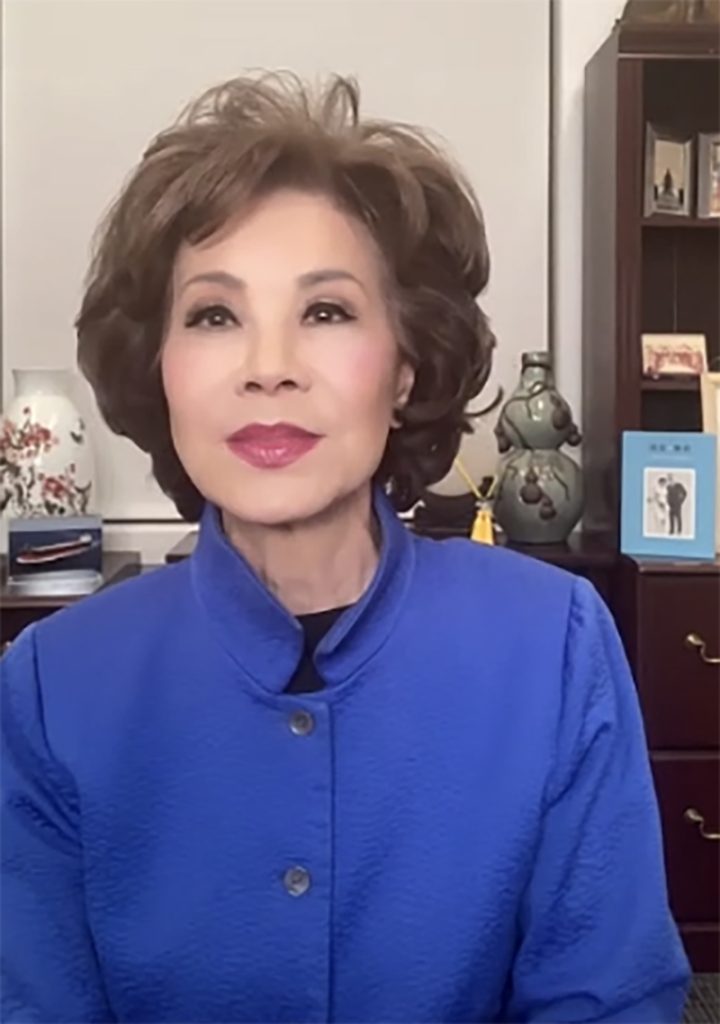
Elaine Chao
Growing up, Elaine Chao was taught to be proud of her heritage, not ashamed or secretive.
“One of the greatest gifts my parents gave their daughters was to have pride in our ethnic heritage. We were never conflicted,” Chao told interviewer Peter Young and attendees at the Committee of 100’s virtual interview event on Nov. 25. “We are both Americans and Chinese. … We’re proud of our Chinese heritage, and we’re proud of our American heritage as well.”
Chao is the first Asian American woman to serve in a presidential cabinet, and was the longest-serving cabinet secretary since WWII, holding both Secretary of Labor and Secretary of Transportation positions. She also served as president of the Peace Corps and the CEO of United Way. She is married to Sen. Mitch McConnell (R-KY.).
The Committee of 100, an organization founded to advance Chinese American participation in the public sphere and promote constructive U.S.-China relations, interviewed Chao as part of its ongoing series meant to highlight Chinese and Chinese American leaders throughout the country. The organization has also interviewed former Gov. Gary Locke, and co-hosted a small panel discussing relations between the United States and China earlier this month.
Chao came from difficult roots, she told attendees, and it informed her life. Her parents came from vastly different backgrounds, meeting through mutual friends in Shanghai in 1949—a rarity for the time, Chao said. Usually, people met through their parents—but her father “never thought he would have a chance with my mother,” because they came from vastly different backgrounds. Chao’s mother’s family was wealthy, while her father’s was not.
But the Communist Party takeover of Shanghai on May 27, 1949 changed all of that. Chao’s father had gone to Taiwan mere days before, sailing on a ship as part of his marine engineering degree from Shanghai Jiao Tong University.
“My father, being very bright, thought, ‘Well, Ruth’—my mother’s name—‘must be in Taiwan because she’s wealthy. She comes from a distinguished family,’” Chao said. “He looked for her for two and a half years. He finally found her. Everybody was equally poor by that time. My mother’s family lost everything. And so my father had a chance. So my father’s really, really philosophical and funny, too. He says, in crisis, in turmoil, there is always opportunity. And so he persuaded her to marry him.”
Chao was born in Taiwan, but came over to the United States with her two sisters and mother, after her father had established himself there. The family lived in a small apartment in Queens, New York, a place Chao said she and her father still regularly visit “just to remind ourselves as to how far we’ve come and where we came from.”
Chao’s family encouraged her and her siblings to explore the world, and, though she had originally graduated from Harvard Business School and gone into banking, Chao found herself interested in government. She entered the White House Fellowship Program, and, following her time there. began her career in government.
While Chao admitted that, at first, she was afraid to ask questions, specifically because she was a young Asian American woman, she quickly pushed past that barrier. After all, she said, reporters already asked her whether she encountered barriers because of her race and gender.
“If I thought that because I was young, a minority—which was a term at the time—a female, that I couldn’t make it in this world, I wouldn’t get out of bed in the mornings,” Chao said. “But I am my father’s and my mother’s daughter. I am just so enthusiastic and I greet each day with a lot of excitement and with joy.”
Chao said her philosophy was always to “underpromise and overdeliver.” She said that part of this attitude stems from the fact that she is an immigrant.
“I’m hardworking and I was always afraid for the longest time that I was going to lose my job. I worked really, really hard, in part because I loved it, but also because I was just always concerned,” Chao recalled. “[In] every single one of these jobs, there are accomplishments that I can talk about. … but let me just say also, this is so un-Asian. You can tell the Americanization of Elaine Chao has happened. Because when I was first starting out and people asked for my accomplishments, I was so embarrassed.”
Since then, Chao has managed to overcome that attitude. She listed her various accomplishments working in presidential cabinets and with the Peace Corps. These included everything from being the first Secretary of Labor to breaking out employment data of Asian Americans in the United States and helping to pass the Pension Protection Act, to starting the first Peace Corps programs in the former Soviet Union, while heading up the agency.
But this doesn’t mean that she didn’t experience racism and sexism in these roles.
“People who were worse than mean,” Chao recalled. “They would just look past me. They wouldn’t even acknowledge my presence.”
This is why, when she became a cabinet secretary, she would specifically say hello to the staff there to greet her and other secretaries on various site visits.
“I was one of those … people in the back [thinking] that if I can just catch a glimpse of the VIP, I would have been so, so happy,” Chao said. “So, I always make a point to say hello to them, to get their names, to spend a few moments chatting with them, understanding where they’re from and what they are doing. It’s respect. It’s respect for those who spare the time to come and see me.”