


By Carolyn Bick
NORTHWEST ASIAN WEEKLY
The federal government appears to once again be targeting lawful permanent residents—also known as green card holders—through the federal Supplemental Nutrition Assistance Program (SNAP) by permanently withholding SNAP benefits from them. These legal permanent residents include refugees and those granted asylum.
Funding for the SNAP program was recently restored, following the end of a 43-day-long federal government shutdown, the longest in history. The second-longest shutdown also occurred under President Donald Trump.
The government shutdown and consequent loss of funding for critical programming threatened the long-term health of many in the AAPI community. Even though that funding has been restored, green card holders in the community continue to face that threat, in addition to extra hurdles like language barriers and limited employment opportunities and resource access.
Washington state Attorney General Nick Brown and 21 other states’ attorneys general have filed a lawsuit against the Trump administration, asserting that such withholding is illegal.
On Oct. 31, before the end of the shutdown, the United States Department of Agriculture (USDA) issued a memo regarding SNAP eligibility under the so-called One Big Beautiful Bill Act. The memo included significant changes that narrowed eligibility for certain groups of non-U.S. citizens, including people admitted under humanitarian protection.
In a Nov. 26 press release regarding the lawsuit, Attorney General Nick Brown’s office stated that the memo “incorrectly asserted that all individuals who entered the country through these humanitarian pathways would remain permanently ineligible for SNAP, even after obtaining green cards and becoming lawful permanent residents.”
As written, the new USDA guidance also appears to violate the agency’s own rules, Brown’s office said.
For many households that United Territories of Pacific Islanders Alliance Washington (UTOPIA Washington) serves, SNAP is a vital resource, and forcing legal green card holders out of the system is particularly harmful. Founded in 2009 by women of color who identify as transgender and/or fa’afafine, UTOPIA Washington is a grassroots organization that helps community members access resources, health care, education, employment, and more. Among UTOPIA Washington’s care work areas is SNAP enrollment.
“Legal permanent residents … are integral members of our community who already navigate barriers that most people never have to consider,” Community Services Director Tweetie Fatuesi explained. “Language access issues, limited employment pathways, cultural displacement, and systemic discrimination create financial conditions where SNAP is not a benefit, but a need.”
Removing or reducing access to SNAP benefits for these households, Fatuesi said, “is not a policy shift. It is the intentional destabilization of families who are still trying to rebuild their lives.”
“These cuts push already vulnerable communities into deeper precarity and widen economic disparities that were never of their making,” she continued. “It is alarming because it punishes people who are doing everything our systems ask of them, yet are continually denied the support required to survive.”
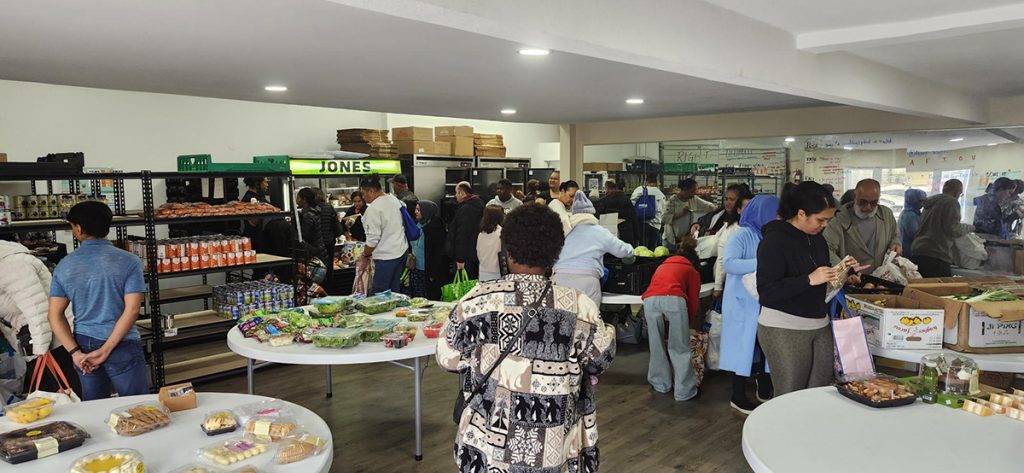
UTOPIA Washington’s Makeki Village Market has free fresh produce, frozen items, non-perishable items, and more. (Courtesy: UTOPIA Washington)
Fatuesi said that not only do many of the households the organization serves rely on SNAP as their primary source for groceries, participation data the organization gathers from its food pantry, Makeki Village Market, demonstrates that need is growing.
Though the data is not yet complete, Fatuesi said that while the pantry served 377 household members in quarter one of this year, that number nearly tripled to 1,146 in quarter three. Most of the families served live in Kent.
“The dramatic jump in Q3 is not a coincidence. It reflects what we are hearing from our families every day: food insecurity is rapidly rising, and people are increasingly forced to rely on a patchwork of resources including SNAP, TANF, and SSDI benefits just to get by,” Fatuesi said.
These families do not have any savings set by, and there is nothing else they can fall back on to keep themselves and their families fed. Instead, she said, families are forced to stretch their already limited funds, or even skip meals. The pantry, she said, has become a lifeline.
“We are not forecasting a surge in demand, we are already seeing it. Cuts to SNAP do not land as policy changes in our communities. They show up as empty cupboards, missed meals, and a deepening sense of instability. As benefits decrease in the coming weeks, we anticipate an even sharper rise in pantry visits and requests for food support.
It’s not just households who feel the strain of these targeted regulations. UTOPIA Washington as an organization feels it, too, as more and more community members turn to it to fill the sudden gaps in resource assistance.
“Our team is stepping up as we have always done, but rising food costs, inconsistent supply availability, and increasing demand from 2SLGBTQIA+, immigrant, and refugee households are stretching our capacity to its limits,” Fatuesi said.
While the organization is doing all it can to ensure the communities it serves do not go hungry, and isn’t slowing down, she said, burgeoning need in the face of limited funding and support means that UTOPIA Washington, too, is limited.
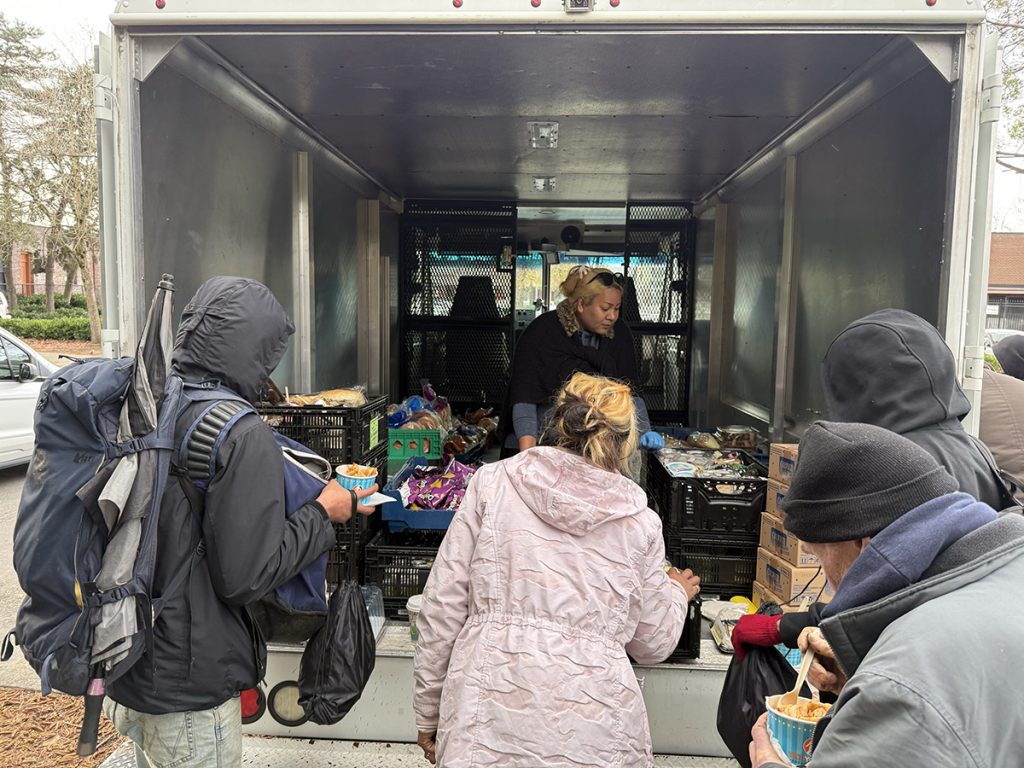
UTOPIA Washington team members distributing food resources to houseless communities in the Kent area (Courtesy: UTOPIA Washington)
She said that there are ways people can help support the organization and the communities it serves, including partnerships that would mean increased food deliveries and access to bulk or wholesale produce. She also said that the organization would be able to meet growing staffing and food demand with more supplemental funding and volunteer support on Tuesdays and Thursdays, the days the pantry sees a large number of visitors.
Fatuesi also said that a partnership with Food Lifeline, a nonprofit organization that distributes food to food banks and food pantries throughout Western Washington, would go a long way towards feeding the community. UTOPIA Washington already has some committed food pantry partners, but these partners can only do so much, she explained. For several years, the organization has been in pending status with Food Lifeline, which recently invited UTOPIA Washington to resubmit its application. However, they have not yet secured partnership with Food Lifeline.
Any “[a]dvocacy that helps accelerate these partnerships, coordinate shared distribution efforts, and open doors to other food partners would significantly expand what we can provide to families who have nowhere else to turn,” Fatuesi said.