



By Carolyn Bick
NORTHWEST ASIAN WEEKLY
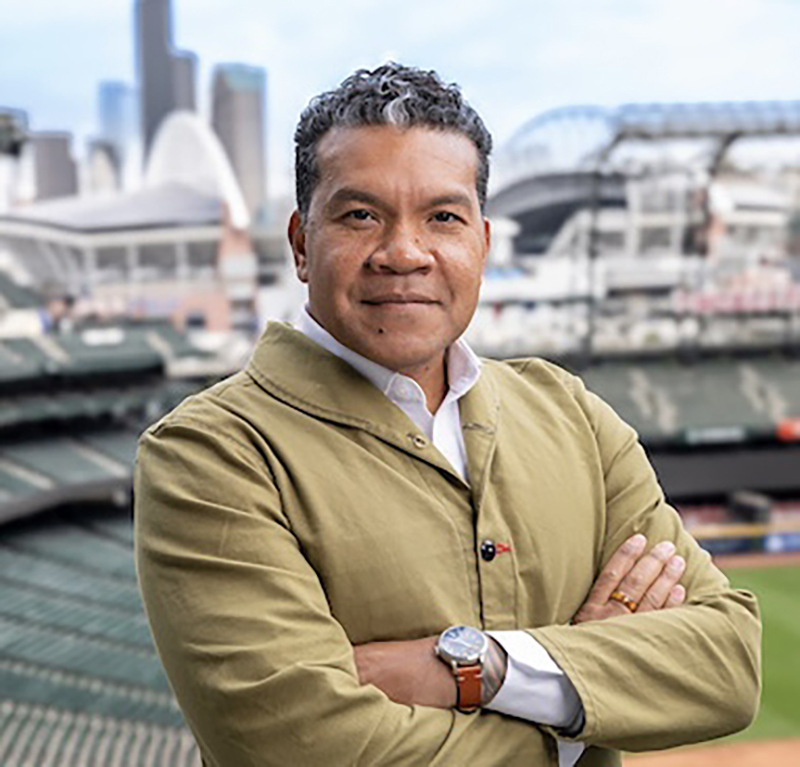
Brian Surratt (Photo by Sage Wilson)
Incoming Deputy Mayor Brian Surratt is proud of his mixed-race heritage. It’s what’s at the heart of his work to invest in underserved communities. It’s also why he believes that representation matters, especially in a public role, where he will bring his background and lived experience to the table.
“I’m proud of the fact that I have a measure of trust and standing with a lot of different communities across Seattle. I hope to continue to earn that trust with communities across our city. I feel like I can go into corporate boardrooms and have really important conversations with those leaders,” Surratt said. “I also feel like I can be in community and really understand what the day-to-day struggles and hopes are for folks in our various communities in Seattle. … Government is meant to serve, and part of service is listening, engaging, and working with a lot of different people to find solutions.”
Surratt accepted the role of deputy mayor in early December. Unlike almost every other Seattle administration, Mayor-elect Katie Wilson chose just one person—Surratt—to serve as deputy mayor. Usually, mayors choose a few different people to serve as deputy mayors to help run different areas of government, but Wilson, Surratt said, wanted to create an organized, streamlined decision-making process that minimized siloing different areas of governance.
“There’s clarity internally of how to elevate issues and how to get decisions made,” Surratt explained. “It’s helpful for external partners as well. They know exactly where they need to go to identify and address issues.”
In many ways, Surratt’s personal life has been inextricably intertwined with his professional life, shaping his career path to lead up to this moment.
Born in South Korea to a Korean mother and Black father serving in the United States military, Surratt and his family immigrated to the U.S. when he was just 5 years old. The family settled in Oklahoma. Surratt’s mother’s career path in many ways, he said, was the “classic immigrant story.”
“She owned a number of small businesses while [we were] growing up, from custodial businesses to sandwich shops to Korean restaurants. My mom was involved in every venture you possibly could imagine,” Surratt remembered. “My younger brother and I, we worked in every one of those places, so I have a deep understanding of the immigrant entrepreneurial story in that role.”
Surratt also watched his father work as an aircraft mechanic for American Airlines in Tulsa, Oklahoma, after retiring from military service. Surratt’s father’s work allowed him to understand the meaning and importance of having high-skilled manufacturing jobs that employed community members and supported that community.
He and his brother were also first-generation college graduates, so “there was a lot of pride.”
After getting his master’s degree in public policy from the University of Washington’s Evans School of Public Policy & Governance, Surratt served then-freshman legislator Rep. James “Jim” McIntire in Olympia. McIntire eventually became state treasurer. Surratt said that McIntire, along with the late state Rep. Kip Tokuda and state Rep. Sharon Tomiko Santos, were his mentors.
Surratt was young at the time—22 or 23—so “to have those really important people help shape my thinking and understanding of what’s important in the community was really, really powerful.”
From there, Surratt moved to Seattle to work on mitigation efforts surrounding the construction of Lumen Field. That work helped Surratt become more connected to several impacted communities, including the Chinatown-International District.
Following a stint in the City’s development office, where he cultivated a deeper understanding of how investment and capital work support different communities, Surratt moved into the private sector to work in real estate. His most recent role in the private sector was as CEO of Greater Seattle Partners, a private-public partnership that works to create both cross-sector and international business connections and to nurture investment, trade, and growth throughout the region.
“I tell folks that career paths—they’re never a straight line, but you always have to be open to possibility,” Surratt said. “I’ve been fortunate, again, to really have a career that’s allowed me to see how economic development and investments really impact community, and I hope to bring that perspective to my new role.”
Surratt said that his role as deputy mayor entails figuring out strategy and working with both the incoming administration and external partners to help the new administration lay out its long-term plans for affordable living within the city, including affordable housing and mitigating homelessness. He will also help the administration in its goals of an expanded, improved transportation system.
At the end of the day, Surratt said, he feels it’s important to hammer home the fact that Seattle’s AAPI community “has always had deep impacts and history and helped shape Seattle’s past and shaping it now.”
“What I want,” Surrat continued, “is the API community to be at the table in shaping what Seattle will look like in the next 5, 10, 30 years. This is really a critical juncture in our city’s history. And we want to make sure that all communities are served well by the city government.”