


By James Tabafunda
NORTHWEST ASIAN WEEKLY
In a rural Indonesian village during the 1980s, Rachmi Diyah Larasati was forced to watch a propaganda film designed to terrorize children. The mandatory screening depicted Communist women as sadistic murderers—dancing over tortured generals, celebrating atrocities that justified mass killings.
“The most violent part for me … is really still traumatic in that movie that we had to see,” Larasati recalled during a Nov. 18 interview examining Indonesia’s 1965 genocide. She walked many kilometers to reach the screening location—a forced journey to the state’s official version of a past that claimed between 500,000 and 1 million lives.
Sixty years after one of the 20th century’s worst atrocities, three scholars gathered at the University of Washington (UW) on Nov. 5 to confront a question that is still connected to Indonesia: What does it mean to commemorate a genocide?
When official truth becomes state-sponsored fiction
The panel, titled “Truths and Narratives of Indonesia’s Tragedy 1965,” brought together historians, a dancer, and literary scholars working to preserve memories that Indonesia’s government has spent six decades suppressing. Their conclusion: When official archives present an alternative truth and survivors fear speaking openly, the body itself becomes a repository of historical knowledge.
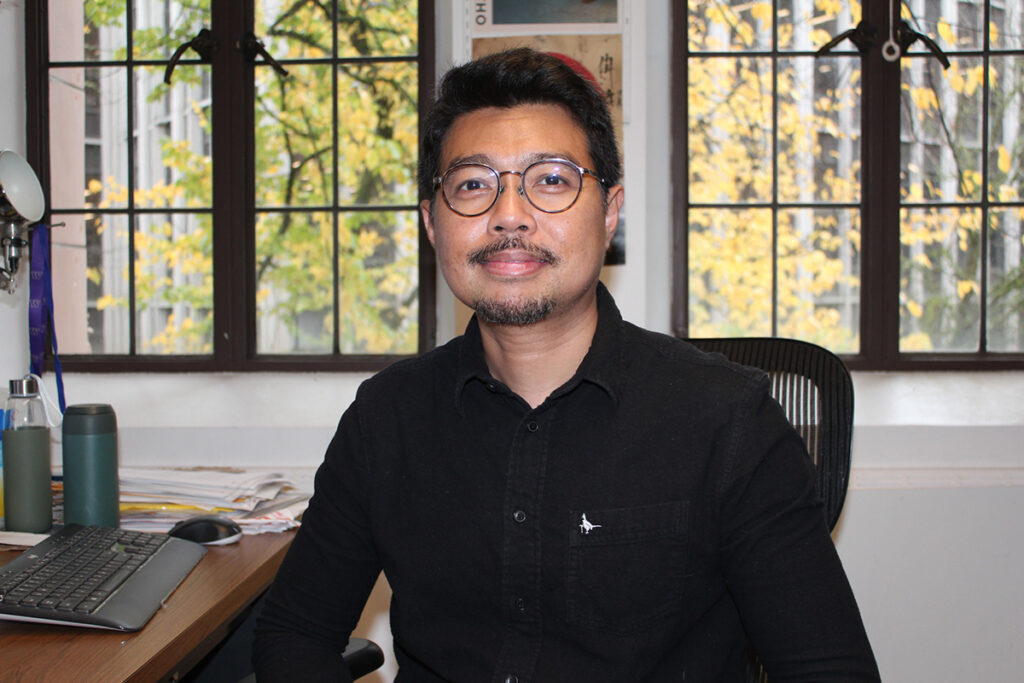
Nazry Bahrawi, assistant professor of Southeast Asian literature and culture at the University of Washington (Photo by James Tabafunda)
“It’s very hard to establish truth because truth is controlled by the government,” said Nazry Bahrawi, assistant professor of Southeast Asian literature and culture at the UW, who moderated the discussion as part of his course, “Decolonizing Authenticity in Southeast Asian Translation.”
The three panelists—Baskara T. Wardaya, who directs the PRAKSIS Jesuit Center for Research and Advocacy in Jakarta; Larasati, an associate professor at the University of Minnesota, who specializes in dance and gender studies; and Sylvia Tiwon, who teaches literature and cultural studies at the University of California, Berkeley—each brought different methods to address this challenge of documenting what the state denies.
Wardaya spent many years collecting oral histories from survivors across Indonesia, documenting their experiences in their own words. Larasati examines how embodied performance—the movement and memory encoded in the body—can express what words cannot capture. Tiwon works through literary narratives to understand how stories are constructed, contested, and reconstructed.
Commemoration in response
What emerged from their conversation was a striking conclusion. All three emphasized the value of arts-based approaches precisely because factual and empirical evidence cannot be trusted in Indonesia’s political environment.
“When truth is controlled by the government,” Bahrawi explained, survivors and scholars must find alternative pathways to historical knowledge: a dance, a poem, even a recorded interview with a survivor—cultural forms that can convey emotional and embodied truth.
History
The 1965-66 killings began after a failed coup attempt on Sept. 30, 1965, when military officers kidnapped and killed six army generals and one lieutenant. Gen. Suharto’s military blamed the Indonesian Communist Party, known as Partai Komunis Indonesia, and launched a campaign of mass murder.
After the massacres, Suharto displaced President Sukarno—full birth name Kusno Sosrodihardjo—in 1966 and established what became known as the New Order regime, ruling Indonesia with authoritarian control for three decades. School textbooks, state ceremonies, films, and official documentation told a singular story: that the Communist Party had attempted a coup, the military had heroically prevented it, and that civilian deaths were either collateral damage or justified.
Silencing one of Asia’s best writers
For 32 years under Suharto’s rule, alternative narratives were strictly forbidden. Political prisoners were detained and exiled, including renowned writer Pramoedya Ananta Toer, who was imprisoned on Buru Island, a remote penal colony in eastern Indonesia, from 1969 to 1979.
“He was supposed to be Southeast Asia’s best candidate for the Nobel Prize,” Bahrawi said.
Even after Suharto’s fall in 1998, successive Indonesian governments have failed to provide accountability or reparations to victims’ families. As recently as 2017, the military banned screenings of documentaries that interviewed perpetrators of the massacres, claiming they would “distort history.”
The meanings of commemoration
For Larasati, commemoration becomes not a ceremony of grief alone but a defiant act of naming what the state refuses to acknowledge.
“Commemoration has two things,” Larasati explained. “One is from the dissident or from the people that remember differently or understand differently. And commemoration becomes the language of or the event of naming that as a mode of speaking.”
In this framework, commemoration is not primarily about ritual or solemnity. It is about creating a space where survivors and descendants can name 1965 as the beginning of a genocide—a designation the Indonesian government has never officially accepted.
The act of naming carries profound political weight. Since 1965, the Indonesian state has controlled the vocabulary through which the killings can be discussed. In Suharto’s New Order regime, the events were memorialized annually on Oct. 1 as “Pancasila Sanctity Day,” portraying the military’s actions as a heroic defense of the nation against communist betrayal.
What distinguishes survivor-led commemorations from state-sponsored memorials is their function. They do not celebrate. They do not glorify mass suffering.
“[They do] not commemorate celebration in terms of glamorization of pain and the wounded and the murdered,” Larasati emphasized. Rather, they serve as what she described as “commemoration of thinking, of political consciousness.”
In this understanding, commemoration becomes what Larasati described: a practice of naming what is officially denied, witnessing what is systematically forgotten, and building political consciousness about ongoing oppression.
“I think it’s urgent to make sure that knowledge is understood,” Larasati said. “Not the side of the powerful state that has their own version.”
The dancing body as an archive
The dual function of commemoration—as both naming and collective witnessing—serves urgent practical purposes. Survivors are aging. Many direct witnesses have already died. Within another decade, fewer of them will remain.
Larasati’s work focuses on how dance preserves knowledge that written archives cannot capture. She learned traditional Indonesian dances not from state-sponsored schools but from her grandmother.
“Dance is a very embodied knowledge,” Larasati explained. “The transmission of it also requires a knowledge of what we call ethnic-dance technique during the genocide.”
Learning the movements—the specific gestures, spatial patterns, rhythms—requires embodying not just choreography but the cultural worldview those movements carry. When a dancer learns to move in particular ways, she is internalizing a way of knowing and relating to the world.
“Therefore, the people who bear witness as a recipient of knowledge from previous generations have an obligation to retain in their body the feeling to try the dance and engagement, to particular technique with that kind of consciousness of context,” she said. “And that is, I think, why embodiment is also a form of archive.”
This concept—the body as an embodied archive—offers a form of historical preservation that persists independent of state control. When official archives disappear or are destroyed, when survivors cannot access legal proceedings, when the government rejects all calls for accountability, the body remembers.
Reading people
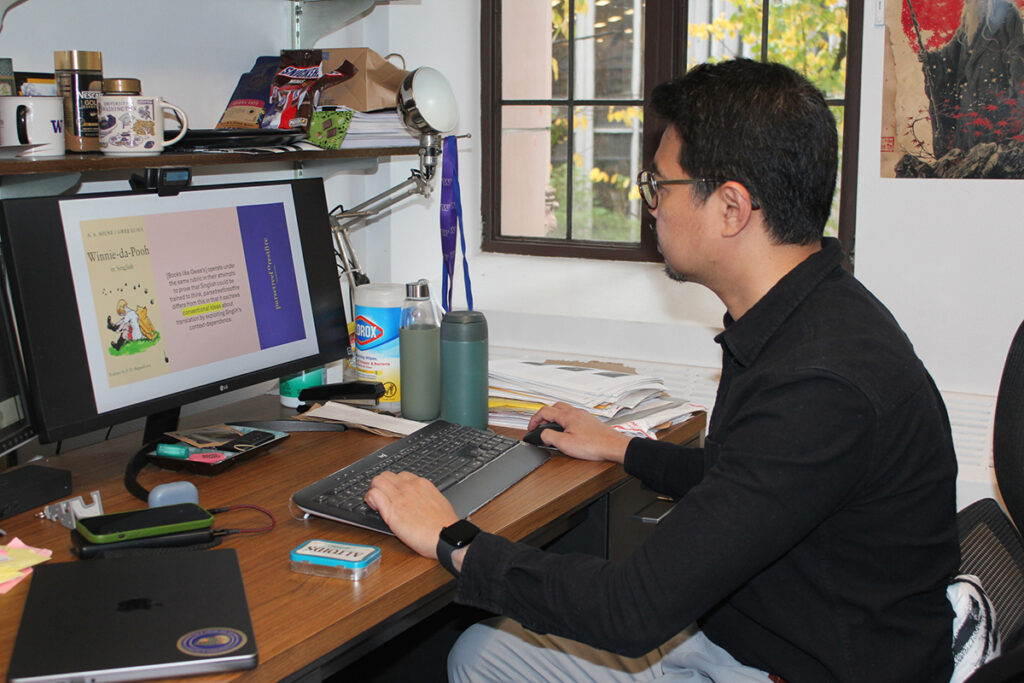
Photo by James Tabafunda
Bahrawi said that understanding this requires scholars and citizens to “learn to understand how people say things, especially the victims, how and why they say certain things and why they don’t say certain things.”
The difficulty lies not in survivors’ memory, which remains sharp and specific. Rather, it lies in the conditions that make full disclosure feel impossible. When survivors fear speaking openly, scholars must analyze what people say, what they don’t say, and how those silences relate to perpetrators’ accounts.
“You have got to hear their narrative and read between the lines,” he said. “You have got to see what they say, what they don’t say, and then see that in relation to what other people say.”
Division
Differences exist within the survivor community itself. Wardaya, who works extensively in urban Jakarta, has found that many survivors seek reconciliation and healing. In contrast, Larasati, who comes from a rural village in East Java, has encountered survivors who take a different view. They do not seek reconciliation with perpetrators. They want accountability.
These differences reflect lived experiences shaped by geography, economics, and power. Neither perspective is more valid than the other. Both reveal essential truths about what justice and healing require.
No accountability
In 2025, 60 years after the killings began, Indonesia still has not issued a national apology, conducted a comprehensive truth commission, or prosecuted perpetrators. Conservative Islamic groups and military officials continue to disrupt survivor gatherings, calling them attempts to revive communism.
An international panel of judges concluded in 2016 that Indonesia’s mass killings of 1965 were crimes against humanity. It recommended the Indonesian government apologize to victims and their families among others. Indonesia rejected all recommendations, saying it would resolve the issue “in our way.”
When the state monopolizes memory, the scholars argued, artists and survivors can create alternative archives—stored in bodies, transmitted through movement, and preserved in ritual and performance. These embodied counter-archives may never gain official recognition, but they demonstrate a resilience that the state cannot suppress.