

By Jingyu Zahng
Northwest Asian Weekly
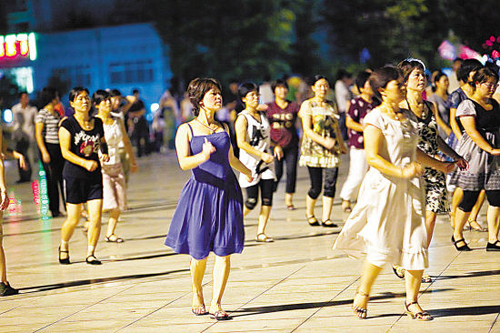
Dancing Damas
It shouldn’t be confused with the traditional American square-dancing.
Square dancing in open squares or other public spaces is a favorite pastime for middle-aged and retired women across China, who usually enjoy it in the evening, or sometimes much later into the night. It is a good way to keep fit and socialize. Whatever the dance routine, whether it’s waltzing, line-dancing, rock n’ roll style jiggling, or just free-style bumping and grinding, the dancers have at least two things in common: no one is usually aged much below 45, and the music is loud enough to blow out an eardrum. They are called the Dancing Dama (“ senior ladies”). And their passion is for the Guang Chang Wu, which is roughly translated as the “Public Square Dance.”
You can often witness a square dance in China. It has long been considered a form of healthy exercise and is a way for senior ladies to have fun and socialize.
 The Dancing Damas have danced in Sunset Park, the Place du Louvre and even other European landmarks. There is no doubt that the Dancing Damas have become popular. However, the culture and legal issues are quite different here in the United States. These ladies do affect other people’s lives, but there exists a big gap between Western and Asian culture, and there seems to be a resistance in the United States. When the Chinese Dancing Damas dance performed in New York City, they danced since early hours, making a lot of noise. Some of the public could not stand the amount of noise and are were really upset with the performance, and even called the police to restrain them. Every coin has two sides. Such dancing, however innocent, can disturb public peace. We have seen incidents on the Internet where conflicts broke out between residents who could no longer bear the noise. What is a general global opinion of the square dance? Much more positive than ours here in the United States. For example, a dance in the capital of Romania-Bucharest, a group which is called “Red Dragon” would start dancing every night at 6:30 in the northeast suburb of the city. They not only brought a lot of fun to the neighborhood, but also attracted more local people who can engage in the dancing.
Chinese square dancing has had a difficult time surviving outside China. The key is how to resolve conflict between two different cultures. We hope our compatriots planning to go and live abroad learn to respect a local way of life and tradition.
French media recently published an article that showed that we need to have a more complacent attitude when it comes to “dancing in the square.” It should not be considered an alternative culture, but rather, appreciated as an element of contemporary Chinese culture. (end)
Jingyu Zahng can be reached at info@nwasianweekly.com.